



Student Union
- By VOA News
Should College Presidents Criticize Political Candidates?
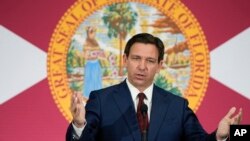
Higher education is under deep scrutiny from America’s 2024 presidential contenders. For example, Florida Governor Ron DeSantis has tried to defund all Diversity, Equity and Inclusion (DEI) programs in Florida’s public universities. Many college leaders feel that academic freedom is under threat, and that they have to speak out to save it. But many others have remained silent. Josh Moody of Inside Higher Ed dives into their anxieties and motivations. (June 2023)
- By VOA News
What Can a Hit Netflix Show Teach Us About Elite College Admissions?
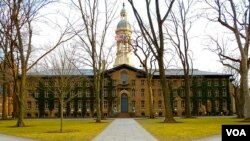
The show Never Have I Ever follows an Indian American girl growing up in Los Angeles, and a major plot point in its final season is her attempts to get into Princeton University in Princeton, New Jersey. The show explores the difficulties of getting a good recommendation letter, and the agonizing choice of whether to apply “early decision” or at the regular deadline. Scott Jaschik for Inside Higher Ed explores what the show gets right and what it doesn’t. (June 2023)
Scholarships Help Afghan Students Find Homes at Universities Across US
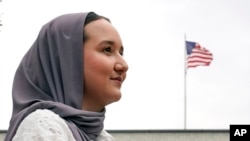
DALLAS — As the Taliban swept back into power in Afghanistan, in the summer of 2021, Fahima Sultani and her fellow university students tried for days to get into the Kabul airport, only to be turned away by gun-wielding extremists.
"No education, just go back home," she recalled one shouting.
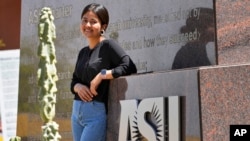
Nearly two years later, Sultani, now 21, is safely in the U.S. and working toward her bachelor's degree in data science at Arizona State University in Tempe on a scholarship. When she's not studying, she likes to hike up nearby Tempe Butte, the kind of outing she enjoyed in her mountainous homeland.
Seeing students like Sultani rush to leave in August 2021 as the U.S. withdrew from Afghanistan after 20 years, colleges, universities and other groups across the U.S. started piecing together the funding for hundreds of scholarships so they could continue their educations outside of their home country.
Women of Sultani's generation, born around the time the U.S. ousted the Taliban after the 9/11 attacks in 2001, grew up attending school and watching as women pursued careers. The Taliban's return upended those freedoms.
"Within minutes of the collapse of the government in Kabul, U.S. universities said, 'We'll take one;' 'We'll take three;' 'We'll take a professor;' 'We'll take a student,'" said Allan Goodman, CEO of the Institute of International Education, a global not-for-profit that helps fund such scholarships.
The fears leading the students to quickly board flights were soon justified as the Taliban ushered in a harsh Islamic rule: Girls cannot attend school beyond the sixth grade and women, once again required to wear burqas, have been banned from universities and are restricted from most employment.
Sultani is one of more than 60 Afghan women who arrived at ASU by December 2021 after fleeing Afghanistan, where she had been studying online through Asian University for Women in Bangladesh during the pandemic.
"These women came out of a crisis, a traumatic experience, boarded a plane not knowing where they were going, ended up in the U.S.," said Susan Edgington, executive director and head of operations of ASU's Global Academic Initiatives.
After making their way to universities and colleges across the U.S. over the last two years, many are nearing graduation and planning their futures.
Mashal Aziz, 22, was a few months from graduating from American University of Afghanistan when Kabul fell and she boarded a plane. After leaving, she scoured the internet, researching which schools were offering scholarships and what organizations might be able to help.
"You've already left everything and you are thinking maybe there are barriers for your higher education," she said.
Aziz and three other Afghan students arrived at Northeastern University in Boston in January 2022 after first being taken to Qatar and then a military base in New Jersey. She graduated this spring with a bachelor's degree in finance and accounting management and plans to start work on her master's degree in finance this fall at Northeastern.
Just two days after the fall of Kabul, the University of Tulsa in Oklahoma announced it had created two scholarships for Afghans seeking refuge in the U.S. Later, the university created five more scholarships that went to some of the young Afghans who had settled in the area. Five more Afghans have received scholarships to study there this fall.
Danielle Macdonald, an associate anthropology professor at the school, has organized a regular meetup between TU students and college-aged Afghans who have settled in the Tulsa area.
Around two dozen young people attend the events, where they've talked about everything from U.S. slang to how to find a job. Their outings have included visiting a museum and going to a basketball game, Macdonald said.
"It's become a really lovely community," she said.
Sultani, like many others who left Afghanistan, often thinks about those who remained behind, including her sister, who had been studying at a university, but now must stay home.
"I can go to universities while millions of girls back in Afghanistan, they do not have this opportunity that I have," Sultani said. "I can dress the way I want and millions of girls now in Afghanistan, they do not have this opportunity."
Since the initial flurry of scholarships, efforts to assist Afghan students have continued, including the creation of the Qatar Scholarship for Afghans Project, which has helped fund 250 scholarships at dozens of U.S. colleges and universities.
But there are still more young people in need of support to continue their educations in the U.S. or even reach the U.S. from Afghanistan or other countries, explained Jonah Kokodyniak, a senior vice president at the Institute of International Education.
Yasamin Sohrabi, 26, is among those still trying to find a way to the U.S. Sohrabi, who had been studying at American University of Afghanistan, realized as the withdrawal of U.S. forces neared that she might need to go overseas to continue her studies. The day after the Taliban took Kabul, she learned of her admission to Western Kentucky University in Bowling Green, but wasn't able to get into the airport to leave Afghanistan.
A year later, she and her younger sister, who has also been accepted at the university, got visas to Pakistan. Now they are trying to find a way to get into the U.S. Their brother, who accompanied them to Pakistan, is applying to the school as well.
Sohrabi said she and her siblings try not to focus on what they have lost, but instead on how to get to WKU, where 20 other Afghans will be studying this fall.
"That's one of the things in these days we think about," she said. "It keeps us going."
- By VOA News
Why Are US Teens Struggling Academically?
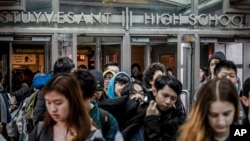
The latest “nation’s report card” saw large declines in math and reading for 13-year-olds. Math scores, in particular, saw the biggest decline in 50 years, and fewer teens than ever say they like to read for fun. Lauren Camera summarizes the findings for U.S. News and World Report. (June 2023)
- By VOA News
More International Students Eligible for US STEM Work Program
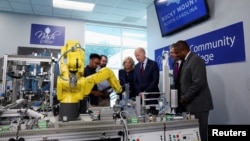
The United States will add eight new fields of study for international students looking to acquire practical work experience in the country, the Department of Homeland Security announced last week.
The eight new fields of study include: landscape architecture; institutional research; mechatronics, robotics and automation engineering technology/technician; composite materials technology/technician; linguistics and computer science; developmental and adolescent psychology; geospatial intelligence; and demography and population studies.
The new fields will all be added to the science, technology, engineering, mathematics Optional Practical Training, or STEM OPT, program. Announced in a July 12 Federal Register notice, the additions will provide international students with more opportunities to temporarily work in the United States.
This is the latest move intended to attract more foreign STEM students to the United States.
Early last year, the Biden administration added 22 fields of study to the STEM OPT program.
“STEM innovation allows us to solve the complex challenges we face today and make a difference in how we secure and protect our country,” Department of Homeland Security Secretary Alejandro Mayorkas said in announcing the 2022 expansion. “Through STEM education and training opportunities, DHS is expanding the number and diversity of students who excel in STEM education and contribute to the U.S. economy.”
DHS received nominations for 120 fields, from which eight were selected and announced last week.
Through OPT, international students on an F-1 visa can gain experience in their area of study during or following the completion of their degree.
More than 200,000 international students used the program to gain work experience in the United States during the 2020-21 academic year.
The program usually lets students work for up to one year, but certain STEM students can extend that for an additional two years.
Boundless, a firm that helps people immigrate to the U.S., hailed the latest STEM expansion.
“As the world becomes increasingly interconnected, initiatives like STEM OPT play a crucial role in promoting innovation, economic growth and cultural exchange,” the Seattle-based company said in a recent statement. “By expanding access to practical training, the U.S. signals a commitment to fostering a diverse and globally connected workforce.”
- By VOA News
Can Higher Ed Convince the Public That Sciences and Humanities Are Worthwhile?

In the United States, degrees are usually split between academic ones (English, math, physics, dance) and professional ones (law, nursing, business). The public can often be skeptical of academic degrees because they seemingly don’t lead directly to a career. But Rick Van Kooten, the dean of arts and sciences at Indiana University, writes in The Hechinger Report that the sciences and humanities are essential in a world fueled by AI artificial intelligence and automation. (June 2023)
- By VOA News
How Are ‘Talent Visas’ Used to Lure International Students to the US?

Foreign students educated in the United States are often bright, hardworking and eager to land a job. But the backlog for U.S. work visas has created an opportunity for other countries to snag talented workers.
Britain, Canada and Australia offer streamlined visas for graduates with in-demand skills or prestigious degrees. As one immigration lawyer in London put it: “We are the beneficiaries of the failures of the U.S. system.”
Jon Marcus of The Hechinger Report has more. (June 2023)
- By VOA News
Tips for International Students Looking for US Scholarships
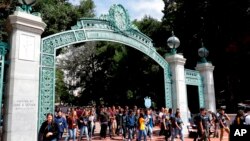
Can international students get scholarships to attend U.S. schools?
Chase bank says yes and offers tips on how to do it. Among the suggestions: Don't hesitate to apply to a lot of options and be wary of paying anyone to help you find scholarships. (June 2023)
- By VOA News
North Carolina Arts School Answers Common International Student Questions
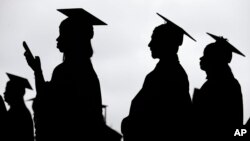
The University of North Carolina School of the Arts wants to make attendance as easy as possible for its international students. It has put together a series of frequently asked questions, along with details about entering the U.S., campus resources for international students and F-1 student visa compliance requirements. Check it out here. (June 2023)
What Will Biden's New Plan Mean for Borrowers Set to Begin Paying Back Their Student Loans?
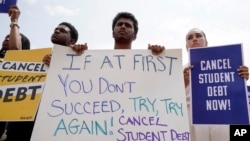
Following the Supreme Court's decision to effectively kill Biden’s earlier student debt forgiveness proposal, the White House is trying again to ease the burden on those carrying student loans using a different legal approach.
Biden's original plan would have canceled up to $20,000 in federal student loans for 43 million people. Of those, 20 million would have had their remaining student debt erased completely.
With repayments set to begin in October, many borrowers are wondering if they still have to pay. Here's what to know about where the new Biden plan stands.
What is the new plan and how is it different?
Under the proposed approach, the White House is now planning to use the Higher Education Act of 1965 — a sweeping federal law that governs the student loan program — to bring about relief for student borrowers.
Biden said the authority of the act will provide “the best path that remains to provide as many borrowers as possible with debt relief.”
The law includes a provision giving the education secretary authority to “compromise, waive or release” student loans.
In its previous attempt to forgive student loans, Biden's White House appealed to a bipartisan 2003 law dealing with national emergencies, known as the HEROES Act, for the authority to cancel the debt. The court's 6-3 decision, with conservative justices in the majority, said the administration needed Congress’ endorsement before undertaking so costly a program.
Who will be eligible and how much debt will be canceled?
So far, it remains unclear which loan holders will qualify and how much of their debt will be forgiven. To figure it out, the Education Department will go through a process known as negotiated rulemaking.
Should borrowers still make loan payments?
Hours after the Supreme Court decision, President Joe Biden announced a 12-month grace period to help borrowers who struggle after payments restart. Biden said borrowers can and should make payments during the first 12 months after payments resume, but, if they don’t, they won’t be at risk of default and it won’t hurt their credit scores. Interest will resume in September, however, and it will accrue whether borrowers make payments or not. Biden reiterated that it is not the same as the student loan pause, adding that “if you can pay your monthly bills, you should.”
Experts at the Student Borrower Protection Center and Institute of Student Loan Advisors encourage borrowers not to begin to make payments again until the fall, when interest starts up again and the pause lifts, since there is no penalty for not doing so during the freeze. Instead, any savings that would have gone to payments can earn interest in those remaining few months.
Finally, after the year-long grace period, if you’re in a short-term financial bind, you may qualify for deferment or forbearance — allowing you to temporarily suspend payment.
To determine whether deferment or forbearance are good options for you, contact your loan servicer. One thing to note: Interest still accrues during deferment or forbearance. Both can also affect future loan forgiveness options. Depending on the conditions of your deferment or forbearance, it may make sense to continue paying the interest during the payment suspension.
Following the year-long on-ramp offered by the Biden administration, if you don’t make student loan payments, you’ll risk delinquency and default, which will harm your credit score and potentially lock you out of other aid and benefits down the line.
What about declaring bankruptcy?
The Biden administration is also working to make a clearer path for borrowers considering bankruptcy.
In November, the Justice Department announced a process with new guidelines for students with federal loans who are unable to pay. Under the new guidance, debtors will fill out an “attestation form,” which the government will use to determine whether or not to recommend a discharge of debt. If borrowers’ expenses exceed their income and other criteria are met, the government will be more likely to recommend a full or partial discharge of loans.
How soon could the new plan happen?
Get ready to wait.
The overall idea is to create a new federal rule by gathering together lots of people with different views and hashing out the details. The goal is to reach a consensus, but the Education Department doesn’t need it to move forward.
It’s possible the Biden administration will go through the process, fail to reach a consensus but still proceed with whatever it decides is the best cancellation plan.
Still, this could take a long time. The absolute minimum for something like this would be about a year, according to Michael Brickman, who was part of multiple rounds of negotiated rulemaking as an education official for the Trump administration. There’s bureaucratic red tape to navigate, and the process is designed to slow things down and force a deliberate negotiation.
The process of negotiated rulemaking requires a period for written feedback from the public, a public hearing (a virtual hearing is scheduled for July 18) and negotiating sessions.
Given that the administration is just starting the process, Brickman said it’s possible it could take up to two years.
Asked why the Education Department didn’t try this route from the start, Secretary Miguel Cardona acknowledged Friday that it “does take longer.”
Is this plan on firmer legal ground?
That’s up for debate.
In a 2021 memo, the former top education lawyer for the Obama administration cast doubt on the president’s authority to enact mass student loan cancellation. The memo, from Charlie Rose, first reported by The Wall Street Journal and obtained by the AP, warned that “the more persuasive analyses tend to support the conclusion that the Executive Branch likely does not have the unilateral authority to engage in mass student debt cancellation.” Instead, it found that the education secretary’s authority is “limited to case-by-case review and, in some cases, only to nonperforming loans."
Some advocates had been urging Biden go this route all along, and the White House says it’s confident the plan will work. But it’s almost certain to face legal challenges. The Education Department has used the Higher Education Act to cancel student loans before, but never at the scale being discussed now. Backers including Sen. Elizabeth Warren have said the legal authority is clear, but lawyers for the Trump administration concluded in 2021 that mass student loan forgiveness was illegal. It could wind up being a gray area that courts need to sort out.
Brickman, who is now an adjunct fellow at AEI, a conservative think tank, predicts a similar fate to Biden’s previous plan. “The Supreme Court has told them no, and yet they’re undeterred,” he said. “I’m sure there’s a population out there that really admires that. But at some point the Constitution is the Constitution, and you have to just kind of accept that.”
- By VOA News
International Students Can Face Special Problems After Graduation
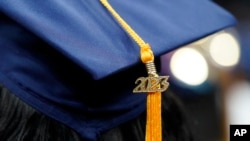
For international students, getting to and through a U.S. college or university is only part of the challenge. The students face additional hurdles once they graduate, says Idaho Ed News.
It talks about those challenges, and some of the students facing them, here. (June 2023)
Founder of Student Aid Startup Frank Appears in Court

The founder of student aid startup Frank shook her head repeatedly Thursday as a prosecutor claimed that she tricked J.P. Morgan Chase into paying $175 million for her business by lying about its client base.
Assistant U.S. Attorney Micah Fergenson described criminal charges against Frank founder Charlie Javice and codefendant Olivier Amar, the company's chief growth officer, to a federal judge at a pretrial hearing during which each of them entered pleas of not guilty to an indictment unveiled Wednesday.
Fergenson said the deal two years ago was consummated only after Javice and Amar “created a fake data set” in response to the bank's data validation request to make it appear that Frank had over 4 million customers rather than the roughly 300,000 clients the company actually had.
As Fergenson spoke, Javice, a Miami, Florida, resident, repeatedly shook her head.
The prosecutor said Javice, 31, and Amar, 49, produced lots of data for J.P. Morgan Chase but that "it was all fake.”
He said the pair paid $100,000 to purchase college student data with over 4 million names and contact information, but when the bank tested about 400,000 of the entries, the “response was horrible.”
“A lot of the emails didn't work,” Fergenson said.
Javice’s attorney, Alex Spiro, predicted that yet-to-be-disclosed communications between J.P. Morgan Chase executives at the bank will ultimately support his client’s contention that she did not act illegally.
He said prosecutors were “just regurgitating” the claims J.P. Morgan Chase made in a lawsuit against his client. He said prosecutors would typically gather evidence such as communications among the bank's employees before bringing criminal charges.
After Spiro spoke, Fergenson acknowledged that prosecutors still must review hundreds of thousands of documents before enough evidence will be given to defense lawyers that a trial date could be set as early as Aug. 15, when the next pretrial hearing is scheduled.
Lawyers for Amar did not immediately return messages seeking comment.
Javice was arrested in April. Authorities said then that she would have pocketed $45 million from the deal.
Javice had appeared on the 2019 Forbes 30 Under 30 list of young professionals with admirable careers.
In 2017, she founded TAPD Inc., which operated under the name Frank, to provide an online platform to simplify the process of filling out the Free Application for Federal Student Aid, a federal government form used by students to apply for financial aid for college or graduate school.
- By VOA News
Help for International Students Aiming for Athletic Scholarships

Telangana Today looks at athletic scholarships in the U.S. and offers international students a guide to finding and getting them.
"Athletic scholarships in the United States offer opportunities for talented student-athletes to fund their education while pursuing their sports careers," the story notes. (June 2023)
First Over-the-Counter Birth Control Pill Gets FDA Approval
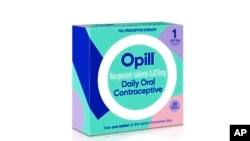
U.S. officials have approved the first over-the-counter birth control pill, which will let American women and girls buy contraceptive medication from the same aisle as aspirin and eyedrops.
The Food and Drug Administration said Thursday it cleared Perrigo's once-a-day Opill to be sold without a prescription, making it the first such medication to be moved out from behind the pharmacy counter. The company won't start shipping the pill until early next year, and there will be no age restrictions on sales.
Hormone-based pills have long been the most common form of birth control in the U.S., used by tens of millions of women since the 1960s. Until now, all of them required a prescription.
Medical societies and women's health groups have pushed for wider access, noting that an estimated 45% of the 6 million annual pregnancies in the U.S. are unintended. Teens and girls, women of color and those with low incomes report greater hurdles in getting prescriptions and picking them up.
Some of the challenges can include paying for a doctor's visit, getting time off from work and finding child care.
"This is really a transformation in access to contraceptive care," said Kelly Blanchard, president of Ibis Reproductive Health, a non-profit group that supported the approval. "Hopefully this will help people overcome those barriers that exist now."
Ireland-based Perrigo did not announce a price. Over-the-counter medicines are generally much cheaper than prescriptions, but they aren't covered by insurance.
Many common medications have made the switch to non-prescription status in recent decades, including drugs for pain, heartburn and allergies.
Perrigo submitted years of research to FDA to show that women could understand and follow instructions for using the pill. Thursday's approval came despite some concerns by FDA scientists about the company's results, including whether women with certain underlying medical conditions would understand they shouldn't take the drug.
FDA's action only applies to Opill. It's in an older class of contraceptives, sometimes called minipills, that contain a single synthetic hormone and generally carry fewer side effects than more popular combination hormone pills.
But women's health advocates hope the decision will pave the way for more over-the-counter birth control options and, eventually, for abortion pills to do the same.
That said, FDA's decision has no relation to the ongoing court battles over the abortion pill mifepristone. The studies in Perrigo's FDA application began years before the Supreme Court's reversal of Roe v. Wade, which has upended abortion access across the U.S.
With some states curtailing women's reproductive rights, the FDA has faced pressure from Democratic politicians, health advocates and medical professionals to ease access to birth control. The American Medical Association and the leading professional society for obstetricians and gynecologists backed Opill's application for over-the-counter status.
An outside panel of FDA advisers unanimously voted in favor of the switch at a hearing in May where dozens of public speakers called for Opill's approval.
Dyvia Huitron was among those who presented, explaining how she has been unable to get prescription birth control more than three years after becoming sexually active. The 19-year-old University of Alabama student said she still isn't comfortable getting a prescription because the school's health system reports medical exams and medications to parents.
"My parents did not let me go on the pill," Huitron said in a recent interview. "There was just a lot of cultural stigma around being sexually active before you're married."
While she uses other forms of contraception, "I would have much preferred to have birth control and use these additional methods to ensure that I was being as safe as possible."
Huitron spoke on behalf of Advocates for Youth, one of the dozens of groups that have pushed to make prescription contraceptives more accessible.
The groups helped fund some of the studies submitted for Opill and they encouraged HRA Pharma, later acquired by Perrigo, to file its application with the FDA.
Advocates were particularly interested in Opill because it raised fewer safety concerns. The pill was first approved in the U.S. five decades ago but hasn't been marketed here since 2005.
"It's been around a long time and we have a large amount of data supporting that this pill is safe and effective for over-the-counter use," said Blanchard, of Ibsis Reproductive Health.
Newer birth control pills typically combine two hormones, estrogen and progestin, which can help make periods lighter and more regular. But their use carries a heightened risk of blood clots and they shouldn't be used by women at risk for heart problems, such as those who smoke and are over 35.
Opill has only progestin, which prevents pregnancy by blocking sperm from reaching the cervix. It must be taken around the same time daily to be most effective.
In its internal review published in May, the FDA noted that some women in Perrigo's study had trouble understanding the drug's labeling information. In particular, the instructions warn that women with a history of breast cancer should not take the pill because it could spur tumor growth. And women who have unusual vaginal bleeding are instructed to talk to a doctor first, because it could indicate a medical problem.
Perrigo executives said the company will spend the rest of the year manufacturing the pill and its packaging so it can be available in stores nationwide and online by early next year.
- By VOA News
Chinese Student Hurt in Campus Shooting to Sue Michigan State U.

A Chinese student injured at a shooting at Michigan State University intends to sue, MLive.com reports.
Yukai “John” Hao alleges that the school “acted with gross negligence and failed to take reasonable steps to protect students and visitors on its campus from harm," the site reports. The shooting left him paralyzed from the chest down, his lawyers say.
Three students were killed and five more were injured Feb. 13 when a 43-year-old man allegedly came on campus and opened fire. (June 2023)