



Student Union
Could Recent Supreme Court Decisions Sway the Gen Z Vote?
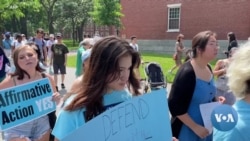

Eighteen-year-old American citizens of the Gen Z generation will be eligible to vote in a US presidential election for the first time next year. VOA’s Veronica Balderas Iglesias interviewed several young adults about what political and legal issues are important to them
- By VOA News
Applying to US Universities: What You Need to Know
The Teen Mag has a guide for international students considering applying to U.S. schools.
The article says it "aims to provide a comprehensive overview of key considerations for international students applying to U.S. universities."
Topics covered include scholarships, safety on campus and immigration and visa regulations. Read it here. (June 2023)
- By VOA News
Are the Humanities Really Dying?

The U.S. media has run several stories recently on the "death of the humanities," with undergraduate enrollments dropping by more than 50% at some schools. But Karin Beck, an associate dean at Lehman College in New York City, says this is misleading.
Elite schools’ humanities programs are declining – but her school, which mostly serves low-income and first-generation students, is graduating more humanities majors than ever before. She argues that culturally sensitive and rewarding humanities classes can captivate anyone, even students who are assumed to lack interest.
Weigh her arguments in Inside Higher Ed. (June 2023)
- By VOA News
Will a ‘Side Hustle’ Help Me Through My International Degree?

Students can pay tuition, build their resumes and pursue their passions with “passive income” generated without a formal job. (Work requirements vary by country, so double-check before you start.)
Ashreena Kaur of Study International lays out several options, from freelance translation to stock photography. (June 2023)
- By VOA News
Can Technology Connect International Students Across Campuses?

That’s the bet global education group INTO University Partnerships is making. The company is rolling out an online platform for students at its member schools to talk to one another, meet with their own institution’s faculty, and get personalized help with visas and housing.
Arrman Kyaw of Diverse Issues in Higher Education has more. (June 2023)
- By VOA News
Which Colleges Does Your School Think Are Its Equal?
The U.S. Department of Education asks colleges this question every year, and Jacquelyn Elias of the Chronicle of Higher Education has visualized the data. (June 2023)
- By VOA News
What’s It Like to Find a Job Using OPT?
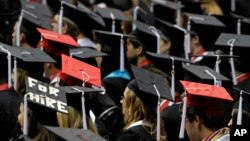
The United States gives international students the option to work for a year after graduating, without receiving a work visa. But the process to apply is long, difficult and carries risks.
Sarah Dittenber of Idaho Ed News profiled undergraduates who are beginning new jobs and contributing to Idaho’s economy, using the Optional Practical Training (OPT) program. (June 2023)
- By VOA News
US Refusing More Student Visas, Report Says

ICEF Monitor, a dedicated market intelligence resource for the international education industry, has worrying news for international students seeking visas to study in the U.S.
It says student visa refusals soared for 2022, with more than 1 in 3 students failing to get a visa.
“This is both a notable increase in the overall refusal rate for F-1 applicants, and also considerably higher than the average rate for other non-immigrant visa classes," ICEF Monitor notes.
It takes a closer look at the trend here. (June 2023)
Activists Spurred by Affirmative Action Ruling Sue Harvard Over Legacy Admissions
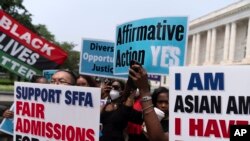
A civil rights group is challenging legacy admissions at Harvard University, saying the practice discriminates against students of color by giving an unfair boost to the mostly white children of alumni.
It’s the latest effort in a growing push against legacy admissions, the practice of giving admissions priority to the children of alumni. Backlash against the practice has been building in the wake of last week’s Supreme Court’s decision ending affirmative action in college admissions.
Lawyers for Civil Rights, a nonprofit based in Boston, filed the suit Monday on behalf of Black and Latino community groups in New England, alleging that Harvard’s admissions system violates the Civil Rights Act.
“Why are we rewarding children for privileges and advantages accrued by prior generations?” said Ivan Espinoza-Madrigal, the group's executive director. “Your family’s last name and the size of your bank account are not a measure of merit and should have no bearing on the college admissions process.”
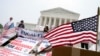
Opponents say the practice is no longer defensible without affirmative action providing a counterbalance. The court’s ruling says colleges must ignore the race of applicants, activists point out, but schools can still give a boost to the children of alumni and donors.
A separate campaign is urging the alumni of 30 prestigious colleges to withhold donations until their schools end legacy admissions. That initiative, led by Ed Mobilizer, also targets Harvard and other Ivy League schools.
President Joe Biden suggested last week that universities should rethink the practice, saying legacy admissions “expand privilege instead of opportunity.”
Several Democrats in Congress demanded an end to the policy considering the court’s decision, along with Republicans including Sen. Tim Scott of South Carolina, who is vying for the GOP presidential nomination.
The new lawsuit draws on Harvard data that came to light amid the affirmative action case that landed before the Supreme Court. The records revealed that 70% of Harvard’s donor-related and legacy applicants are white, and being a legacy student makes an applicant roughly six times more likely to be admitted.
It draws attention to other colleges that have abandoned the practice amid questions about its fairness, including Amherst College and Johns Hopkins University.
The suit alleges that Harvard’s legacy preference has nothing to do with merit and takes away slots from qualified students of color. It asks the U.S. Education Department to declare the practice illegal and force Harvard to abandon it if the university receives federal funding. Harvard did not immediately respond to a request for comment on the lawsuit.
“A spot given to a legacy or donor-related applicant is a spot that becomes unavailable to an applicant who meets the admissions criteria based purely on his or her own merit,” according to the complaint. If legacy and donor preferences were removed, it adds, “more students of color would be admitted to Harvard.”
The suit was filed on behalf of Chica Project, African Community Economic Development of New England, and the Greater Boston Latino Network.
It’s unclear exactly which schools provide a legacy boost and how much it helps. In California, where state law requires schools to disclose the practice, the University of Southern California reported that 14% of last year’s admitted students had family ties to alumni or donors. Stanford reported a similar rate.
An Associated Press survey of the nation’s most selective colleges last year found that legacy students in the freshman class ranged from 4% to 23%. At four schools — Notre Dame, USC, Cornell and Dartmouth — legacy students outnumbered Black students.
Supporters of the policy say it builds an alumni community and encourages donations. A 2022 study of an undisclosed college in the Northeast found that legacy students were more likely to make donations, but at a cost to diversity — the vast majority were white.
- By VOA News
Nigerian Student in New York Joins Ocean Expedition Near Greenland

A Nigerian student working toward a doctorate in geological sciences at the State University of New York, Binghamton, has joined an ocean expedition near Greenland and Iceland.
“I was captivated by the potential for groundbreaking research and knew immediately that I wanted to be part of such a significant scientific endeavor,” Halima Ibrahim told BingUNews.
She'll work as a ship-based sedimentologist examining sediment drilled from the ocean floor. Read the full story here. (June 2023)
High Court Rejects Biden's Student Loan Plan; Fight 'Not Over,' He Says
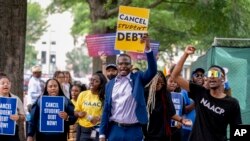
WASHINGTON — A sharply divided Supreme Court on Friday effectively killed President Joe Biden's $400 billion plan to cancel or reduce federal student loan debts for millions of Americans. "This fight is not over," he said.
The 6-3 decision, with conservative justices in the majority, said the Biden administration had overstepped its authority with the plan. The ruling leaves borrowers on the hook for repayments that are expected to resume in the fall.
The court held that the administration needed Congress's endorsement before undertaking so costly a program. The majority rejected arguments that a bipartisan 2003 law dealing with national emergencies, known as the HEROES Act, gave Biden the power he claimed.
Biden, who once doubted his own authority to offer student loan forgiveness, said later Friday that he would push ahead with a new debt relief plan while blaming Republican "hypocrisy" for the decision that wiped out his original effort.
The president said he would work under the authority of the Higher Education Act to begin a new program designed to ease borrowers' threat of default if they fall behind over the next year.
Caution from Roberts
The Supreme Court ruling was blunt in rejecting Biden's first plan.
"Six states sued, arguing that the HEROES Act does not authorize the loan cancellation plan. We agree," Chief Justice John Roberts wrote for the court.
Justice Elena Kagan wrote in a dissent, joined by the court's two other liberals, that the majority of the court "overrides the combined judgment of the legislative and executive branches, with the consequence of eliminating loan forgiveness for 43 million Americans." She read a summary of her dissent in court to emphasize her disagreement.
Roberts, perhaps anticipating negative public reaction and aware of declining approval of the court, added an unusual coda to his opinion, cautioning that the liberals' dissent should not be mistaken for disparagement of the court itself. "It is important that the public not be misled either. Any such misperception would be harmful to this institution and our country," the chief justice wrote.
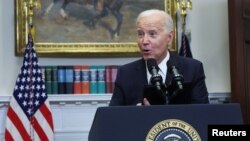
Biden blamed Republican officials for causing the dispute that led to Friday's ruling.
They "had no problem with billions in pandemic-related loans to businesses. ... And those loans were forgiven," Biden said. "But when it came to providing relief to millions of hardworking Americans, they did everything in their power to stop it."
Loan repayments will resume in October, although interest will begin accruing in September, the Education Department has announced. Payments have been on hold since the start of the coronavirus pandemic more than three years ago.
The forgiveness program would have canceled $10,000 in student loan debt for those making less than $125,000 or households with less than $250,000 in income. Pell Grant recipients, who typically demonstrate more financial need, would have had an additional $10,000 in debt forgiven.
Twenty-six million people had applied for relief and 43 million would have been eligible, the administration said. The cost was estimated at $400 billion over 30 years.
Other initiatives
The loan plan joins other pandemic-related initiatives that faltered at the Supreme Court.
Conservative majorities ended an eviction moratorium that had been imposed by the Centers for Disease Control and Prevention and blocked a plan to require workers at big companies to be vaccinated or undergo regular testing and wear a mask on the job. The court upheld a plan to require vaccinations for health care workers.
The earlier programs were billed largely as public health measures intended to slow the spread of COVID-19. The loan forgiveness plan, by contrast, was aimed at countering the economic effects of the pandemic.
In more than three hours of arguments last February, conservative justices voiced their skepticism that the administration had the authority to wipe away or reduce student loans held by millions.
Republican-led states arguing before the court said the plan would have amounted to a "windfall" for 20 million people who would have seen their entire student debt disappear and been better off than they were before the pandemic.
Roberts was among those on the court who questioned whether non-college workers would essentially be penalized for a break for the college educated.
In contrast, the administration grounded the need for the sweeping loan forgiveness in the COVID-19 emergency and the continuing negative impacts on people near the bottom of the economic ladder. The declared emergency ended May 11.
Without the promised loan relief, the administration's top Supreme Court lawyer told the justices, "delinquencies and defaults will surge."
At those arguments, Justice Sonia Sotomayor said her fellow justices would be making a mistake if they took for themselves, instead of leaving it to education experts, "the right to decide how much aid to give" people who would struggle if the program were struck down.
The HEROES Act — the Health and Economic Recovery Omnibus Emergency Solutions Act — has allowed the secretary of education to waive or modify the terms of federal student loans in connection with a national emergency. The law was primarily intended to keep service members from being hurt financially while they fought in wars in Afghanistan and Iraq.
- By VOA News
Examining International Student Loan Options for African Students

After School Africa offers an in-depth look at the best international student loans for African students and details the ins and outs of getting them.
In the U.S., federal student loans are often touted as the best option. But many foreign students find they're not eligible and end up looking at private student loans. Read the full story here. (June 2023)
US Supreme Court Strikes Down Affirmative Action in College Admissions
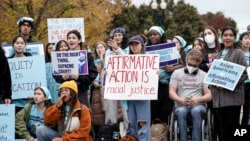
The U.S. Supreme Court on Thursday decisively struck down the use of affirmative action in college admissions, ruling that consideration of a student's race to help decide who is admitted to the halls of higher learning was unconstitutional.
In a 6-3 ruling, the court's conservative majority specifically overturned admission plans at Harvard University and the University of North Carolina, the country's oldest private and public colleges, respectively.
The high court's decision will force colleges and universities across the United States to look for new ways to achieve diverse student enrollment without considering race, such as looking more closely at the economic background of prospective students' families and the nature of the communities where they grew up.
Writing for the court's majority, Chief Justice John Roberts said that for too long, universities have "concluded, wrongly, that the touchstone of an individual's identity is not challenges bested, skills built, or lessons learned but the color of their skin. Our constitutional history does not tolerate that choice."
Hundreds of schools have for decades utilized affirmative action programs to one degree or another to boost the admissions of racial minorities at places where whites only had dominated. U.S. businesses and government agencies have also utilized affirmative action plans, although Thursday's ruling dealt only with admission to colleges.
In a dissent, one of the court's liberals, Justice Sonia Sotomayor, said the decision "rolls back decades of precedent and momentous progress." In a separate dissent, Justice Ketanji Brown Jackson — the court's first Black female justice — called the decision "truly a tragedy for us all."
U.S. President Joe Biden said, "I strongly, strongly disagree with the court's decision. I believe our colleges are stronger when they are racially diverse."

Much like its decision a year ago overturning the national right to abortion, the court was overturning its previous rulings.
The Supreme Court had twice upheld race-conscious college admissions programs in the past 20 years, including as recently as 2016.
But former President Donald Trump's appointment of three conservative jurists to the Supreme Court tipped the balance against affirmative action.
The ruling was not unexpected. All six conservative justices expressed concerns about the practice at arguments last October, even though lower courts had upheld the affirmative action programs at both Harvard and UNC, rejecting claims that the schools discriminated against white and Asian-American applicants.
Trump, the leading Republican presidential candidate ahead of the 2024 election, called the decision "a great day for America."
In a short address from the White House, President Biden said "We cannot let this decision be the last word," adding that "discrimination still exists in America. We need a higher education system that works for everyone."
Consistent with the ruling moving forward, Biden called on universities to give greater consideration to other aspects of the background of applicants, including the financial wherewithal of the student or their family, where a student grew up and went to high school and the personal experiences of hardship or discrimination, including racial discrimination, that a student may have faced.
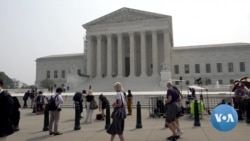
Many schools, in the expectation that the court's conservative majority would block the use of affirmative action, say they already are giving greater weight to Biden's suggested considerations in making admission decisions, along with factoring in test scores, high school grade point averages, and application essays.
Other reaction to the court decision also broke down along predictable ideological lines, with Democratic lawmakers denouncing the decision and Republicans applauding it.
Democratic Senate Majority Leader Chuck Schumer said, "The Supreme Court ruling has put a giant roadblock in our country's march toward racial justice."
He added, "The consequences of this decision will be felt immediately and across the country, as students of color will face an admission cycle next year with fewer opportunities to attend the same colleges and universities as their parents and older siblings. These negative consequences could continue for generations, as the historic harms of exclusion and discrimination in education and society are exacerbated."
Senator Mitch McConnell, the Republican Senate minority leader, characterized the ruling as "a long overdue step toward ensuring equal protection under the law. For decades, the court turned a blind eye as higher education prioritized illegal social engineering over merit."
- By VOA News
International Students Worry AI Detectors Wrongly Flag Them as Cheaters

Some universities are using AI detectors to root out cheating. But international students worry that they'll be wrongly targeted by the algorithms.
A recent study from Stanford University underscores the concern, finding that AI detectors can be "unreliable and biased against non-native English writers," the Financial Express reports.
Among other things, the study found that non-native speakers' use of translation and grammar tools can wrongly indicate the work was generated by AI.
Read the full story here. (June 2023)
- By VOA News
Can US Reverse College Enrollment Declines?
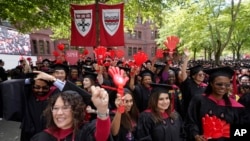
Due to a shrinking youth population, the dislocations of the pandemic and rising tuition costs, fewer Americans are choosing college. However, it remains a good choice – graduates earn more and even live longer. Katharine Meyer of the Brookings Institution offers recommendations, such as financial aid for older people and partnerships with local businesses and welfare offices. (June 2023)