



Accessibility links

Breaking News

Australia and New Zealand Remember Sacrifice at Gallipoli

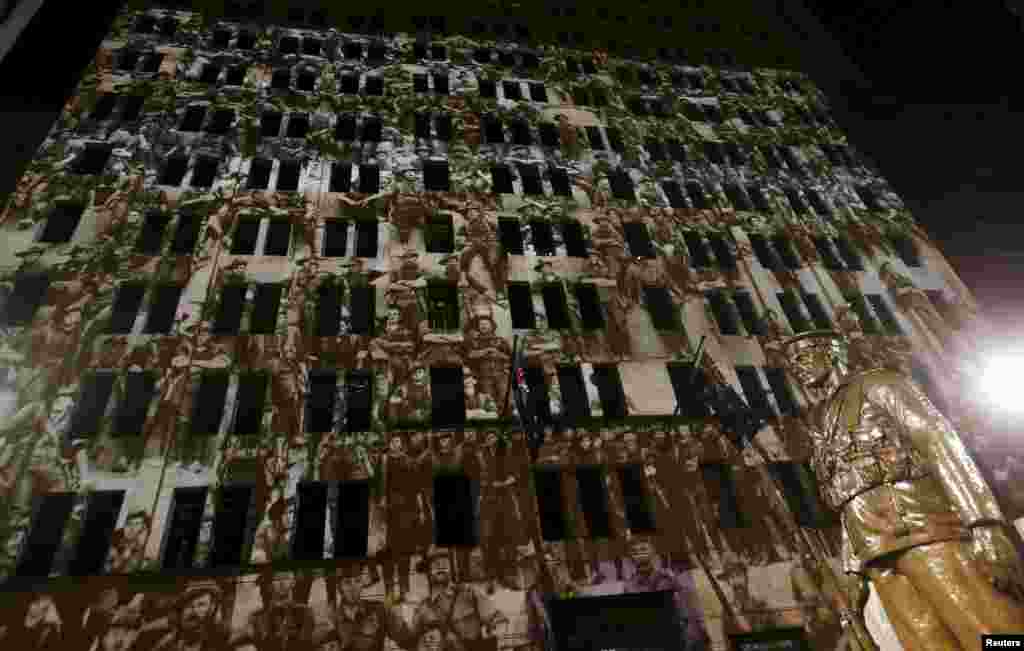
Old photographs of Australian soldiers are projected onto an office building alongside a bronze statue at the Cenotaph war memorial on ANZAC (Australian and New Zealand Army Corps) day in Sydney, April 25, 2015.

Anzac Day commemorations have been held across Australia and New Zealand. In Canberra, 120,000 people attended a dawn service to remember the ill-fated allied landing at Gallipoli in 1915.

To many Australians and New Zealanders the slaughter at Gallipoli in northwestern Turkey saw their fledgling nations come of age.

Both were former British colonies and had gone to war as independent countries for the first time.

The sacrifice and heroism of the Anzacs - the Australian and New Zealand Army Corps - are widely credited with instilling a sense of national self-confidence.

In New Zealand’s capital, Wellington, Australia’s Governor-General Peter Cosgrove said the Anzacs had created unshakeable ties between the Pacific neighbors.

“The bonds that were created there and existed thereafter were built on trust and respect, and a shared experience," Cosgrove said.

"That bond continues to bind our nations together forever in a way that nothing else can. That is the Anzac legacy, and it is what those people did and what they gave us that we commemorate today,” he said.

At Collaroy Beach in Sydney, 100 surfboats came ashore in a symbolic re-enactment of the Gallipoli landings. In the spirit of reconciliation, a Turkish crew also took part before a crowd of several thousand.

Brad Hazzard, a New South Wales government minister, said the Anzacs helped to forge Australia’s national identity.

“Gallipoli cemented where we were as a nation. We were there to fight together for freedom, for democracy and to make sure the world knew that we were certainly a power to be reckoned with, and I think that is where we are now,” he said.

More than 8,700 Australians died at Gallipoli, alongside almost 2,800 New Zealanders. As small countries, they suffered disproportionately high rates of casualties compared to others.

Dawn services and parades were also held. A crowd of more than 100,000 gathered in Canberra, while in Melbourne, there was increased security after last weekend’s police raids that uncovered an alleged terrorist plot targeting Anzac Day events.

There were also solemn services in Turkey to remember the World War I battle. Tens of thousands of Turkish troops died at Gallipoli, alongside others from Britain, France, Ireland and India.

Honoring the Fallen of Gallipoli

The family of Australian Sgt. D. M. Williamson, killed May 3, 1915, placed tributes on his grave in Turkey's Shrapnel Valley cemetery, April 23, 2015. Nearly 700 Allied servicemen killed during the Gallipoli campaign are buried there.
1/7 The family of Australian Sgt. D. M. Williamson, killed May 3, 1915, placed tributes on his grave in Turkey's Shrapnel Valley cemetery, April 23, 2015. Nearly 700 Allied servicemen killed during the Gallipoli campaign are buried there.
Britain's Prince Charles, center, and Prince Harry, right, visit Turkey's Cape Helles British Memorial before a ceremony marking the Battle of Gallipoli's 100th anniversary, April 24, 2015.
2/7 Britain's Prince Charles, center, and Prince Harry, right, visit Turkey's Cape Helles British Memorial before a ceremony marking the Battle of Gallipoli's 100th anniversary, April 24, 2015.
A memorial in the Turkish coastal town of Eceabat in Gallipoli peninsula pays tribute to the doomed Allied offensive to secure a naval route from the Mediterranean to Istanbul, April 23, 2015.
3/7 A memorial in the Turkish coastal town of Eceabat in Gallipoli peninsula pays tribute to the doomed Allied offensive to secure a naval route from the Mediterranean to Istanbul, April 23, 2015.
Poppies decorate a commemorating wall with the names of fallen servicemen at the Lone Pine cemetery and memorial site in Gallipoli peninsula, Turkey, April 23, 2015.
4/7 Poppies decorate a commemorating wall with the names of fallen servicemen at the Lone Pine cemetery and memorial site in Gallipoli peninsula, Turkey, April 23, 2015.
Old photographs of Australian soldiers are projected onto an office building alongside a bronze statue at the Cenotaph war memorial on ANZAC (Australian and New Zealand Army Corps) day in Sydney, April 25, 2015.
5/7 Old photographs of Australian soldiers are projected onto an office building alongside a bronze statue at the Cenotaph war memorial on ANZAC (Australian and New Zealand Army Corps) day in Sydney, April 25, 2015.
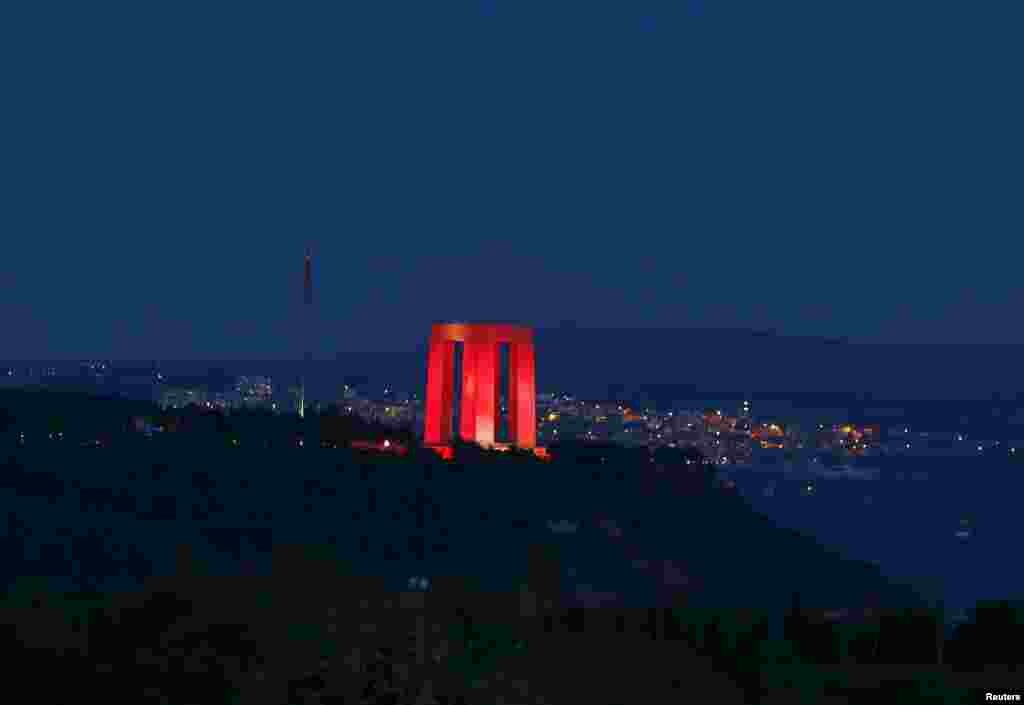
A Turkish memorial is seen on the hills overlooking the Canakkale straits, where the first battle of the Gallipoli campaign was fought ahead of the 100th anniversary of the Battle of Gallipoli, in Gallipoli, April 23, 2015.
6/7 A Turkish memorial is seen on the hills overlooking the Canakkale straits, where the first battle of the Gallipoli campaign was fought ahead of the 100th anniversary of the Battle of Gallipoli, in Gallipoli, April 23, 2015.
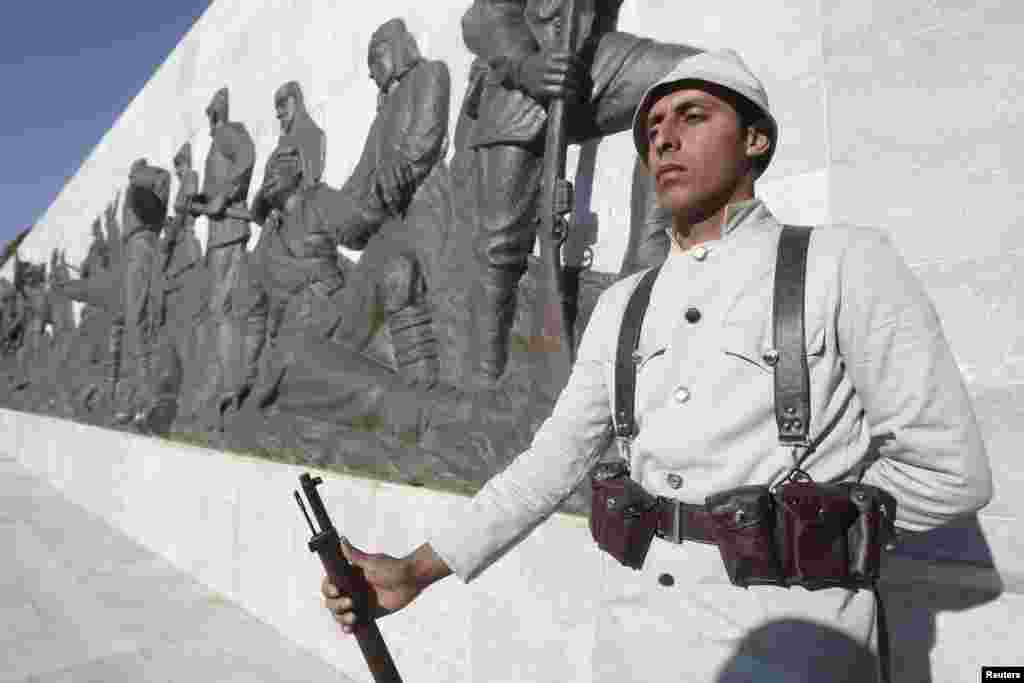
A Turkish soldier in historical uniform stands at a ceremony marking the 100th anniversary of the Battle of Canakkale, as part of the Gallipoli campaign in Gallipoli, Turkey, March 18, 2015.
7/7 A Turkish soldier in historical uniform stands at a ceremony marking the 100th anniversary of the Battle of Canakkale, as part of the Gallipoli campaign in Gallipoli, Turkey, March 18, 2015.
Previous slide
Next slide

XS
SM
MD
LG