Museum Focused on Peace and Reconciliation Opens in Battambang
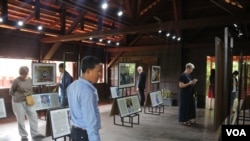
Guests observing the portraits of advocates for peace in Cambodia at the Cambodia Peace Gallery in Battambang. (Hor Singhuo/VOA)
Dr. Soth Plai Ngarm, a peace activist and the founder of the museum, said the project would use photographs and other art forms to help visitors interpret conflict through a different lens.
BATTAMBANG —
A new museum has opened its doors to Cambodians who want to learn about their fellow citizens’ experiences of war, civil conflict, and eventual reconciliation.
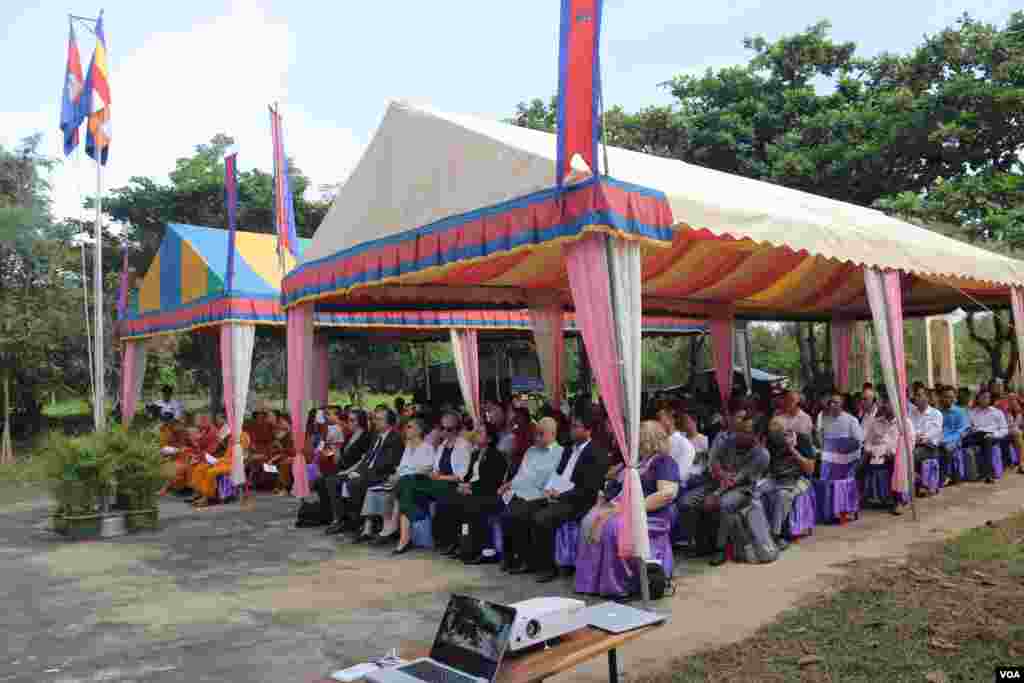
The Cambodia Peace Gallery, which opened in Battambang City this month, aims to provide a safe space for survivors to reflect on their shared experiences of Cambodia’s wars, and learn more about how to build peace.
The project, developed and run by the Center for Peace and Conflict Studies, an NGO headquartered in Siem Reap, will also provide visitors the opportunity to study successful peace-building strategies and how they can be applied to current conflicts in the region.
Dr. Soth Plai Ngarm, a peace activist and the founder of the museum, said the project would use photographs and other art forms to help visitors interpret conflict through a different lens.
“Art forms that we use are the things that represent both history and positivity. We have plenty of museums that show in-depth suffering of Cambodians, so we instead want to bring an art form that has positive character for young Cambodian leaders of the next generation.”
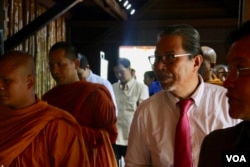
Dr. Soth Plai Ngarm, was born in Battambang province and became a child soldier during the Khmer Rouge regime. He is now an active international peace activist and founder of the Cambodia Peace Gallery. (Rithy Odom/VOA Khmer)
Dr. Soth believes that there is still work to be done to heal the collective trauma suffered by the Cambodian people. The country witnessed decades of conflict in the 20th century, including civil unrest in the 1950s and ’60s, U.S. carpet-bombing of the countryside in the late 1960s and early 1970s, and an increasingly devastating civil war from 1970 to 1975.
Most catastrophically, the radical Communist Khmer Rouge took over the country in April 1975 and killed as many as 2.2 million people. Although they were ousted in 1979, remnants of the Khmer Rouge continued to wage war against the government in Phnom Penh for nearly two decades.
“People from my period were radicalized,” said Dr. Soth, who is now 55 and lived through the Khmer Rouge regime as a young teenager. “When we joined groups, not for any political reason, but rather to seek food, we were trapped. These groups created their own identity, which never really existed.”
“When war ended and we lived together again, these identities make us suspect each other, even if we are friends and neighbors. Therefore, reconciliation is very important for young people. If reconciliation is not done right, the divide will infect later generations.”
(See photogallery of the Cambodia Peace Gallery below)
In Photos: First Cambodia Peace Gallery to Provide a Safe Space to Study Cambodia's History
1/9A Panorama shot of the interior of the main exhibition hall featuring the beginning of peace-building in the post-war period of Cambodia. (Rithy Odom/VOA)
After more than a decade of working in conflict resolution around the world, Dr. Emma Leslie, executive director of the Centre for Peace and Conflict Studies, together with her husband Dr. Soth Plai Ngarm, brought to Cambodia the Cambodia Peace Gallery. The gallery had its official opening on October 23, 2018, in Battambang province.
2/9Guests observing the portraits of advocates for peace in Cambodia. (Hor Singhuo/VOA)
After more than a decade of working in conflict resolution around the world, Dr. Emma Leslie, executive director of the Centre for Peace and Conflict Studies, together with her husband Dr. Soth Plai Ngarm, brought to Cambodia the Cambodia Peace Gallery. The gallery had its official opening on October 23, 2018, in Battambang province.
3/920-year-old Pheav Phy (left), 22-year-old Chan Khimhseang (Middle), and 21-year-old Chey Sophann, majoring in Khmer Literature and General Management at the Preah Sihanouk Raja Buddhist University in Phnom Penh, think that young Cambodian should learn about Cambodia's history thoroughly, not to repeat the same mistake as that of the Khmer Rouge. Photo is taken on October 23, 2018. (Rithy Odom/VOA)
After more than a decade of working in conflict resolution around the world, Dr. Emma Leslie, executive director of the Centre for Peace and Conflict Studies, together with her husband Dr. Soth Plai Ngarm, brought to Cambodia the Cambodia Peace Gallery. The gallery had its official opening on October 23, 2018, in Battambang province.
4/9Nikki Singer, Director of Cambodia Peace Museum, stands in front of a painting on the wall, portraying of the brief history of Cambodia as she observes the gallery. (Rithy Odom/VOA)
After more than a decade of working in conflict resolution around the world, Dr. Emma Leslie, executive director of the Centre for Peace and Conflict Studies, together with her husband Dr. Soth Plai Ngarm, brought to Cambodia the Cambodia Peace Gallery. The gallery had its official opening on October 23, 2018, in Battambang province.
5/9Dr. Emma Leslie, Executive Director of the Centre for Peace and Conflict Studies, cut the ribbon before leading the crowd to one of the exhibition halls, in Battambang, on October 23, 2018. (Rithy Odom/VOA)
After more than a decade of working in conflict resolution around the world, Dr. Emma Leslie, executive director of the Centre for Peace and Conflict Studies, together with her husband Dr. Soth Plai Ngarm, brought to Cambodia the Cambodia Peace Gallery. The gallery had its official opening on October 23, 2018, in Battambang province.
6/9Dr. Soth Plai Ngarm, a Battambang-born peace activist and founder of the Cambodia Peace Gallery, said the Cambodia Peace Museum will feature art forms that would represent both history and positivity. (Hor Singhuo/VOA)
After more than a decade of working in conflict resolution around the world, Dr. Emma Leslie, executive director of the Centre for Peace and Conflict Studies, together with her husband Dr. Soth Plai Ngarm, brought to Cambodia the Cambodia Peace Gallery. The gallery had its official opening on October 23, 2018, in Battambang province.
7/9At the entrance to the Cambodia Peace Museum, Emma Leslie (in blue) talk with Sharon May (In Emerald), writer and photographer who stayed at refugee camp Site II, one of the largest refugee camps in Southeast Asia between 1985 and 1993. Sharon May spent two years at the border between Cambodia and Thailand to document the life of the Cambodian refugees. (Rithy Odom/VOA)
After more than a decade of working in conflict resolution around the world, Dr. Emma Leslie, executive director of the Centre for Peace and Conflict Studies, together with her husband Dr. Soth Plai Ngarm, brought to Cambodia the Cambodia Peace Gallery. The gallery had its official opening on October 23, 2018, in Battambang province.
8/9Journalists, civil society, monks, students and embassy delegations joining the early morning opening ceremony of the Cambodia Peace Gallary in Odambang Commune, Battambang province, on October 23, 2018. (Hor Singhuo/VOA)
After more than a decade of working in conflict resolution around the world, Dr. Emma Leslie, executive director of the Centre for Peace and Conflict Studies, together with her husband Dr. Soth Plai Ngarm, brought to Cambodia the Cambodia Peace Gallery. The gallery had its official opening on October 23, 2018, in Battambang province.
9/9Guests walked through the museum’s campus to the gallery hall featuring recovery efforts including demining and advocating for victims of war, in the procession after Buddhist monks. (Rithy Odom/VOA)
After more than a decade of working in conflict resolution around the world, Dr. Emma Leslie, executive director of the Centre for Peace and Conflict Studies, together with her husband Dr. Soth Plai Ngarm, brought to Cambodia the Cambodia Peace Gallery. The gallery had its official opening on October 23, 2018, in Battambang province.
Previous slide
Next slide
The museum currently features a photo gallery divided into three sections. The first deals with the end of Cambodia’s civil war and the peace negotiations in the early 1990s. A second area is devoted to the ensuing period of recovery and reconstruction, as well as demining efforts. A third section displays portraits of people who lived through the war, survived, and lived to help promote reconciliation.
Future plans for the museum, which is free but asks for a suggested donation of $2.50 for Cambodians and $10 for foreign visitors, include creating a meditation garden and various educational programs.
Angela Corcoran, the Australian ambassador to Cambodia, was among the guests who attended the opening of the new museum on October 23.
She said that Australia was providing financial support to the Peace Gallery because it believed in the institution’s mission.
“We do think that continuing dialogue and having a place where people can have a dialogue about peace is very important—where people can talk about difficult things in a non-confrontational way, in a way that allows for disagreement, but also in a respectful way,” she said.
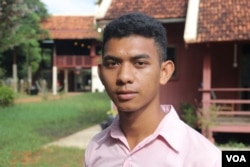
Chey Sophann, a 21-year-old Cambodian majoring in general management at the Preah Sihanouk Raja Buddhist University in Phnom Penh, believes young generation needs to know about Cambodia’s past in order to know how to prevent tragedy from happening in the future. (Rithy Odom/VOA Khmer)
Chey Sophann, 21, a university student who also attended the event, said it was important for the young to learn about the horrors of war, but also the efforts that were taking place to reconcile old differences.
“As a young Cambodian, I want to see my country grow, have peace and to prevent what happened to us before from happening again,” he said.
For Dr. Soth, the establishment of the Peace Gallery marks a significant chapter in both his personal life and the lives of many Cambodians.
“When I do this work, it heals my past,” he said. “I don’t have much sorrow because I use the past as motivation to produce things instead. When I can no longer do anything as I get older, at least I am happy with what I leave behind.”