



Student Union
- By VOA News
International Students Want to Work, But Visa Rules Can Get in Their Way

Foreign undergraduate students at the University of Missouri hail from Afghanistan, India and South Korea. This year, some have been accepted into study abroad programs in Iraq and internships with local crisis shelters.
But student visa rules forbid first-year students from working off-campus. And even when they are eligible, the permit process is complex and takes months.
Adeleine Halsey of the Columbia Missourian profiles undergraduates who are running into these restrictions. (July 2023)
- By VOA News
Scholarships Help Afghan Students Find Homes at Universities Across US

As the Taliban swept back into power in Afghanistan in the summer of 2021, Fahima Sultani and her fellow university students tried for days to get into the Kabul airport, only to be turned away by gun-wielding extremists.
"No education, just go back home," she recalled one shouting.
Nearly two years later, Sultani, now 21, is safely in the U.S. and working toward her bachelor's degree in data science at Arizona State University in Tempe on a scholarship. When she's not studying, she likes to hike up nearby Tempe Butte, the kind of outing she enjoyed in her mountainous homeland.
Seeing students like Sultani rush to leave in August 2021 as the U.S. withdrew from Afghanistan after 20 years, colleges, universities and other groups across the U.S. started piecing together the funding for hundreds of scholarships so students could continue their educations outside of their home country.
The Associated Press has the story. (July 2023)
- By VOA News
Coming to America: What International Students Can Expect at Customs

Telangana Today has an article detailing what international students can expect on arrival in the U.S. It includes what documents U.S. Customs and Border Protection officials will review and what information your passport stamp should contain.
Read the full article here. (July 2023)
- By VOA News
Transition Tips for International Students Bound for US

All Together, a blog for the Society of Women Engineers, has transition tips for international students studying the U.S.
Among them:
- Make copies of important documents.
- Explore interests outside the classroom.
- Do what you can to stay safe.
Read the entire blog post here. (July 2023)
- By VOA News
The Biden Administration’s New Student Loan Plan Offer

After a more ambitious relief plan was rejected by the U.S. Supreme Court, the Biden administration has announced it will forgive $39 billion in debt, held by about 804,000 people. Get the specifics in this explainer from Katherine Knott of Inside Higher Ed. (July 2023)
- By VOA News
Colleges Could Recruit Using Generative AI
Himanshu Barthwal is the CEO of Admission Overseas, a startup whose platform helps international student recruiters make recommendations. The recruiters can use it to guess which schools will be a good academic and financial fit for a student.
The program is already being used to fill vacant healthcare positions in Canada, where Barthwal lives. Read his interview with Hessie Jones of Forbes. (July 2023)
Protesters in Miami Blast Florida's Black History Teaching Standards

Dozens of teachers, students and labor leaders marched to a Miami school district headquarters Wednesday to protest Florida's new standards for teaching Black history, which have come under intense criticism for what they say about slavery.
The protesters who marched to the School Board of Miami-Dade County objected to new curriculum standards that, among other things, require teachers to instruct middle school students that enslaved people "developed skills which, in some instances, could be applied for their personal benefit."
Governor Ron DeSantis, who is seeking the 2024 Republican presidential nomination, has repeatedly defended the new language while insisting that his critics, including Vice President Kamala Harris and two leading Black Republicans in Congress, are intentionally misinterpreting one line of the sweeping curriculum.
"These new state standards that DeSantis has come up with will not be tolerated in our schools. We will not let our children be taught that slaves benefited from their slavery. That's a lie," said march organizer Marvin Dunn, a professor emeritus of psychology at Florida International University.
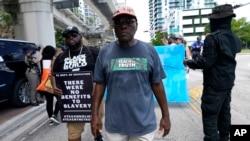
About 50 protesters who started the 1.6-kilometer trek from Booker T. Washington Senior High School in Miami's historically Black Overtown neighborhood chanted, "What do we want? Truth. When do we want it? Now. What if we don't get it? Shut it down!"
They were greeted by another 50 protesters at the school board building, where speakers addressed the crowd. Among them was Tennessee Representative Justin Pearson who was propelled into the national spotlight after being expelled from the Republican-dominated legislative body for leading a gun control protest on the House floor. He was reinstated by local officials and then won a special election.
"The true history is that Black people have always fought to make America what it ought to be, and it has always resisted what it could be," Pearson told the crowd. "We've always fought for the America that we know is possible. That is not here yet."
Harris, the nation's first Black vice president, traveled to Florida last month to condemn the curriculum. Senator Tim Scott of South Carolina, who is the chamber's sole Black Republican and is also seeking the White House, issued a direct rebuke of DeSantis.
Critics said the new school standards are the latest in a series of attacks on Black history by the governor's administration. At the beginning of the year, DeSantis' administration blocked a new Advanced Placement course on African American studies from being taught in high schools, saying it was contrary to state law.
DeSantis also has pushed through the "Stop WOKE Act," a law that limits discussions on race in schools and by corporations, and it banned state universities from using state or federal money for diversity programs.
- By VOA News
Majority of Ivy League Schools Have Women Presidents, Yet Only a Third of US Colleges Overall Do

Six of the eight Ivy League schools, which include Harvard, Yale, Princeton and Columbia, now have women presidents. Yet, according to the American Council of Education, just 32% of all U.S. colleges do, even though a majority of collegiate-level students are women.
But do students care about the president when choosing a school? And which way are these numbers trending? Dan Friedell of VOA Learning English answers these questions, with contributions from Andrew Smith. (July 2023)
US Universities Launch Partnership to Elevate Free Speech

The presidents of 13 universities in the United States are elevating free speech on their campuses this academic year, as part of a new nonprofit initiative announced Tuesday to combat what organizers call dire threats to U.S. democracy.
The Campus Call for Free Expression will take different forms on different campuses. The campaign, created by The Institute for Citizens & Scholars with funding from the Knight Foundation, is designed to cultivate the freedom of expression on campuses and help students work together to find solutions to complicated, divisive problems.
"The national context of the deep political polarization, the inability of people to speak across difference in constructive and civil ways, it seems to me that colleges and universities need to be the institutions at the forefront of showing a better way to do that," said Jonathan Alger, president of James Madison University, which is participating in the initiative.
The Institute for Citizens & Scholars first convened a group of college presidents in March 2022 to discuss how to prepare students to actively participate in democracy. Eventually, the presidents and schools committed to five principles of free expression along with new, on-campus programs that each school designed themselves. Those include new training at freshman orientations, faculty seminars and convocation remarks.
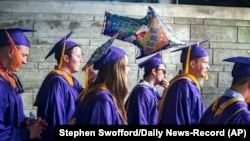
While not new, controversies around free speech at universities abound, from students protesting invited speakers to state legislatures targeting faculty tenure. The controversies also reflect an increase in restrictions on freedom of speech more generally.
The participating schools include The University of Notre Dame, a private Catholic research school; Benedict College, a historically Black school in South Carolina; Rollins College, a small liberal arts school in Florida; and Ivy League member Cornell University, which in April announced that freedom of expression would be the theme for its 2023 school year. The other schools are Claremont McKenna College, DePauw University, Duke University, James Madison University, the University of Pittsburgh, The University of Richmond, Rutgers University, Wellesley College, and Wesleyan University.
Jonathan Holloway, president of Rutgers University in New Jersey and a historian of African American history, said he was motivated to join the initiative in part by what he called a growing deep disregard for American institutions.
"If I don't speak up now on what I see that's so concerning, if I don't do this now, then when?" he asked, adding, "When I saw the Confederate battle flag marched through the Capitol Rotunda in January 2021, that's when things shifted for me."
This September, Holloway will lead a freshman course that will examine the meaning of democracy and ask students to help design a program for the university to improve civic education.
Students' potential fuels effort
For Rajiv Vinnakota, president of the Institute for Citizens & Scholars, there are two main reasons to focus civic education on college students. For many, their colleges will be the most diverse community that they've ever experienced, and students have the potential to shift social norms as they enter public forums and start to participate in politics. He hopes that the collective commitment of these schools to fostering critical thinking and the exchange of ideas around contentious issues will encourage other institutions to join them.
"Are we able to get above the cacophony of these issues of free expression to be able to get people in general (and) leaders to be able to see that higher ed can and should play a leading and proactive and positive role in civic preparedness?" Vinnakota asked.
The Knight Foundation provided a $250,000 grant to the institute to convene the presidents and eventually other university staff in a series of conversations over a year and a half.
"We believe in the free exchange of ideas. We believe in an informed citizenry so that the people may determine their true interest," said Alberto Ibargüen, president of the foundation.
Training aims to open minds
The nonprofit PEN America offers training to colleges and universities around cultivating an exchange of ideas as part of its work advocating for human rights and free speech. In general, Kristen Shahverdian, senior manager of its Free Expression and Education program, said that showing students why protections for free speech matter is an effective way to win over them to hearing about opposing views.
"When students learn about how writers and artists around the world have been persecuted for their free expression, they understand the ramifications of squashing another's speech," she said in response to emailed questions.
- By VOA News
International Students Prefer a Third of Their Classes be Online

Despite the end of COVID-19 restrictions in many places, international students say they’d prefer that about a third of their classes be online. Students say they appreciate the flexibility, and students whose first language isn’t English can benefit from being able to rewatch a lecture afterward.
However, 25% of students said they would like all their classes to be in person. Patrick Jack reviews the survey data in The Times Higher Education. (July 2023)
Biden Administration Urges Colleges to Pursue Racial Diversity Without Affirmative Action
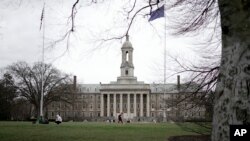
New guidance from the Biden administration on Monday urges colleges to use a range of strategies to promote racial diversity on campus after the Supreme Court struck down affirmative action in admissions.
Colleges can focus their recruiting in high minority areas, for example, and take steps to retain students of color who are already on campus, including by offering affinity clubs geared toward students of a certain race. Colleges can also consider how an applicant's race has shaped personal experience, as detailed in students' application essays or letters of recommendation, according to the new guidance.
It also encourages them to consider ending policies known to stint racial diversity, including preferences for legacy students and the children of donors.

"Ensuring access to higher education for students from different backgrounds is one of the most powerful tools we have to prepare graduates to lead an increasingly diverse nation and make real our country's promise of opportunity for all," Attorney General Merrick Garland said in a statement.
The guidance, from the Justice and Education departments, arrives as colleges across the nation attempt to navigate a new era of admissions without the use of affirmative action. Schools are working to promote racial diversity without provoking legal action from affirmative action opponents.
Students for Fair Admission, the group that brought the issue to the Supreme Court through lawsuits against Harvard and the University of North Carolina, sent a letter to 150 universities in July saying they must "take immediate steps to eliminate the use of race as a factor in admissions."
In its guidance, the Biden administration offers a range of policies colleges can use "to achieve a student body that is diverse across a range of factors, including race and ethnicity."
It also offers clarity on how colleges can consider race in the context of an applicant's individual experience. The court's decision bars colleges from considering race as a factor in and of itself, but nothing prohibits colleges from considering "an applicant's discussion of how race affected the applicant's life," the court wrote.
How to approach that line without crossing it has been a challenge for colleges as they rework admissions systems before a new wave of applications begins arriving in the fall.
The guidance offers examples of how colleges can "provide opportunities to assess applicants' individual backgrounds and attributes — including those related to their race."
"A university could consider an applicant's explanation about what it means to him to be the first Black violinist in his city's youth orchestra or an applicant's account of overcoming prejudice when she transferred to a rural high school where she was the only student of South Asian descent," according to the guidance.
Schools can also consider a letter of recommendation describing how a student "conquered her feelings of isolation as a Latina student at an overwhelmingly white high school to join the debate team," it says.
Students should feel comfortable sharing "their whole selves" in the application process, the administration said. Previously, many students had expressed confusion about whether the court's decision blocked them from discussing their race in essays and interviews.
Countering a directive from Students for Fair Admissions, the new guidance says colleges can legally collect data about the race of students and applicants, as long as it doesn't influence admissions decisions.
Echoing previous comments from President Joe Biden, the guidance urges colleges to rethink policies that tend to favor white, wealthy applicants.
"Nothing in the decision prevents an institution from determining whether preferences for legacy students or children of donors, for example, run counter to efforts to promote equal opportunities for all students," the guidance said.
At the same time, the Justice and Education departments warned that they're ready to investigate if schools fail to provide equal access to students of all races, adding that the administration "will vigorously enforce civil rights protections."
The guidance arrives as colleges work to avoid the type of diversity decline that has been seen in some states that previously ended affirmative action, including in California and Michigan. Selective colleges in those states saw sharp decreases in minority student enrollment, and some have struggled for decades to recover.
- By VOA News
Collegiate Athletes, Including International Students, Can Receive Scholarship Aid

In U.S. collegiate sports, schools sometimes give full scholarships to students who commit to a team, including international ones. Some sports are dominated by international students, such as women’s tennis: 66% of top-tier Division I players are not from the U.S.
However, there is mounting domestic pressure for schools to focus on financial need, and not athletic ability, and scholarships are often swallowed up by the high tuition and cost of living in the U.S. Sophie Hogan of The PIE News has more. (July 2023)
- By VOA News
International Student Bank Accounts in the US: A Guide

TimesHigherEducation.com takes a look at the different kinds of bank accounts in the U.S. and their pros and cons for students. It also tells students how to open a bank account in the U.S. and what documents they'll need to do it. Get the details here. (July 2023)
- By VOA News
7 Key Tips for Indian Students in the US
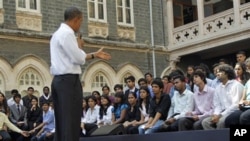
American Bazaar Online takes a look at some of the potential pitfalls for Indian students in the U.S. and explains how to deal with them. Among them: handling health care in the U.S., pursuing employment and understanding the structure of U.S. universities. (July 2023)
- By VOA News
How to Plan for College Tuition

With President Biden’s student loan forgiveness program shelved, many families are wondering whether school is affordable. Ron Lieber and Tara Siegel Bernard, financial aid experts, answer reader questions on international tuition, savings plans, merit scholarships and more. See the questions – and ask one of your own – in The New York Times.