Yemenis protest in front of the U.S. Embassy during a protest about a film ridiculing Islam's Prophet Mohammed, Sanaa, Yemen, September 13, 2012.
Libyan authorities say they have made arrests in association with the killing of U.S. ambassador to Libya during a siege on an American consulate, as waves of anti-American protests against a film mocking Islam continued sweeping the Middle East and Southeast Asia Thursday.
Libyan officials said they were gathering evidence about Tuesday's attack that killed U.S. Ambassador Chris Stevens and three of his staff members, but would not give further details.
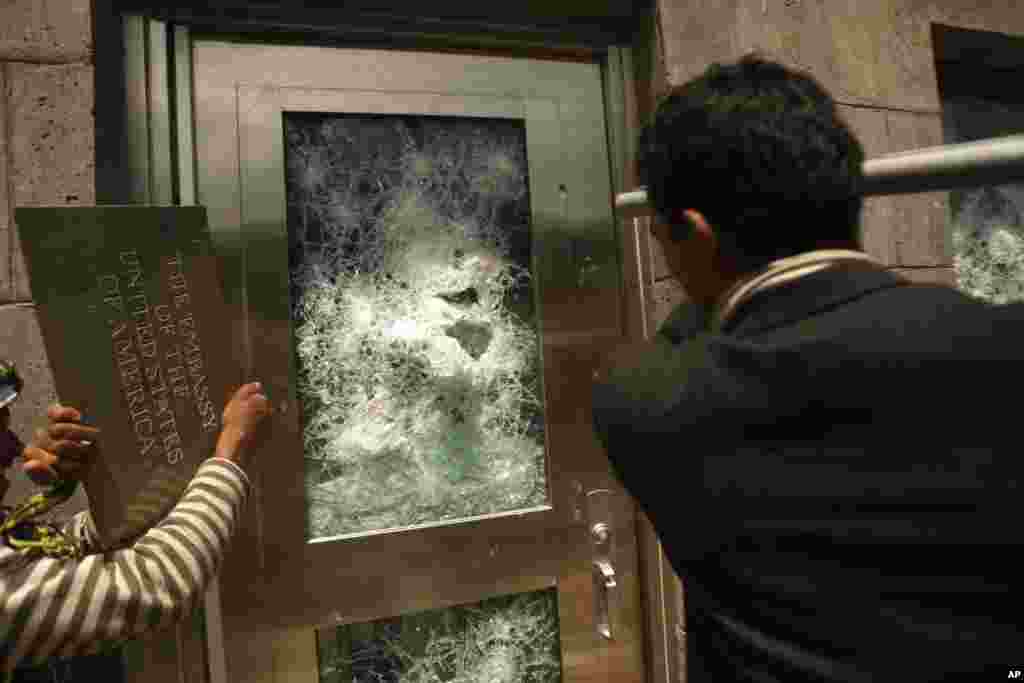
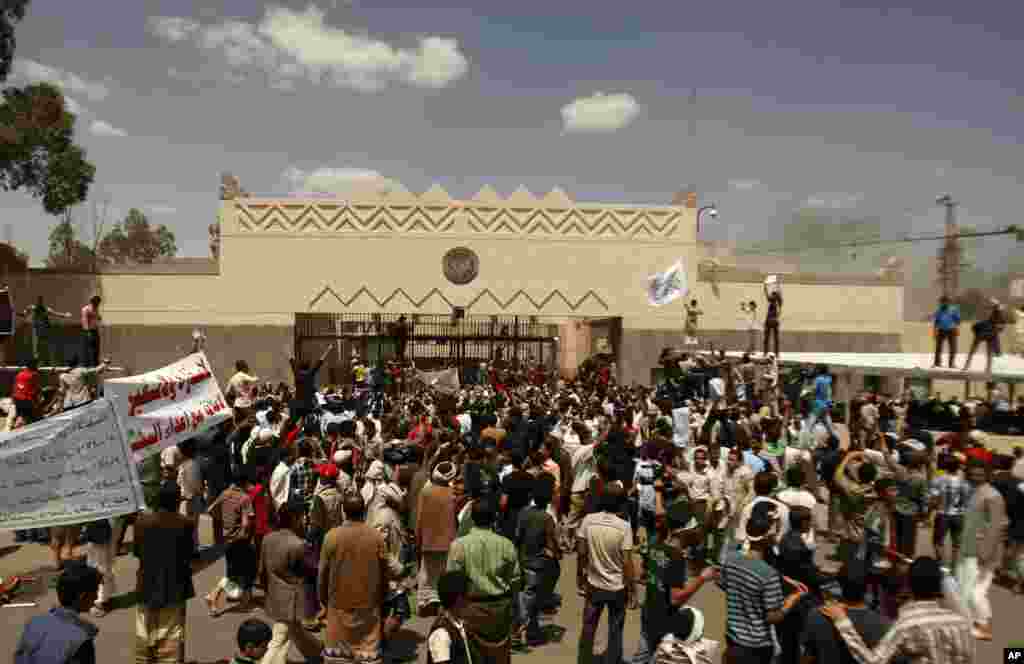
The breakthrough in Libya comes as hundreds stormed the grounds of the U.S. embassy in the Yemeni capital, Sana'a. The mob torched a number of diplomatic vehicles Thursday as security guards used water cannons and warning shots in a bid to drive them out of the heavily fortified compound. A number of people were reported injured.
Protests against the American-made amateur film mocking the Prophet Muhammad also took place in Cairo, Tehran, Baghdad and Dhaka. Demonstrators in Baghdad chanted "no to Israel" and "no to America" while burning an American flag.
Watch related story by Jeff Seldin:
Protests are planned Friday in several countries, including Yemen, Afghanistan and Pakistan.
Clinton rips movie
U.S. Secretary of State Hillary Clinton said on Thursday the U.S. government is not involved with the Internet video triggering the protests.
"The United States government had absolutely nothing to do with this video,” she said.” We absolutely reject its content and message. To us, to me personally, this video is disgusting and reprehensible. It appears to have a deeply cynical purpose: to denigrate a great religion and to provoke rage."
Still, the U.S. comments have done little to dissuade protesters.
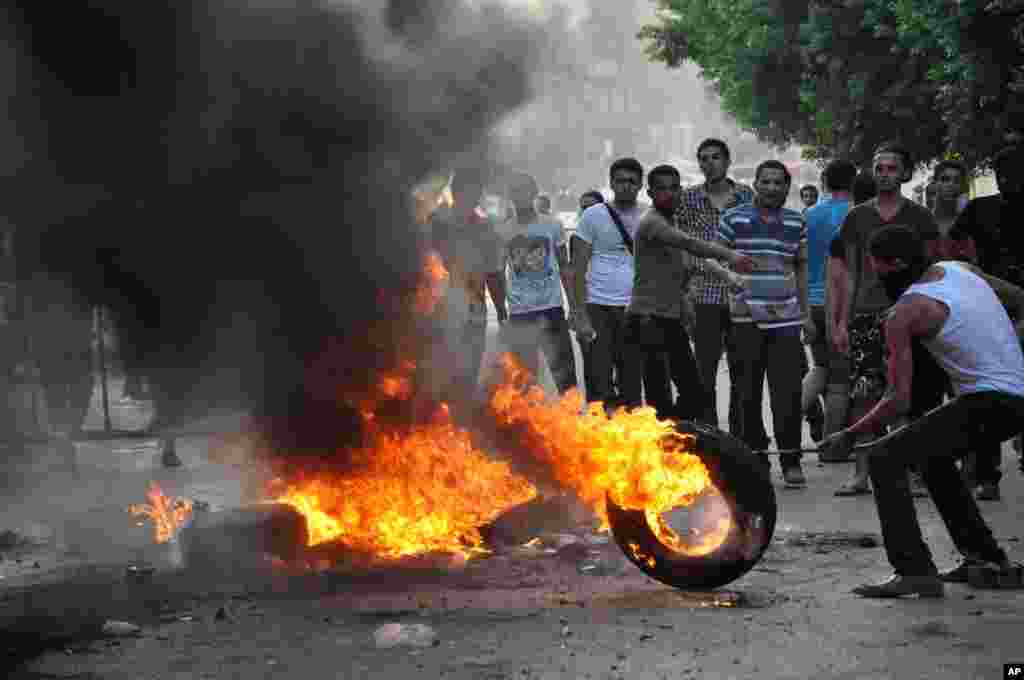
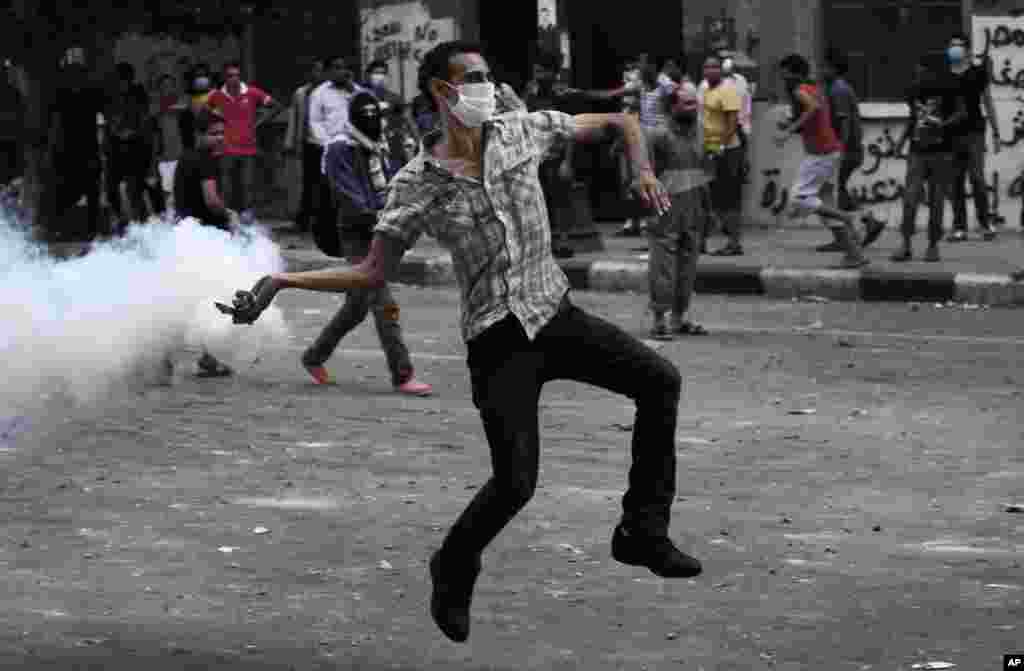
Outside the U.S. embassy in the Egyptian capital, Cairo, police used tear gas against an angry crowd of about 200 youth.
The protests started in Cairo on Tuesday, with protesters scaling the fortified walls of the U.S. Embassy in Cairo and replacing an American flag with an Islamic banner.
Egypt's Islamist President Mohamed Morsi, on an official visit to Brussels Thursday, slammed "attacks" on the Muslim prophet in the film, while also condemning the violence.
"We Egyptians reject any kind of assault or insult against our prophet," Morsi said. "[But] it is our duty to protect our guests and visitors from abroad. I call on everyone to take that into consideration, not to violate Egyptian law, not to assault embassies."
Photo Gallery: Anti-U.S. protests in Libya, Egypt, Yemen
US Diplomatic Posts Attacked in Middle East
1/14Yemeni protestors break a door of the U.S. Embassy during a protest about a film ridiculing Islam's Prophet Mohammed, Sana'a, Yemen, September 13, 2012.
Demonstrators angered over a film mocking Islam attacked U.S. embassies in Egypt and Yemen. The U.S ambassador to Libya was killed during demonstrations at the U.S. consulate in Benghazi, Libya.
Show moreShow less
2/14Yemenis protest in front of the U.S. Embassy during a protest about a film ridiculing Islam's Prophet Mohammed, Sana'a, September 13, 2012.
Demonstrators angered over a film mocking Islam attacked U.S. embassies in Egypt and Yemen. The U.S ambassador to Libya was killed during demonstrations at the U.S. consulate in Benghazi, Libya.
Show moreShow less
3/14Egyptian protesters burn tires as they clash with riot police outside the U.S. embassy in Cairo, Egypt, September 13, 2012.
Demonstrators angered over a film mocking Islam attacked U.S. embassies in Egypt and Yemen. The U.S ambassador to Libya was killed during demonstrations at the U.S. consulate in Benghazi, Libya.
Show moreShow less
4/14An Egyptian protester throws back a tear gas canister toward riot police outside the U.S. embassy in Cairo, September 13, 2012.
Demonstrators angered over a film mocking Islam attacked U.S. embassies in Egypt and Yemen. The U.S ambassador to Libya was killed during demonstrations at the U.S. consulate in Benghazi, Libya.
Show moreShow less
5/14A policeman stands in front of a police car set on fire by protesters in front of the U.S. embassy in Cairo, Egypt, during clashes between protesters and police, September 13, 2012.
Demonstrators angered over a film mocking Islam attacked U.S. embassies in Egypt and Yemen. The U.S ambassador to Libya was killed during demonstrations at the U.S. consulate in Benghazi, Libya.
Show moreShow less
6/14White House staff are pictured after they lowered the U.S. flag to half staff on the roof of the White House in Washington, September 12, 2012, following the death of U.S. Ambassador to Libya, Chris Stevens.
Demonstrators angered over a film mocking Islam attacked U.S. embassies in Egypt and Yemen. The U.S ambassador to Libya was killed during demonstrations at the U.S. consulate in Benghazi, Libya.
Show moreShow less
7/14President Barack Obama delivers a statement with Secretary of State Hillary Clinton from the Rose Garden of the White House in Washington, September 12, 2012
Demonstrators angered over a film mocking Islam attacked U.S. embassies in Egypt and Yemen. The U.S ambassador to Libya was killed during demonstrations at the U.S. consulate in Benghazi, Libya.
Show moreShow less
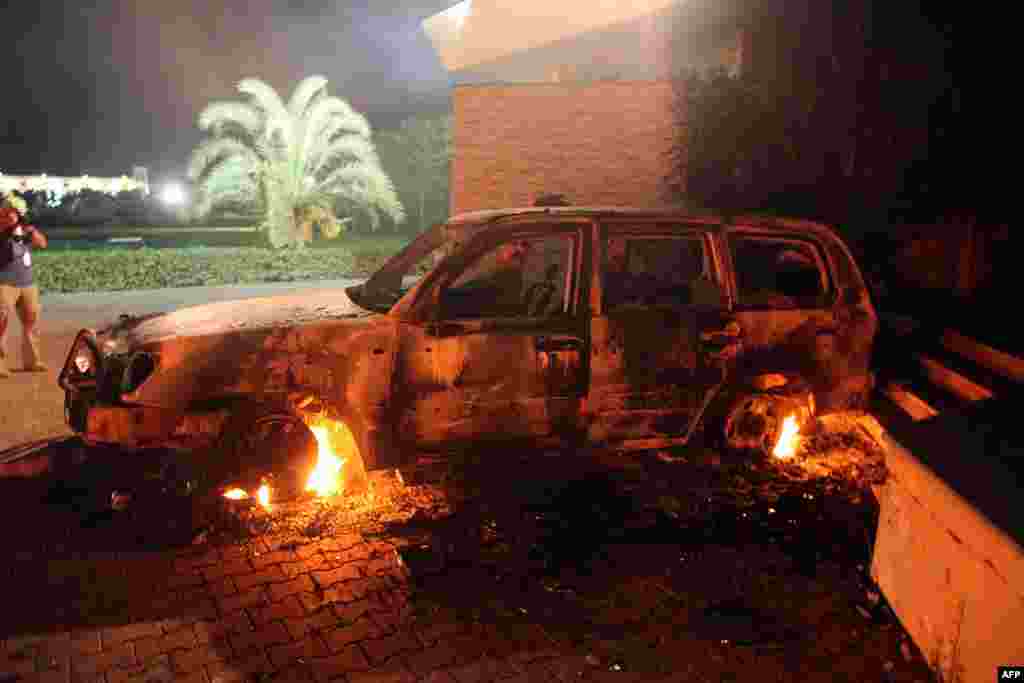
8/14A burnt car is parked at the U.S. consulate, which was attacked and set on fire by gunmen, in Benghazi, Libya, September 12, 2012.
Demonstrators angered over a film mocking Islam attacked U.S. embassies in Egypt and Yemen. The U.S ambassador to Libya was killed during demonstrations at the U.S. consulate in Benghazi, Libya.
Show moreShow less
9/14Typhoon survivor Manolito Pacurib stands inside his damaged home near a shipping vessel that remains grounded after being washed ashore during Typhoon Haiyan, in Tacloban, Philippines, Dec. 23, 2013.
Demonstrators angered over a film mocking Islam attacked U.S. embassies in Egypt and Yemen. The U.S ambassador to Libya was killed during demonstrations at the U.S. consulate in Benghazi, Libya.
Show moreShow less
10/14An interior view of the damage at the U.S. consulate, which was attacked and set on fire by gunmen yesterday, in Benghazi, Libya, September 12, 2012.
Demonstrators angered over a film mocking Islam attacked U.S. embassies in Egypt and Yemen. The U.S ambassador to Libya was killed during demonstrations at the U.S. consulate in Benghazi, Libya.
Show moreShow less
11/14Christopher Stevens, the U.S. ambassador to Libya, was killed along with three of his staff on September 11, 2012 during a demonstration at the U.S. consulate in Benghazi. This photo was taken at his home in Tripoli, June 28, 2012.
Demonstrators angered over a film mocking Islam attacked U.S. embassies in Egypt and Yemen. The U.S ambassador to Libya was killed during demonstrations at the U.S. consulate in Benghazi, Libya.
Show moreShow less
12/14A vehicle sits smoldering in flames after being set on fire inside the US consulate compound in Benghazi late on September 11, 2012.
Demonstrators angered over a film mocking Islam attacked U.S. embassies in Egypt and Yemen. The U.S ambassador to Libya was killed during demonstrations at the U.S. consulate in Benghazi, Libya.
Show moreShow less
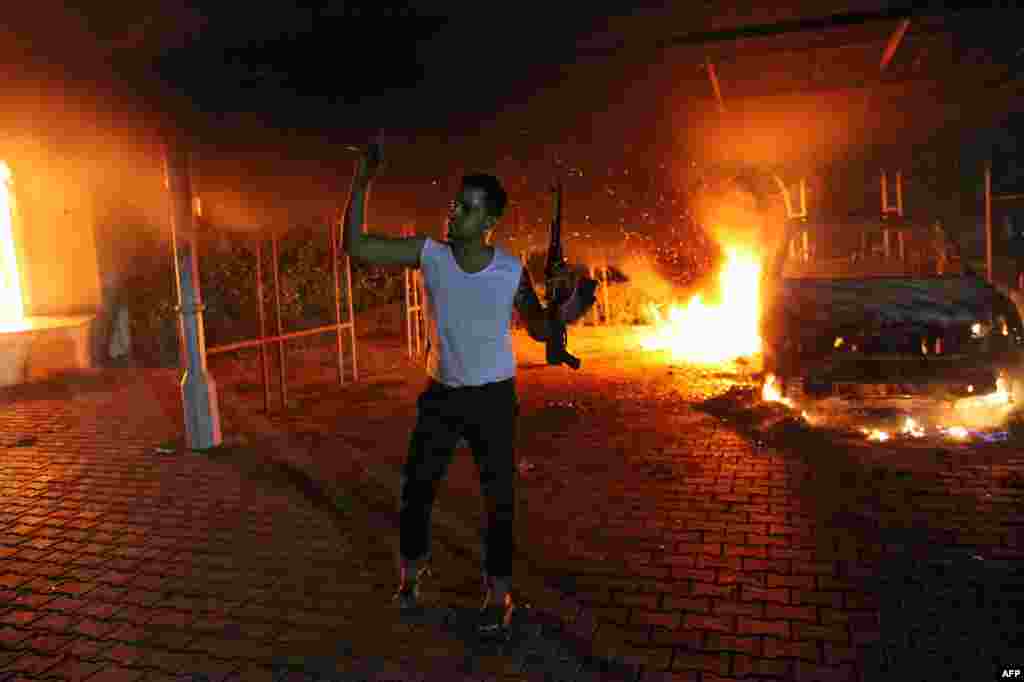
13/14An armed man waves his rifle as buildings and cars are engulfed in flames after being set on fire inside the U.S. consulate compound in Benghazi, Libya, late on September 11, 2012.
Demonstrators angered over a film mocking Islam attacked U.S. embassies in Egypt and Yemen. The U.S ambassador to Libya was killed during demonstrations at the U.S. consulate in Benghazi, Libya.
Show moreShow less
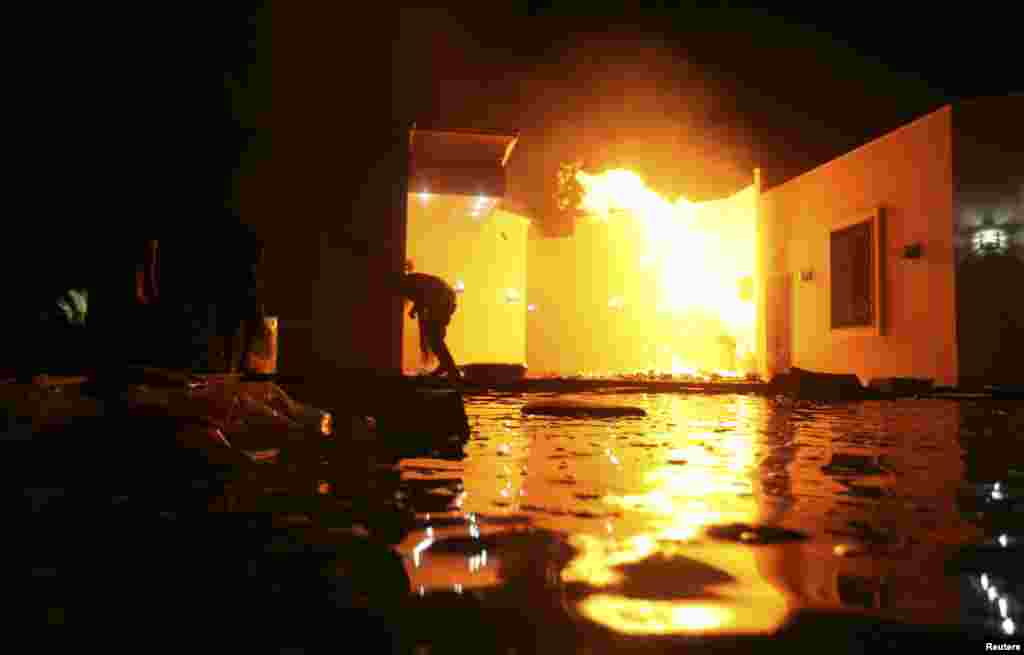
14/14U.S. Consulate in Benghazi in flames during protest, September 11, 2012
Demonstrators angered over a film mocking Islam attacked U.S. embassies in Egypt and Yemen. The U.S ambassador to Libya was killed during demonstrations at the U.S. consulate in Benghazi, Libya.
Show moreShow less
Previous slide
Next slide
The U.S. ambassador to Libya and three of his staff were killed Tuesday after suspected Islamist militants stormed the American consulate in Benghazi during similar demonstrations.
U.S. Secretary of Homeland Security Janet Napolitano said the film was "objectionable and wrong."
"That does not, in and of itself, justify, however, taking life and becoming violent," Napolitano said. "That's a different issue all together, so I think linking the two is not right."
U.S.-Libya cooperation
U.S. President Barack Obama and the president of Libya's National Assembly, Mohamed Magarief, have agreed to cooperate closely in investigating the deadly attack on the U.S. consulate in Benghazi.
The Libyan leader has apologized to the United States for the assault, and Libyans citizens have held public demonstrations to support the U.S.
"The general reaction of Libyans from left to right on the political spectrum, from secular to Islamist, has been to condemn the attack in no uncertain terms," the International Crisis Group's William Lawrence told VOA from the Libyan capital, Tripoli.
"Most Libyans see the assassination as an attack on their revolution, and that's something that Egypt and Pakistan and Afghanistan haven't experienced," he added.
Washington sent two Navy destroyers, a Marine Corps anti-terrorist security team and federal investigators to Libya to protect Americans and help hunt the suspected religious extremists who carried out the attack late Tuesday.
The Obama administration also ordered the evacuation of all U.S. personnel from Benghazi to Tripoli.
American officials said Wednesday the attack on the Benghazi compound and a nearby safe house may have been a planned, coordinated and complex operation, in contrast to the initial Cairo protest, which appeared to be spontaneous. They say armed militants in Libya may have used the Cairo events as cover.
The officials said it is too early to determine whether the assault was timed to coincide with the anniversary of the September 11, 2001 terrorist attacks on the United States.
American intelligence agencies are examining the alleged involvement of pro-al-Qaida Ansar al-Sharia militants, but cautioned they do not have solid evidence. On Wednesday, a brigade from the group denied planning the assault.
US Ambassador J. Christopher Stevens
US Ambassador J. Christopher Stevens
Served as U.S. ambassador to Libya since May
Held two earlier postings in Libya
Previous assignments in Israel, Syria, Egypt and Saudi Arabia
Worked as an international trade lawyer before joining the Foreign Service in 1991
Taught English in Morocco as a Peace Corps volunteer from 1983 to 1985
Stevens is the first U.S. ambassador to be killed on duty since 1979. He was a career foreign service officer and one of the most experienced American diplomats in the region. His colleagues continued to mourn his loss Thursday.
"Chris Stevens quarterbacked the delicate effort of supporting the Libyan opposition as war raged," said David Tafuri, a partner at the Patton Boggs law firm who serves as the U.S. legal counsel to the new government of Libya. "There were few diplomats who could have handled such a crisis with the same calm determination."
Retired U.S. Ambassador Thomas Pickering called Stevens a "first-class professional."
"It was a real tragedy that something like this flared up, on the basis of, apparently, a very irresponsible film that seems to have bordered, if not actually crossed the line, into hate speech," he said.
Film criticized
A trailer for the anti-Islamic video was posted on YouTube in July. An Arabic-language translation began circulating in the Middle East in recent days. Clips from the movie depict the Prophet Muhammad as a villainous, homosexual child-molesting buffoon, among other overtly insulting claims.
The film has been widely condemned across the globe and in the United States.
"This movie is not United States'. It is not the United States government," Ronald E. Neumann, a former U.S. ambassador to Afghanistan and Yemen, said. "It is a few crazy people that want to take shelter in our country to make trouble for our relations with the Muslim world."
While the identity of the film's director remains a mystery, U.S. media reports say the video was publicized last week by a U.S. Coptic Christian activist named Morris Sadek, known for his attacks on Islam. Sadek promoted the video in tandem with a statement by controversial Florida-based Christian Pastor Terry Jones, who declared "International Judge Muhammad Day" on September 11.
Jones said Tuesday the film was not designed to attack Muslims but to show the "destructive ideology of Islam." He triggered deadly riots in Afghanistan in 2010 and 2011 by threatening to set fire to copies of the Quran and then burning one in his church.