Ukraine's Leader Agrees to Repeal Some Anti-Protest Laws
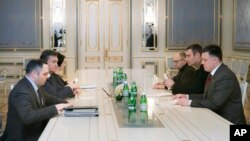
Ukraine's President Viktor Yanukovych, second left, talks to opposition leaders Oleh Tyahnybok, first right, Vitali Klitschko, second right, and Arseniy Yatsenyuk, third right, in Kyiv,Jan. 27, 2014.
KYIV —
Ukraine's embattled President Viktor Yanukovych has agreed to repeal some of the harsh anti-protest laws that have helped fuel increasingly violent protests for more than a week. The decision came after talks with opposition leaders late Monday. A statement on the presidential website said repeal of the laws will be addressed at a special session of parliament that begins on Tuesday.
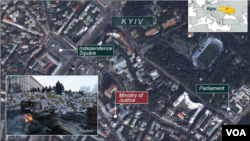
Earlier Monday Ukrainian protesters ended their occupation of the Justice Ministry, allowing talks to start between Yanukovych and opposition leaders.
The talks are seen as crucial to the special session of the nation’s parliament on Tuesday. Ukraine’s beleaguered president has promised to ask the parliament to repeal new authoritarian laws restricting freedom of assembly.
The laws sparked a national wave of protest, plunging Ukraine into its deepest political crisis since it won independence from the Soviet Union 23 years ago.
Martial law?
In recent days, radical protesters occupied the energy, justice and agriculture ministries, prompting some people here to say the president is losing control of the capital. Sunday’s occupation of the Justice Ministry prompted Justice Minister Olena Lukash to threaten Monday to call for a state of emergency.
Widely seen as a form of martial law, this could involve Yanukovych asking the army to repress protesters. It is unclear if army generals would obey orders to act against the spreading protests.
In recent days, protesters took over local government offices in all of western Ukraine. Attempts to take over offices in four eastern Ukrainian cities led to pitched battles between protesters and riot police and civilian gangs. Since Sunday, dozens have been injured and dozens more jailed.
On Monday, Ukrainian TV aired videos of these fights, where young men from sports groups joined riot police in clubbing protesters.
Disappearances and torture
Also Monday, the European Union’s office in Ukraine, accused the government of waging a dirty war against its political opponents.
The EU statement read: “Arrests of wounded people in front of clinics, several cases of disappearance and reported torture are extremely worrying and can be accepted under no circumstances.”
Protests in Kyiv
1/11An opposition supporter looks on as he warms himself next to a fire in a barricade near Kyiv's Independence Square, Jan. 31, 2014.
Show moreShow less
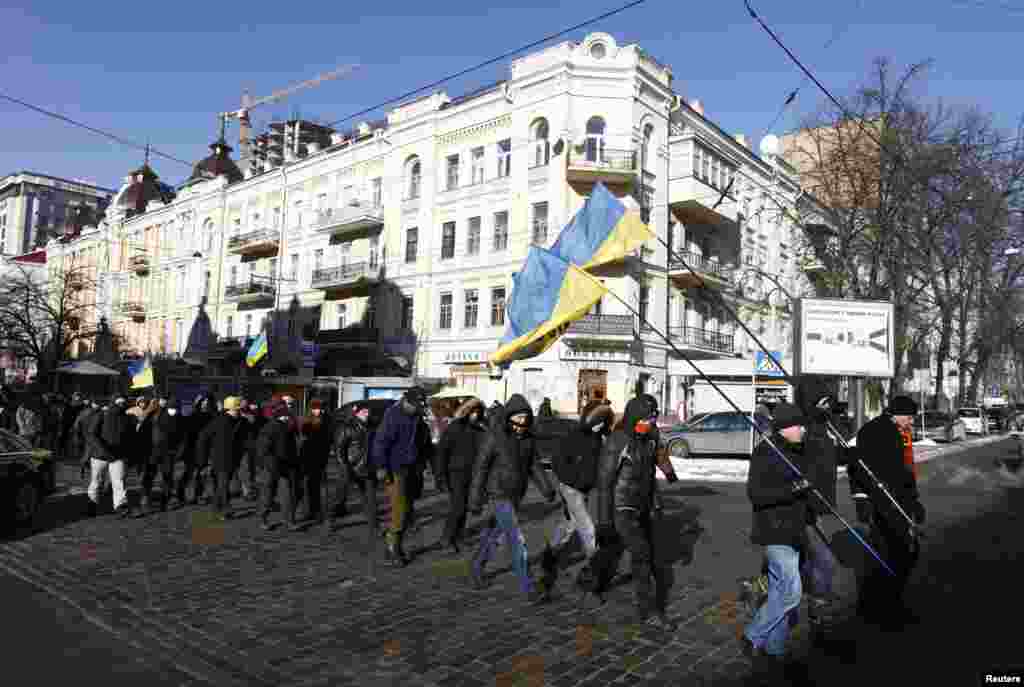
2/11Anti-government protesters march in central Kyiv, Jan. 31, 2014.
Show moreShow less
3/11Anti-government protesters march in central Kyiv, Jan. 31, 2014.
Show moreShow less
4/11An opposition supporter stands next to a burning tire at a barricade in central Kyiv, Jan. 30, 2014.
Show moreShow less
5/11Riot police stand in a cordon facing anti-government protesters as temperatures stand at minus 20 degrees Celsius at a barricade near Independence Square in Kyiv, Jan. 30, 2014.
Show moreShow less
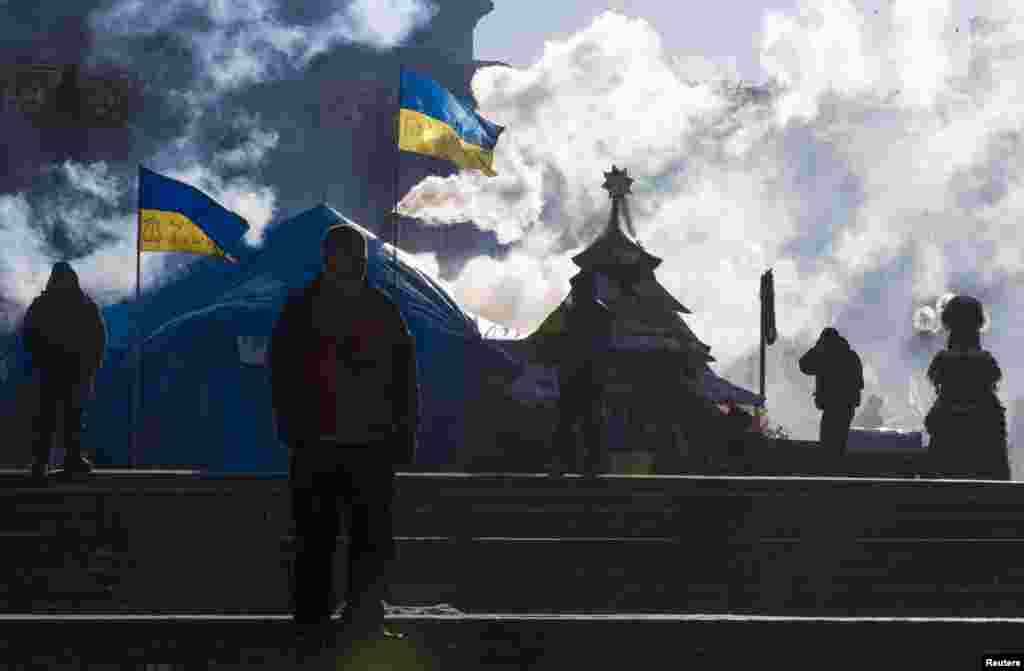
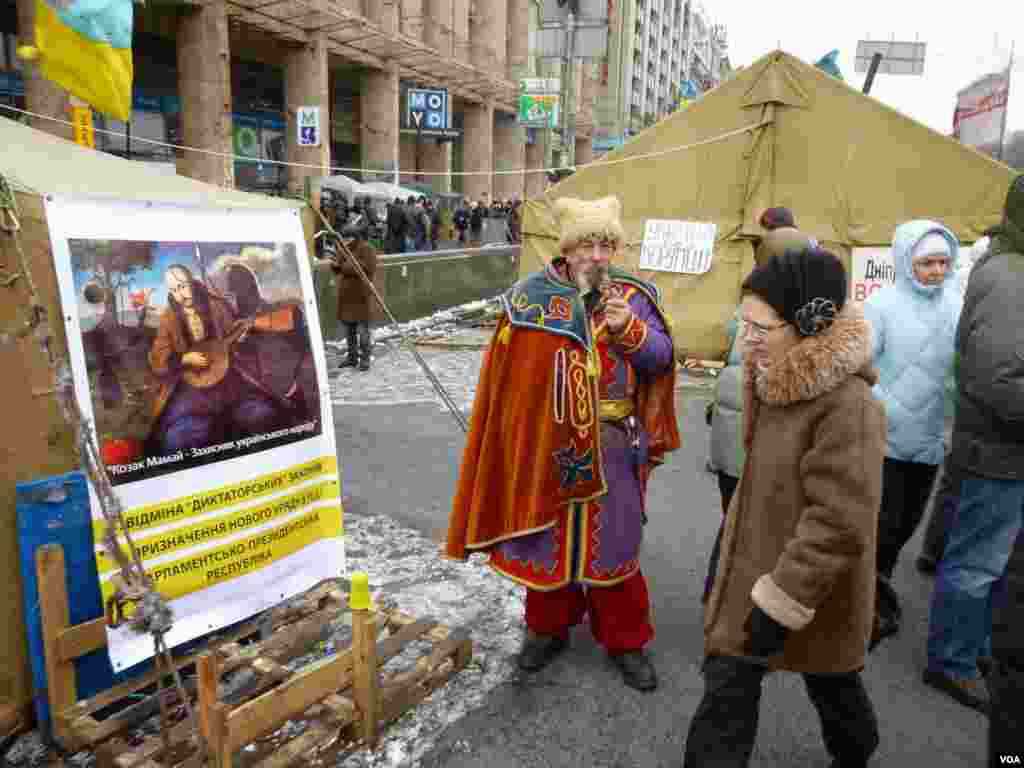
6/11Anti-government protesters walk in the tent city at Independence Square in Kyiv, Jan. 30, 2014.
Show moreShow less
7/11Protesters, with signs reading "Mother" on their chests, and ""The government don't kill our children," walk away from a police cordon in central Kyiv, Jan. 30, 2014.
Show moreShow less
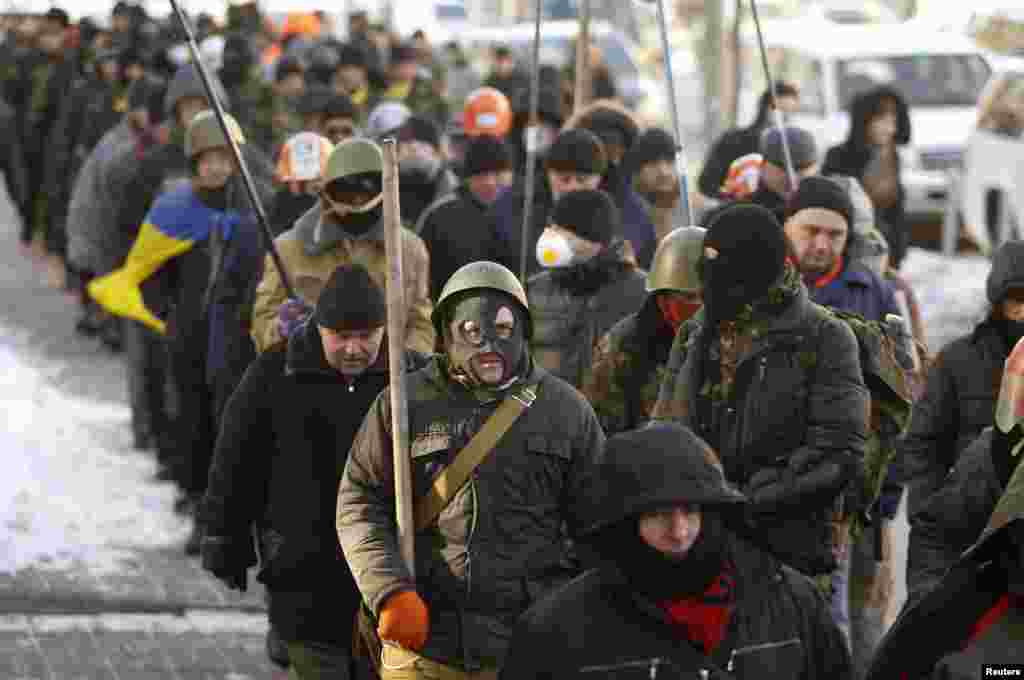
8/11Members of various anti-government paramilitary groups walk in formation during a show of force in Kyiv, Jan. 29, 2014.
Show moreShow less
9/11Members of various anti-government paramilitary groups attend a religious service at a chapel in Kyiv, Jan. 29, 2014.
Show moreShow less
10/11A Kenyan student wears mock chains and another holds a candle as they march with others in memory of the victims of the Garissa college attack and to protest what they say is a lack of security, in downtown Nairobi, le 7 avril 2015.
Ukraine’s protests erupted two months ago, when Yanukovych unexpectedly pulled out of signing an association agreement with the European Union. Instead, he signed up for a $15 billion bailout deal with Russia.
This East-West fight over Ukraine has brought relations between the EU and Russia to their chilliest level since Russia’s war with Georgia five years ago. This week, EU leaders cut a long planned two-day EU-Russia summit to a three-hour meeting on Tuesday. They also cancelled a Monday night dinner with President Vladimir Putin.
Some material in this report was contributed by Reuters