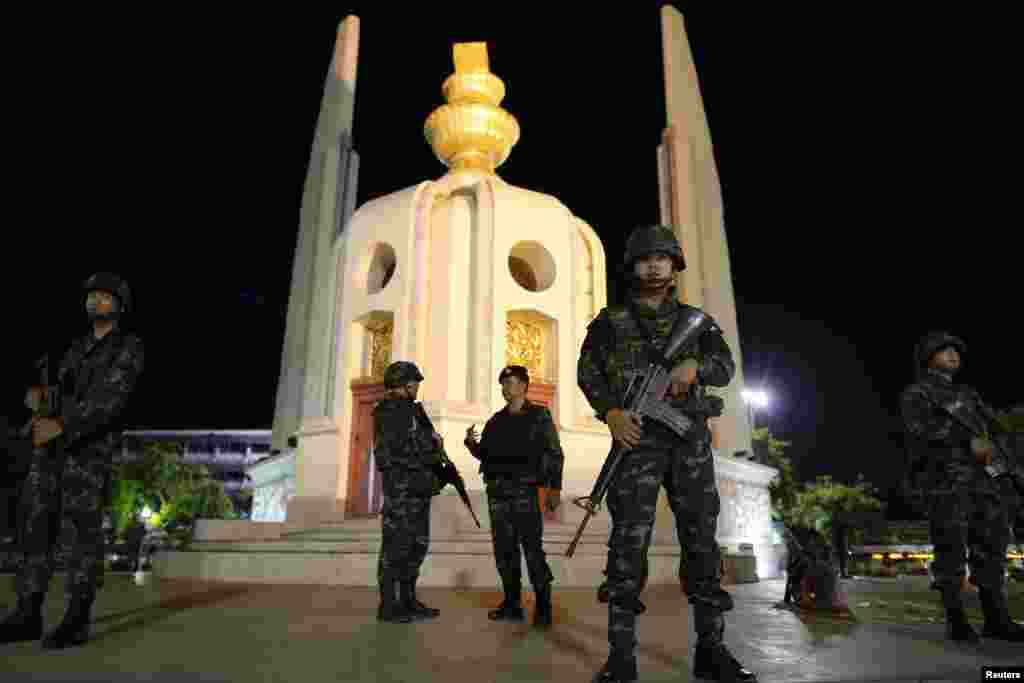
1/9Soldiers take up position at the Democracy monument after the coup was declared in Bangkok, May 22, 2014.
Show moreShow less
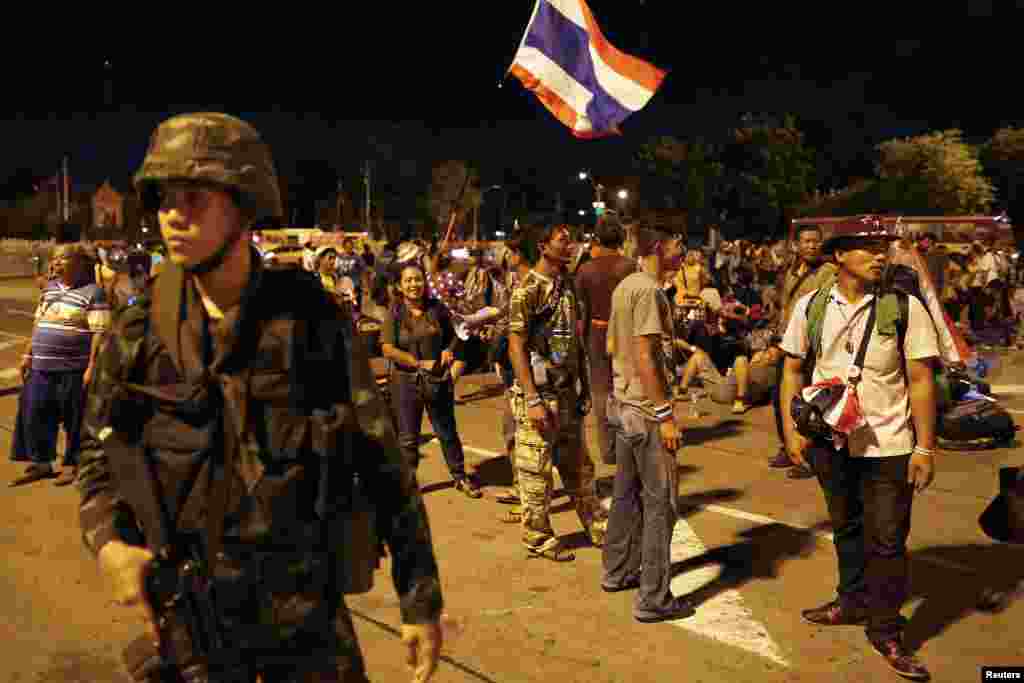
2/9Anti-government protesters waiting at the Royal Plaza for transportation home stand behind a soldier after the coup was declared in Bangkok, May 22, 2014.
Show moreShow less
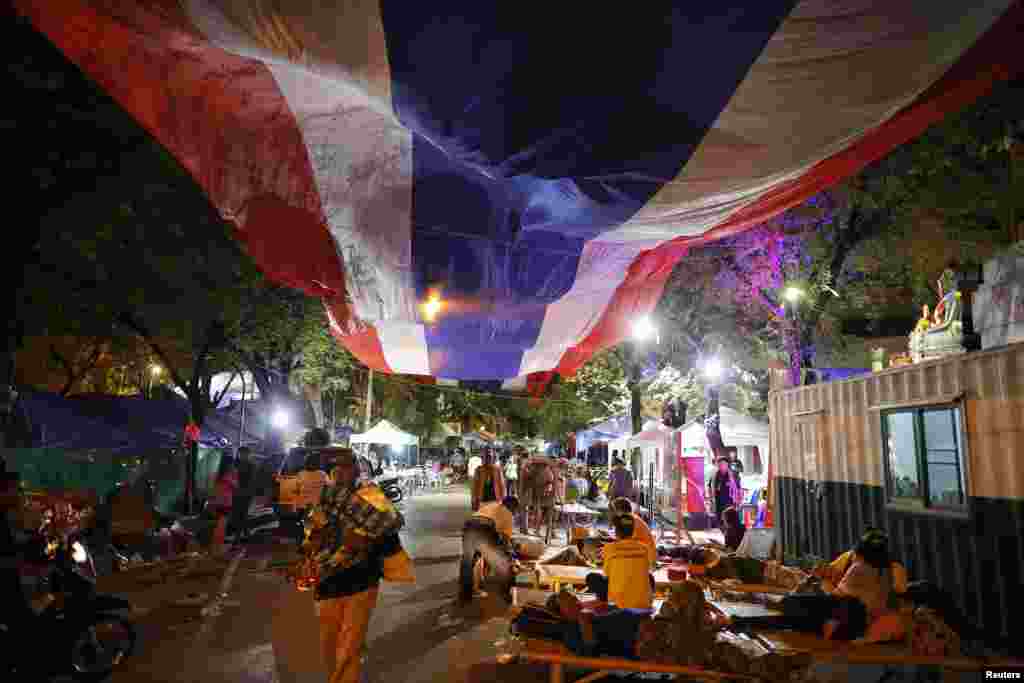
3/9Anti-government protesters get ready to leave their main encampment after the coup was declared in Bangkok, May 22, 2014.
Show moreShow less
4/9Thai journalists and foreign press watch the TV broadcast announcement of the coup by the Thai Armed Forces chiefs, at the press center of the Army Club, in Bangkok, May 22, 2014.
Show moreShow less
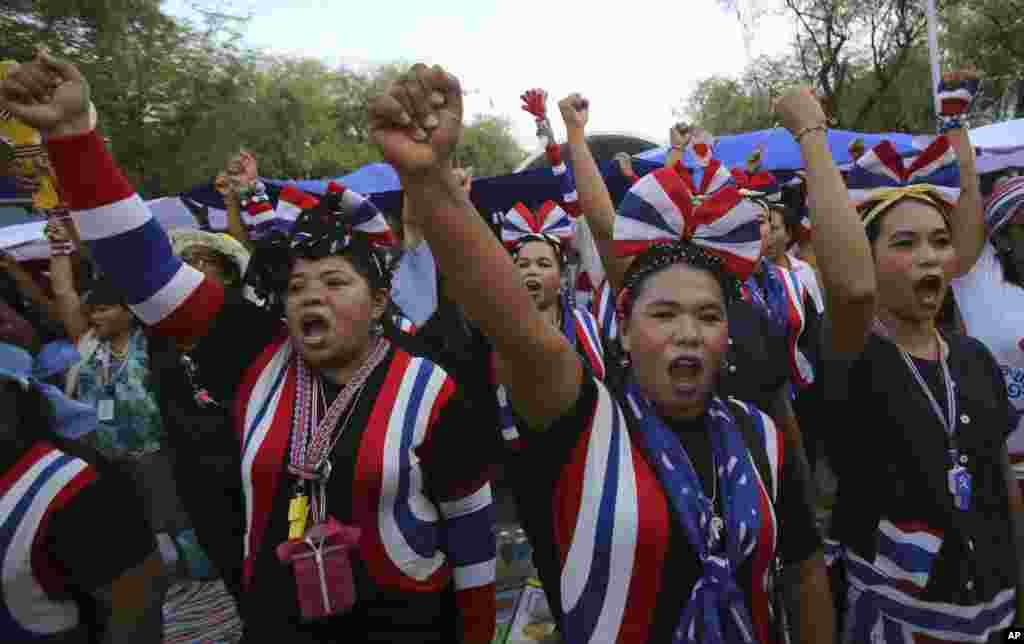
5/9Anti-government protesters raise their fists as they sing the national anthem, in Bangkok, May 22, 2014.
Show moreShow less
6/9Thai soldiers block a motorcade of an attendant at the Army Club shortly after the army staged a coup, May 22, 2014, in Bangkok, Thailand.
Show moreShow less
7/9An armed soldier takes a position behind a military vehicle in the compound of the Army Club shortly after the military staged a coup, in Bangkok, May 22, 2014.
Show moreShow less
8/9Thai soldiers guard an area where anti-government protesters come to rally, in Bangkok, May 22, 2014.
Show moreShow less
9/9Barefoot Buddhist monks walk past a checkpoint near a pro-government "red shirt" supporter encampment in Nakhon Pathom province, on the outskirts of Bangkok, May 22, 2014.
Show moreShow less
Previous slide
Next slide
BANGKOK —
The United States is calling for the release of all of Thailand’s senior political leaders who are currently in military detention following Thursday’s coup.
The U.S. State Department is urging Thailand’s military to restore the ousted civilian government, return the country to democracy and respect human rights and fundamental freedoms.
U.S. Secretary of State John Kerry, in a blunt statement, said “there is no justification for this military coup.”
U.S. ambassador to Thailand Kristie Kenney told VOA the military takeover will have ramifications for the diplomatic relationship between the two countries, which goes back to 1883.
“A coup in Thailand will have a negative implication. There will be a high-level review in Washington by the United States government of our assistance and our engagement with Thailand, especially the Thai military,” said Kenney.
US Ambassador to Thailand Kristie Kenney speaks with VOA's Steve Herman in Bangkok, May 23, 2014.
Thailand is America’s key ally in Southeast Asia. The two countries hold the region’s largest annual military drills, called “Cobra Gold,” but also have significant cooperation in areas from public health to wildlife protection.
The U.S. ambassador said Thursday’s coup, which also suspended the constitution and imposed a nightly curfew, was “a bit of a surprise to all of us” despite the many months of political difficulties leading up to it and the imposition of martial law by the army chief early Tuesday.
“There were signs that things were not normal. But quite frankly right before the announcement came out all of the respective parties were meeting together and so, I think, many of us thought a great opportunity for the kind of genuine dialogue we’d all been looking for,” said Kenney.
Following the coup Thursday, reports circulated online speculating that the acting prime minister and other members of the ousted cabinet had taken refuge in the U.S. embassy. Ambassador Kenney knocked down the reports and said they point to the dangers of the junta’s restrictions on speech and the media.
“You and I are having a conversation here that people in Thailand don’t have the ability to have. So it leads to lots of rumors because there isn’t the usual source of television, radio, discussion of issues. And I think that’s very dangerous in a society,” said Kenney.
The State Department’s sternly worded statement Thursday that called Thailand’s military takeover a “coup” contrasts with the U.S. government’s reaction to the situation in Egypt last year. When that country’s military displaced the elected civilian government, U.S. officials did not characterize the action as a coup.
Analysts say the differing reactions can be explained in part by how the terminology can impact foreign aid.
Under the Foreign Assistance Act, the United States is to suspend assistance to countries that experience a military coup.
Egypt receives about $1.5 billion in foreign aid from Washington.
Following the last coup in Thailand, in 2006, the United States did suspend aid for military training and peacekeeping, but it totaled only $24 million.