


Syrian Foreign Minister Denies Assad Government Used Chemical Weapons
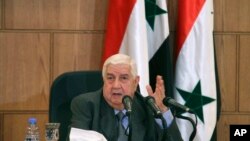
In this photo released by the Syrian official news agency SANA, Syrian Foreign Minister Walid Moallem, speaks during a press conference, in Damascus, Syria, April 6, 2017.
CAIRO —
Syria's foreign minister, Walid Moallem, says the government was not responsible for the alleged chemical weapons attack in the northern Idlib town of Khan Sheikhoun.
Walid Moallem refuted allegations his government dropped chemical bombs against Khan Sheikhoun, now under the control of the Jabhat al-Nusra group, earlier this week. During a news conference Thursday in Damascus, he said the accusations were faulty.
Moallem says that the first allegations of a chemical weapons attack took place more than five hours before the Syrian Air Force attacked the Jabhat al-Nusra-held town. He says Syrian warplanes bombed an arms depot under Jabhat al Nusra’s control that may have contained such weapons.
Photo gallery: Aftermath of deadly gas attack on Khan Sheikhoun
A Day After Deadly Gas Attack in Kahn Sheikhoun, Syria
1/8A Syrian man collects samples from the site of a suspected toxic gas attack in Khan Sheikhun, in Syria’s northwestern Idlib province, April 5, 2017.
The gas attack at Kahn Sheikhoun, described by the opposition Syrian National Coalition as a "horrifying massacre," is widely believed to be the worst such violation of international law in war-ravaged Syria since 2013, when a U.N. probe found credible evidence that sarin gas killed hundreds of civilians near Damascus.
2/8A Syrian man collects and bags the body of a dead bird, reportedly killed by a suspected toxic gas attack in Khan Sheikhun, April 5, 2017.
The gas attack at Kahn Sheikhoun, described by the opposition Syrian National Coalition as a "horrifying massacre," is widely believed to be the worst such violation of international law in war-ravaged Syria since 2013, when a U.N. probe found credible evidence that sarin gas killed hundreds of civilians near Damascus.
3/8A general view shows damage at a site hit by airstrikes on Tuesday in the town of Khan Sheikhoun in rebel-held Idlib, April 5, 2017.
The gas attack at Kahn Sheikhoun, described by the opposition Syrian National Coalition as a "horrifying massacre," is widely believed to be the worst such violation of international law in war-ravaged Syria since 2013, when a U.N. probe found credible evidence that sarin gas killed hundreds of civilians near Damascus.
4/8Syrians bury the bodies of victims of a a suspected toxic gas attack in Khan Sheikhun, April 5, 2017.
The gas attack at Kahn Sheikhoun, described by the opposition Syrian National Coalition as a "horrifying massacre," is widely believed to be the worst such violation of international law in war-ravaged Syria since 2013, when a U.N. probe found credible evidence that sarin gas killed hundreds of civilians near Damascus.
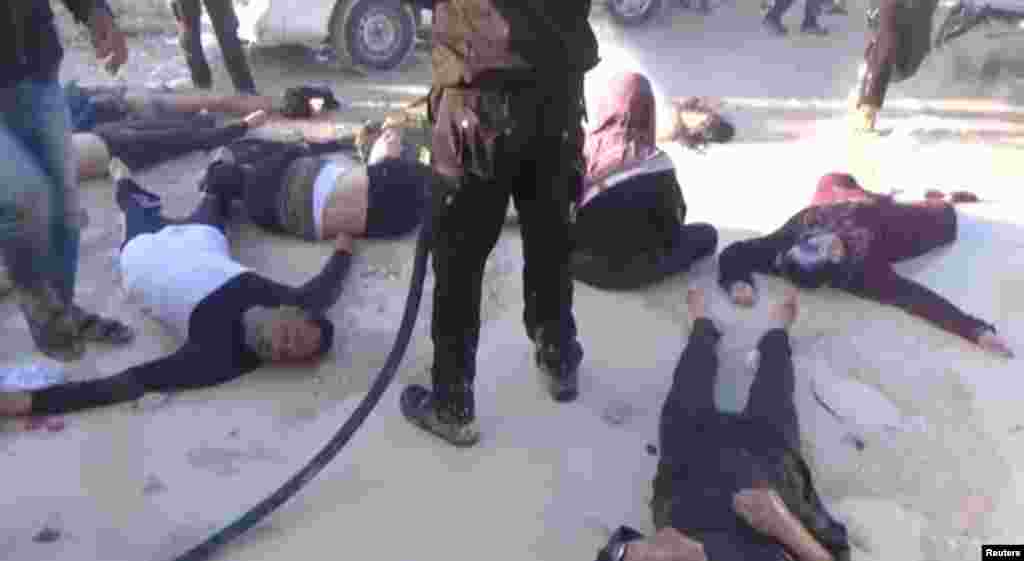
5/8A still image taken from a video posted to a social media website on April 4, 2017, shows people lying on the ground, said to be in the town of Khan Sheikhoun, after what rescue workers described as a suspected gas attack in rebel-held Idlib, Syria.
The gas attack at Kahn Sheikhoun, described by the opposition Syrian National Coalition as a "horrifying massacre," is widely believed to be the worst such violation of international law in war-ravaged Syria since 2013, when a U.N. probe found credible evidence that sarin gas killed hundreds of civilians near Damascus.
6/8A still image taken from a video posted to a social media website on April 4, 2017, shows a man lying on the ground and being sprayed with water, said to be in the town of Khan Sheikhoun.
The gas attack at Kahn Sheikhoun, described by the opposition Syrian National Coalition as a "horrifying massacre," is widely believed to be the worst such violation of international law in war-ravaged Syria since 2013, when a U.N. probe found credible evidence that sarin gas killed hundreds of civilians near Damascus.
7/8A civil defense member breathes through an oxygen mask, after what rescue workers described as a suspected gas attack in the town of Khan Sheikhoun, April 4, 2017.
The gas attack at Kahn Sheikhoun, described by the opposition Syrian National Coalition as a "horrifying massacre," is widely believed to be the worst such violation of international law in war-ravaged Syria since 2013, when a U.N. probe found credible evidence that sarin gas killed hundreds of civilians near Damascus.
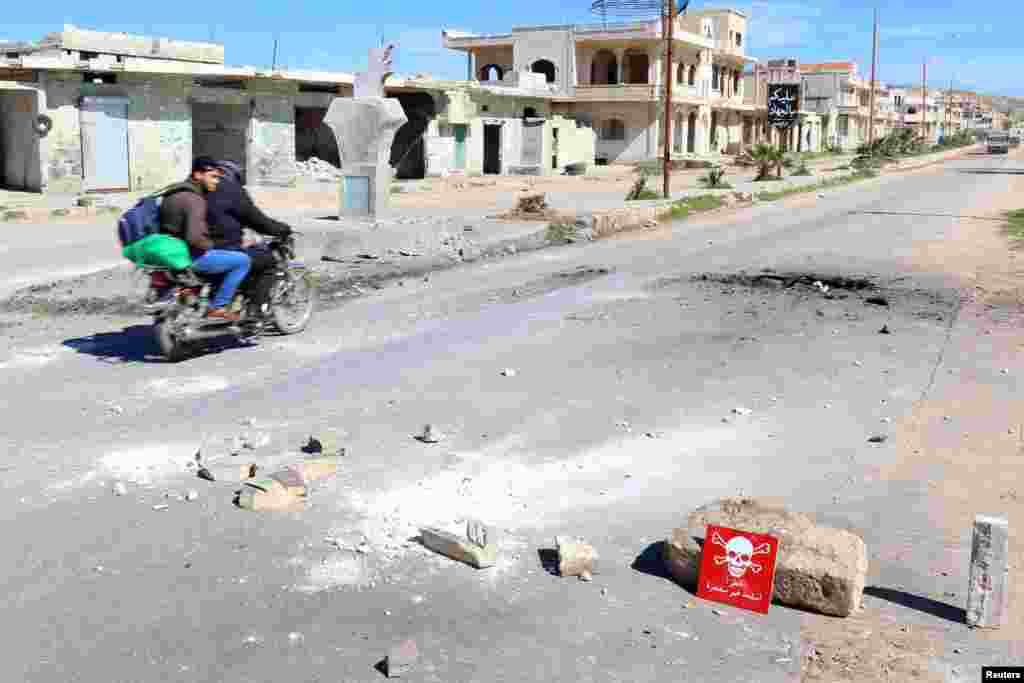
8/8Men ride a motorbike past a hazard sign at a site hit by an airstrike on Tuesday in the town of Khan Sheikhoun, April 5, 2017. The hazard sign reads, "Danger, unexploded ammunition."
The gas attack at Kahn Sheikhoun, described by the opposition Syrian National Coalition as a "horrifying massacre," is widely believed to be the worst such violation of international law in war-ravaged Syria since 2013, when a U.N. probe found credible evidence that sarin gas killed hundreds of civilians near Damascus.
Previous slide
Next slide
Moallem maintained his government “has not and will not use chemical weapons against its own people,” adding it has “no interest” in using poison gas in any case.
He asks if it is “logical” the government would use chemical weapons at a time when it is starting to win on the ground and beginning to convince others of the merits of its cause.
The veteran Syrian foreign minister says he understands the implications of U.S. President Donald Trump’s warning to Syria about taking “unilateral action,” but pointed out that permanent United Nations Security Council members are "bound to uphold" the U.N. Charter and not "take unilateral action.”
Moallem also says U.S.-led coalition forces have struck civilian targets in the town of Mansoura, near Deir ez Zor, and in Raqqa.
"If the United States wants to apply humanitarian criteria [in the Khan Sheikhoun case],” he said sarcastically, “then let them start by applying it to themselves.”
The U.S.-led coalition apologized for what it said was an “accidental” attack on Syrian government positions near Deir ez Zor, late last year.
Moallem went on to allege that a notorious case of chemical weapons usage in 2013 against the eastern suburbs of Damascus was “perpetrated by Qatar and Turkey.” The Syrian government supposedly gave up most of its chemical weapons stockpile following the incident. Western governments accused Damascus of that attack.
The Syrian foreign minister told another journalist that his government was “willing to accept an international investigation” of the Khan Sheikhoun attack, “provided that it is not politicized,” that it includes a “wide array of different parties,” and is “not based outside of Syria, especially in Turkey,” whose “hostility” toward Syria, he alleged, “knows no boundaries.”