NAIROBI —
Delegates for South Sudan's government and the rebels fighting to push it from power have opened talks aimed at ending nearly three weeks of violence. Some experts warn the situation will worsen if the East African regional bloc, the Intergovernmental Authority on Development (IGAD), continues to condemn the actions of the rebel group.
The representatives for South Sudan's government and the rebels have met separately in Addis Ababa with mediators trying to broker a cease-fire. As of Friday afternoon, the two delegations had not met face-to-face.
Jok Madut Jok of the Sudd Institute, an independent research organization in South Sudan, says the immediate cessation of hostilities is more important to the people of South Sudan now than political settlement.
“What people are waiting and hoping for right now in South Sudan is for the factions, these warring parties, to have [an] immediate cease-fire," he said. "That’s really most urgent as people are extremely desperate under the circumstances they find themselves now.”
The United Nations estimates that more than 1,000 people have been killed and around 200,000 displaced from their homes due to the ongoing clashes in South Sudan.
Away from the talks, fighting continues, with military clashes being reported around the rebel-held cities of Bor, in Jonglei state, and the Unity State capital, Bentiu.
Last week, the East African bloc IGAD urged both sides in the conflict to seize "the small window of opportunity" and begin peace talks.
The five nations in IGAD also warned the rebels led by former vice president Riek Machar that they will not accept the "unconstitutional overthrow" of South Sudan's government.
Jok says the regional mediators will find themselves in a delicate situation as they try to end the conflict.
“The East African grouping, the IGAD - on the one hand, they want to send signal to South Sudan and any other country in the region that the use of violence as the avenue to a political power must be and should be discouraged at all cost," he said. "And so they might be trying to condemn the former vice president for his action, but by doing so they risk pushing away into a kind of a civil war.”
South Sudan Displaced Could Reach 400,000: UN
1/9Displaced people who fled the recent fighting between government and rebel forces in Bor by boat across the White Nile, prepare to sleep in the open in the town of Awerial, South Sudan, Jan. 1, 2014.
Show moreShow less
2/9A young displaced boy rests on the wheel arch of a water truck while others fill containers from it, at a United Nations compound on the outskirts of Juba, the South Sudanese capital.
Show moreShow less
3/9Yared, 2, is held by mother Madhn who fled from the town of Bor a few days ago, as she receives medicine for her child at a Medecins Sans Frontieres (MSF) medical tent at a United Nations compound.
Show moreShow less
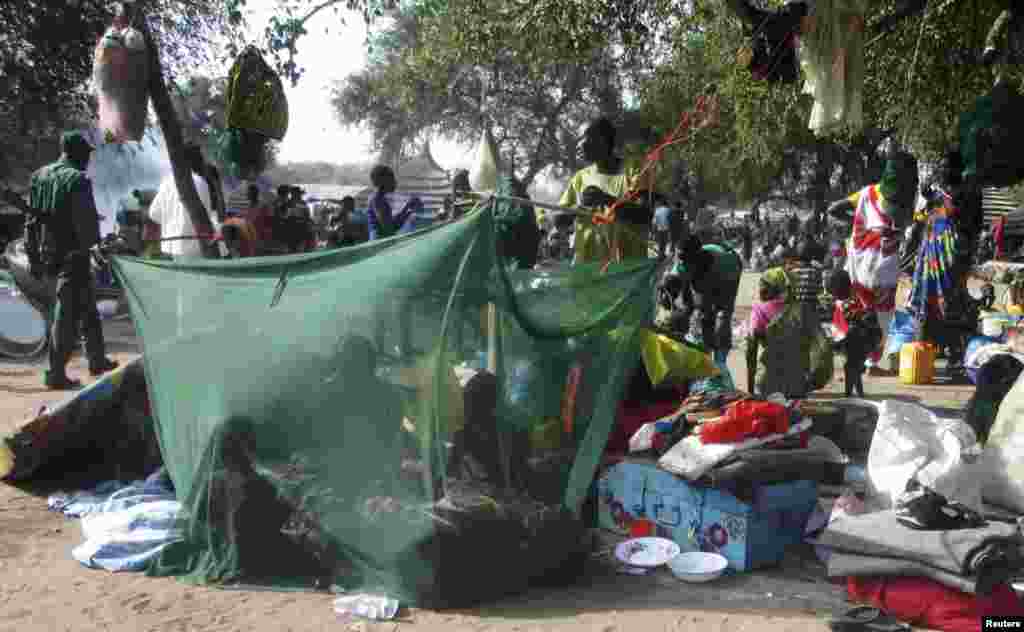
4/9Displaced people gather under a mosquito net tent as they flee from fighting between the South Sudanese army and rebels in Bor town, 180 km (112 miles) northwest from capital Juba December 30, 2013.
Show moreShow less
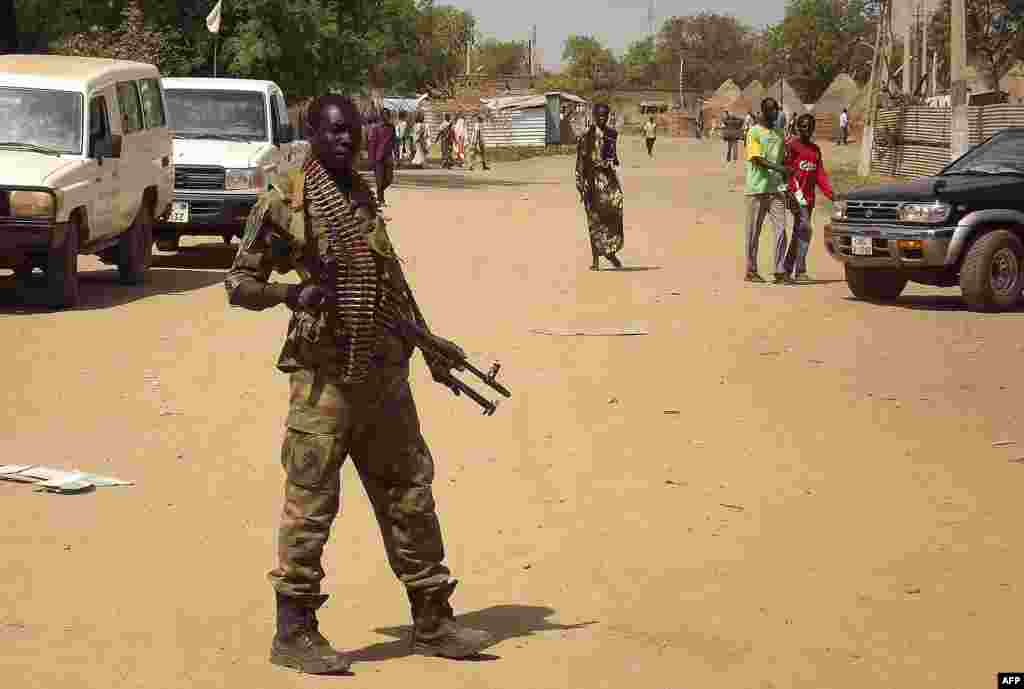
5/9A soldier from South Sudan's army stands guard in Malakal in the Upper Nile State of South Sudan, Dec. 31, 2013.
Show moreShow less
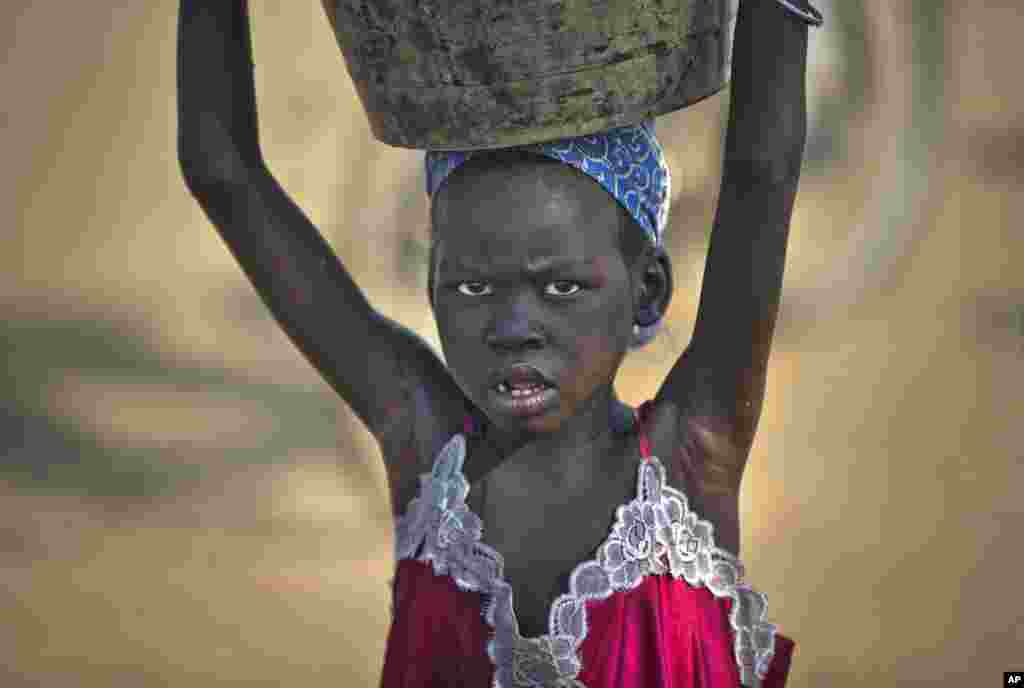
6/9A young displaced girl carries a bucket of water back to her makeshift shelter at a United Nations compound which has become home to thousands of people displaced by the recent fighting, in the Jebel area on the outskirts of Juba.
Show moreShow less
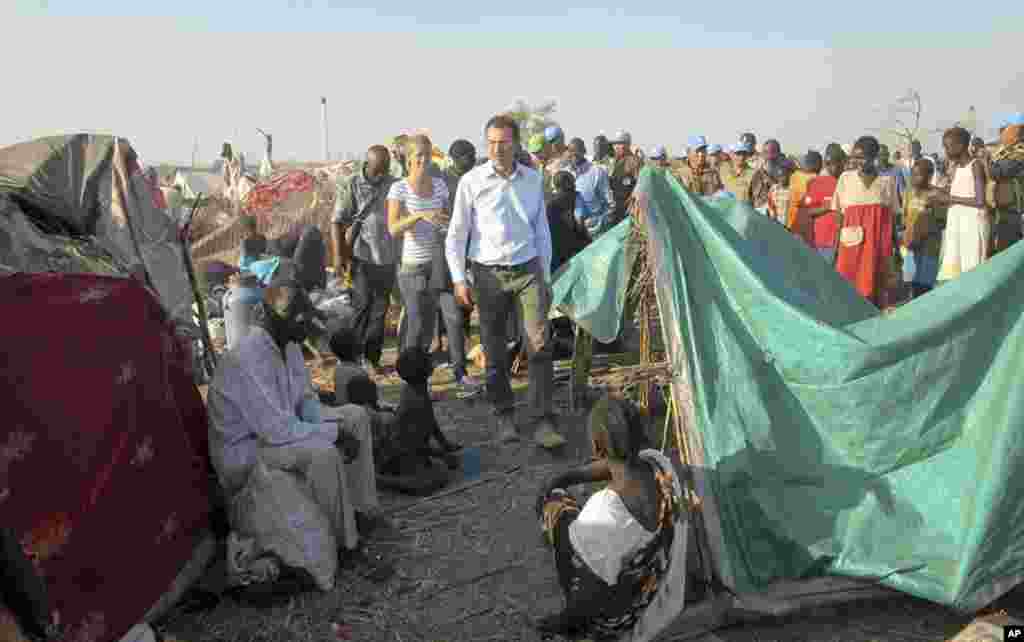
7/9The U.N.'s top humanitarian official in South Sudan, Toby Lanzer, assesses the situation at the U.N. compound where many displaced have sought shelter in Bentiu, Unity state, South Sudan, Dec. 24, 2013. (UNMISS)
Show moreShow less
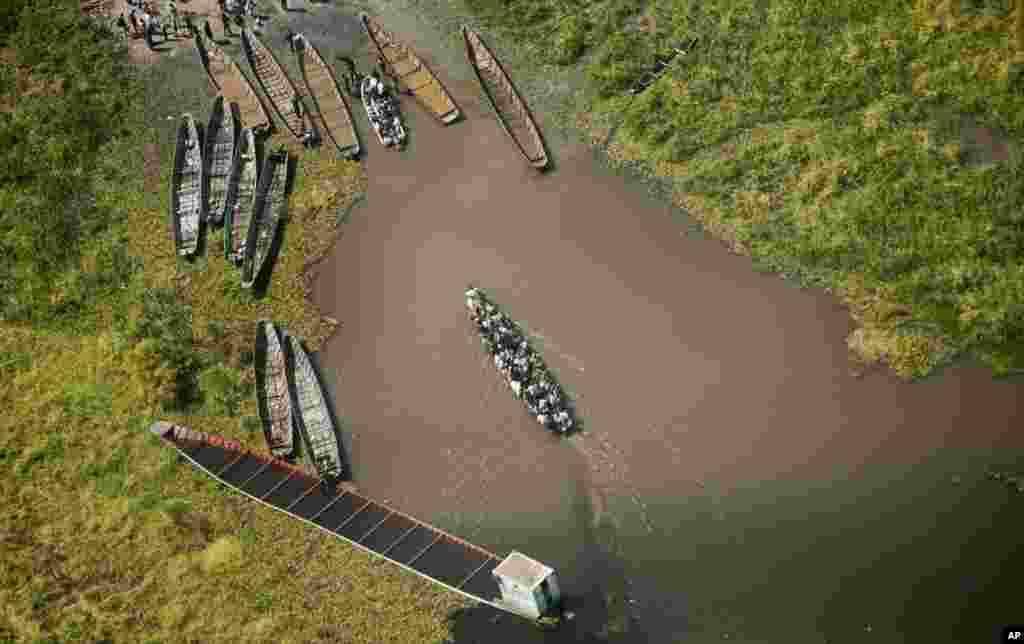
8/9A pirogue packed with passengers arrives at a dock after crossing a waterway near the town of Malakal, seen from an airplane over South Sudan, Dec. 30, 2013.
Show moreShow less
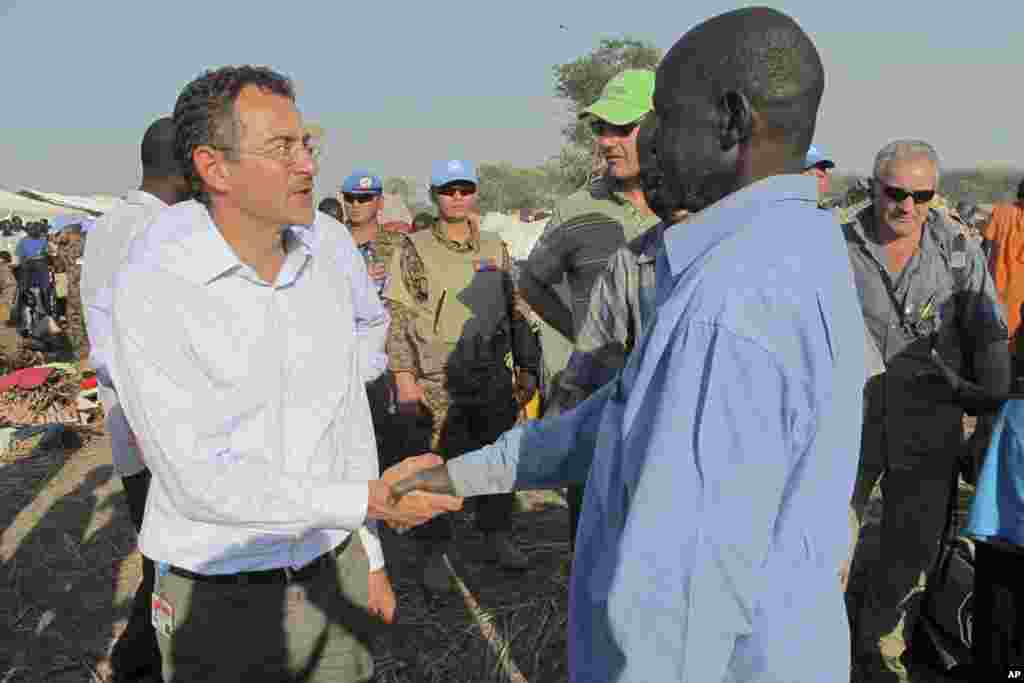
9/9U.N.'s top humanitarian official in the country Toby Lanzer, left, makes a visit to assess the humanitarian situation at the U.N. compound where many displaced have sought shelter in Bentiu, in oil-rich Unity state, in South Sudan, Dec. 24, 2013.
Show moreShow less
Previous slide
Next slide
Bloodshed in the world's newest country erupted when renegade soldiers attacked a South Sudanese army headquarters on December 15. President Kiir accused former vice president Machar of a coup attempt.
The violence split the country along ethnic lines, with supporters of Mr. Kiir, a member of the Dinka tribe, and supporters of Machar, from the Nuer tribe, targeting each other.
Meanwhile, the U.S. embassy in Juba has ordered the evacuation of more staff due to the "deteriorating security situation" in South Sudan.
An embassy statement urged all U.S. citizens to leave and promised the State Department would arrange an evacuation flight Friday.