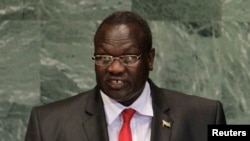
FILE - South Sudan's former vice president Riek Machar
Former South Sudan vice president Riek Machar says groups demanding the immediate cessation of hostilities are “jumping the gun,” insisting representatives of the two warring factions holding peace talks in Ethiopia need to agree on the mechanisms to end the conflict.
United Nations Secretary General Ban Ki-Moon has called for the prosecution of perpetrators of human rights violations in South Sudan, and some observers are calling for the International Criminal Court (ICC) to investigate and prosecute the perpetrators.
Machar also says he backs the prosecution of those who commit gross human rights abuses and crimes against humanity in South Sudan’s ongoing conflict. He blames President Salva Kiir for the ongoing conflict.
“Salva Kiir should go to the ICC,” said Machar. “He has targeted one ethnic group. He has embarked on ethnic cleansing resulting in the Juba massacre.”
The violence in South Sudan erupted after President Salva Kiir, a Dinka, accused former vice president Riek Machar, a Nuer, of attempting a coup. Macher, who is in hiding, denied the accusation.
“There was no coup d’état,” said Machar. “I am committed to a democratic process. It is Salva Kiir who did not want the democratic process in the party, nor does he want to go for the elections in 2015... There was no plan at all for a coup.”
South Sudan Displaced Could Reach 400,000: UN
1/9Displaced people who fled the recent fighting between government and rebel forces in Bor by boat across the White Nile, prepare to sleep in the open in the town of Awerial, South Sudan, Jan. 1, 2014.
Show moreShow less
2/9A young displaced boy rests on the wheel arch of a water truck while others fill containers from it, at a United Nations compound on the outskirts of Juba, the South Sudanese capital.
Show moreShow less
3/9Yared, 2, is held by mother Madhn who fled from the town of Bor a few days ago, as she receives medicine for her child at a Medecins Sans Frontieres (MSF) medical tent at a United Nations compound.
Show moreShow less
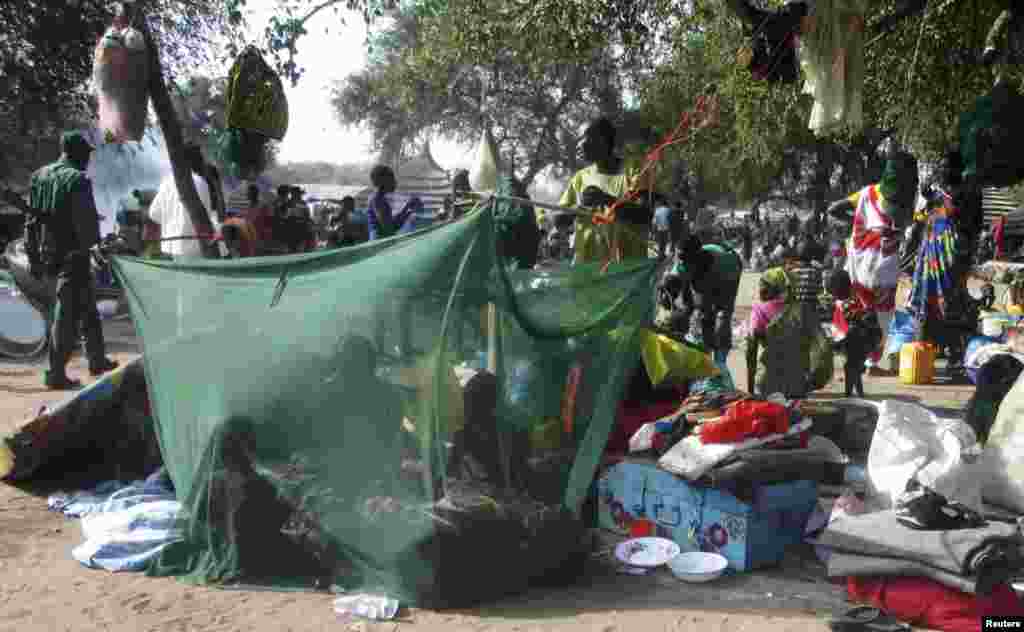
4/9Displaced people gather under a mosquito net tent as they flee from fighting between the South Sudanese army and rebels in Bor town, 180 km (112 miles) northwest from capital Juba December 30, 2013.
Show moreShow less
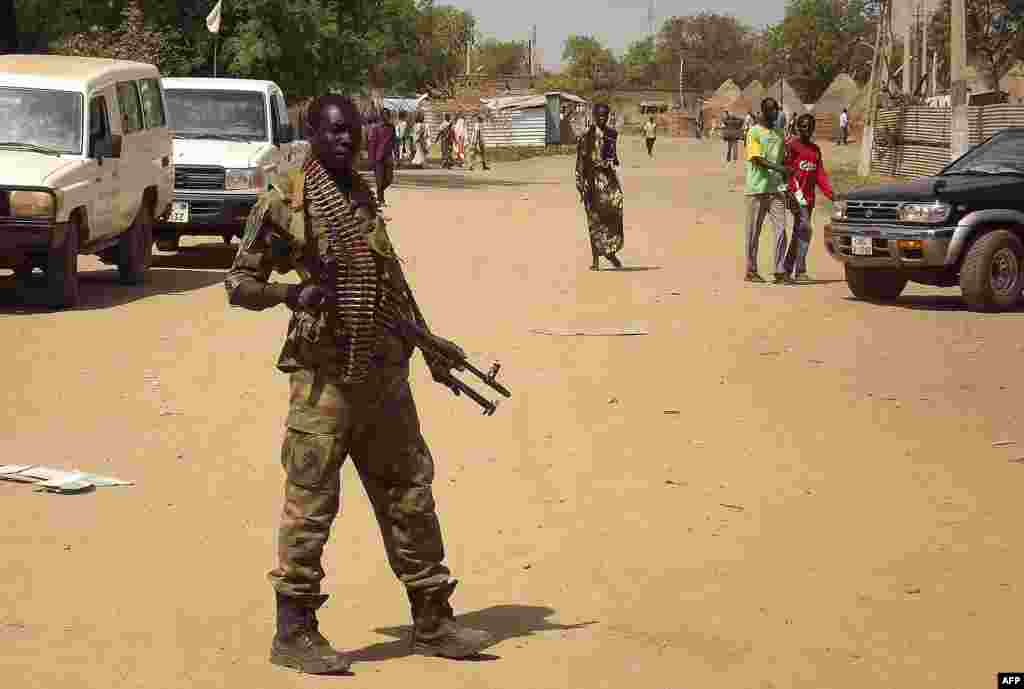
5/9A soldier from South Sudan's army stands guard in Malakal in the Upper Nile State of South Sudan, Dec. 31, 2013.
Show moreShow less
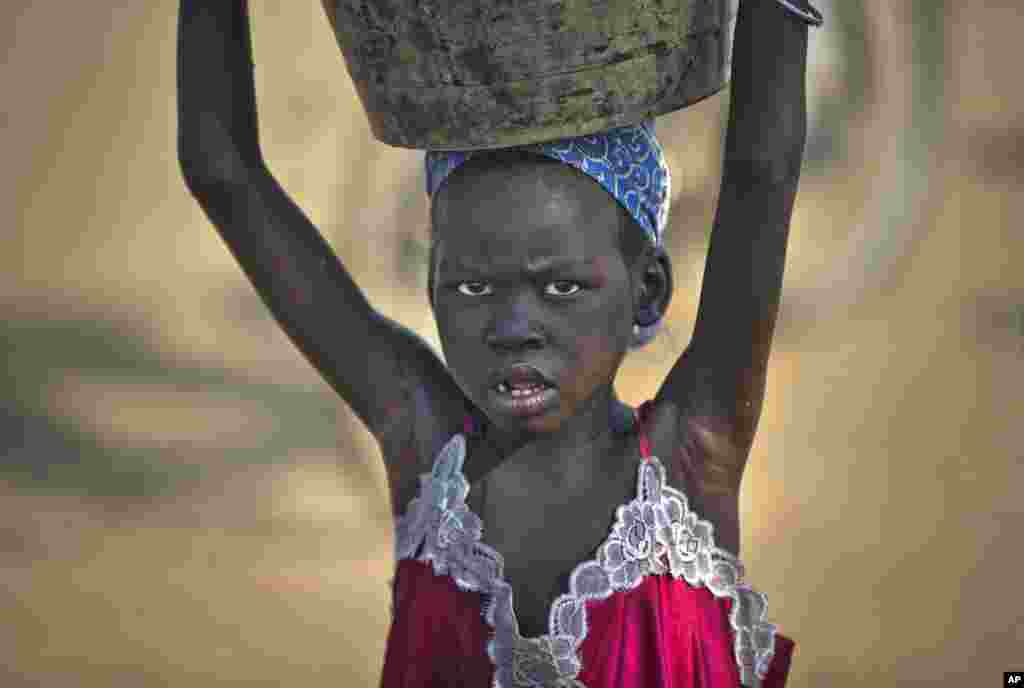
6/9A young displaced girl carries a bucket of water back to her makeshift shelter at a United Nations compound which has become home to thousands of people displaced by the recent fighting, in the Jebel area on the outskirts of Juba.
Show moreShow less
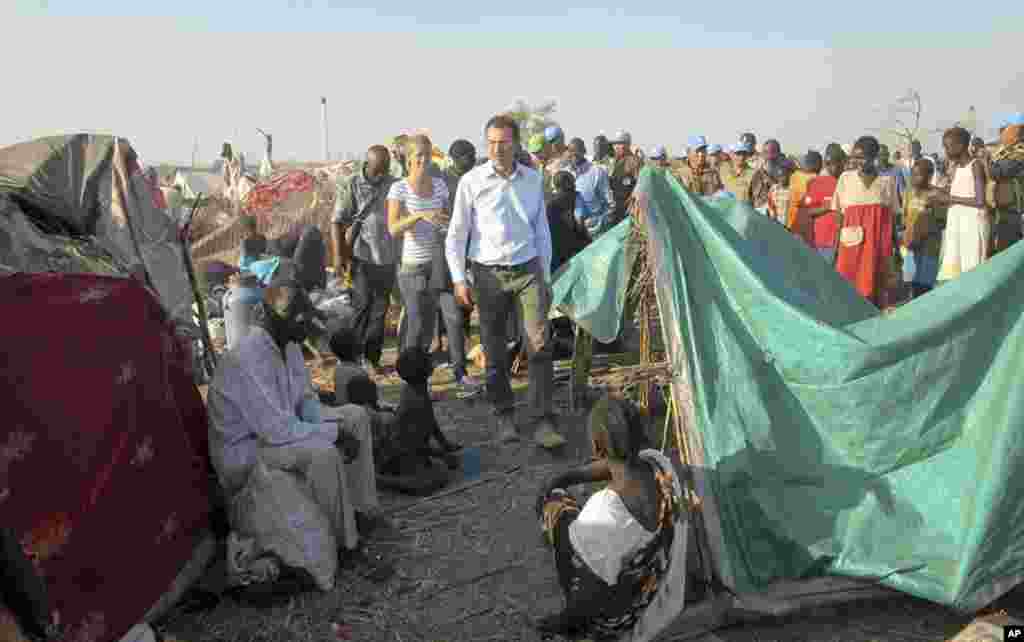
7/9The U.N.'s top humanitarian official in South Sudan, Toby Lanzer, assesses the situation at the U.N. compound where many displaced have sought shelter in Bentiu, Unity state, South Sudan, Dec. 24, 2013. (UNMISS)
Show moreShow less
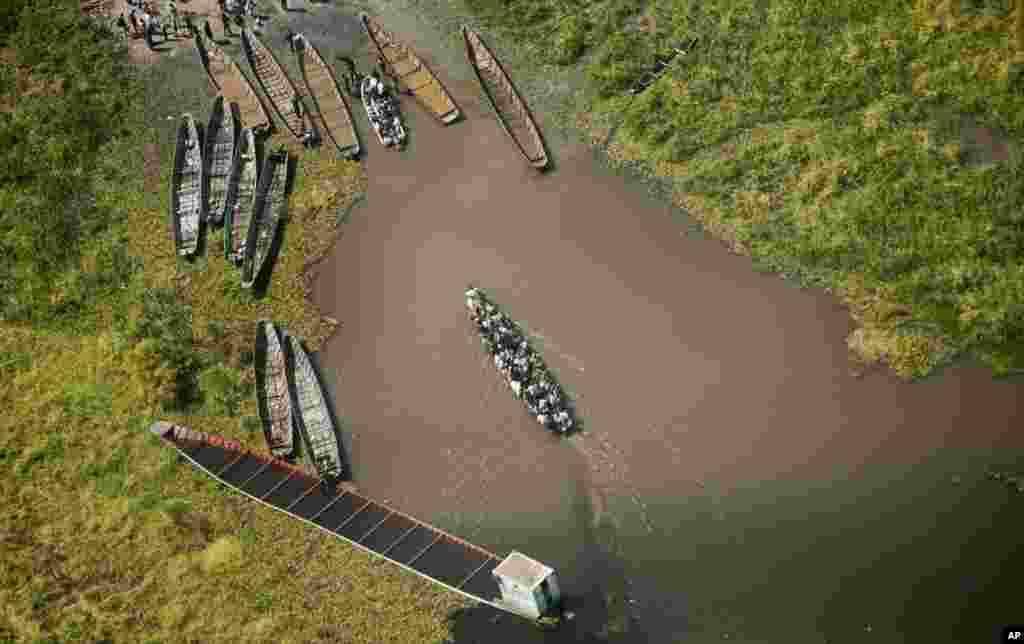
8/9A pirogue packed with passengers arrives at a dock after crossing a waterway near the town of Malakal, seen from an airplane over South Sudan, Dec. 30, 2013.
Show moreShow less
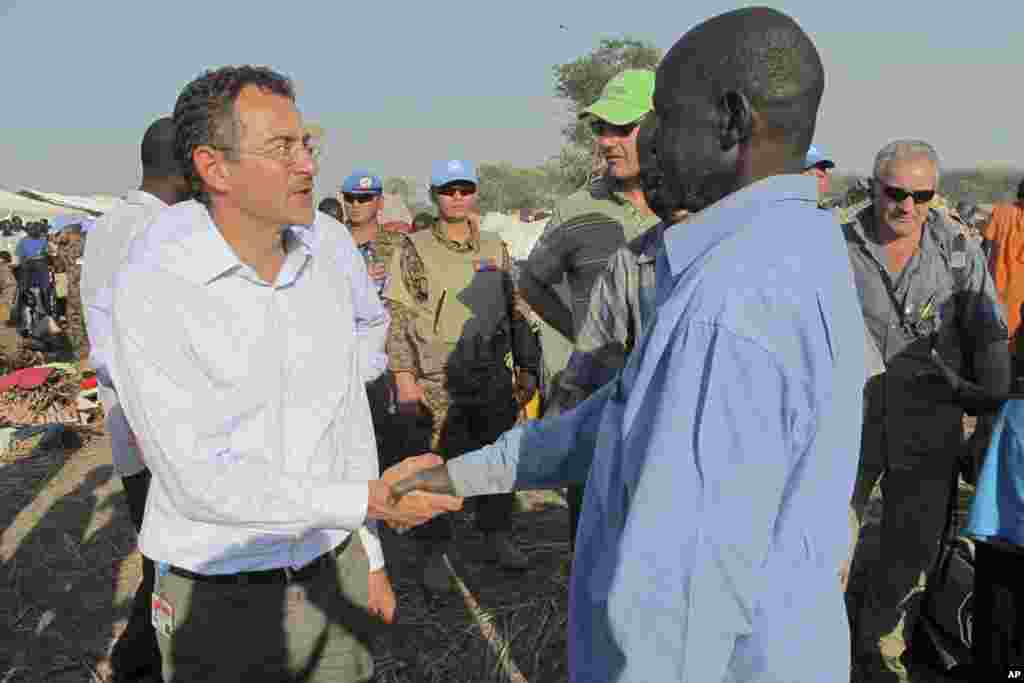
9/9U.N.'s top humanitarian official in the country Toby Lanzer, left, makes a visit to assess the humanitarian situation at the U.N. compound where many displaced have sought shelter in Bentiu, in oil-rich Unity state, in South Sudan, Dec. 24, 2013.
Show moreShow less
Previous slide
Next slide
Member states of the Intergovernmental Authority on Development (IGAD), the African Union and other international human rights groups have demanded a cessation of hostilities in South Sudan’s conflict.
But, Machar says measures including monitoring systems would have to be agreed upon by the two parties in order to ensure both sides adhere to the ceasefire calls.
“The two teams are in Addis [Ababa], they have not yet agreed on an agenda,” said Machar. “Normally, cessation of hostilities is agreed upon and a monitoring system for verification is also agreed upon. So those who are demanding it are jumping the gun. The negotiating teams need to agree on it.”
There are news reports that forces loyal to Machar are marching towards South Sudan’s capital, Juba. But, Machar says troops from the national army have also been heading towards areas under his control.
“There are troops that are allied to Salva Kiir that are marching northwards in an attempt to capture Bor. So, we definitely would match them and we would march southwards,” he said.
The African Union has called on both sides to create the space to enable humanitarian agencies to provided assistance to the victims of the violence. Machar says he agrees with the call.
“The areas which are under our control are open for humanitarian access so that people are served. We have said that publicly, that we would give access to all the humanitarian workers so that they can provide services to the people,” said Machar.