



Accessibility links

Breaking News
USA

Obama: Refugee Tide Is World's Problem

update
President Barack Obama, accompanied by Tech Sgt. Nathan Parry, takes a question from a service member in Afghanistan, on screen at center, during a town hall with service members at Fort Meade, Md., Sept. 11, 2015.

The current tide of refugees overrunning Europe is not just a European problem, “it is a world problem,” President Barack Obama told an audience of U.S. service members Friday.

The president, in a visit to Fort Meade, Maryland, marked the anniversary of the September 11, 2001, terror attacks by answering questions from service members around the world submitted via social media and satellite video.

Obama said the refugee topic would surely come up at the U.N. General Assembly session at the end of this month and that the leaders would “start coming up with a more effective structure for an international response. No one country can solve these problems alone.”

He added that NATO, as the premiere alliance in the world, would have to play a central role.

The president said the only way to solve the refugee crisis was to go to its source.

“There’s the old story about if you see a bunch of bodies floating down a river, part of your job is to pull those folks out and save who you can, but you’ve also got to go upstream and see what exactly is happening,” he said. The source of the refugee river, he said, is the collapse of governance in Syria and the growth of Islamic State.

Obama said the refugee problem would continue for decades because too many states are failing their peoples. In addition, he said, the spread of media gives people in war-torn or poor countries a vision of a better life.

“They are desperate and will take extraordinary risks to get there,” he said.

Watch related video report by Bernard Shusman

US Criticized On Refugee Crisis
please wait

No media source currently available

0:00 0:02:31 0:00

Other causes

Other factors, the president said, will result in even more migration and refugees — for example, climate change.

“I just came back from Alaska, where you're seeing glaciers melt rapidly. … People will be displaced from their traditional lands, either by drought or by flooding, and that can create more refugee problems,” he said.

Obama summed it up: “We’re going to have to work globally.”

Meanwhile, a group Democrats in the House of Representatives is calling on the president to accept 200,000 refugees during the next year. The number is 20 times the 10,000 refugees the president said Thursday that the U.S. would accept.

Seventy-three House Democrats signed a letter Friday, saying that accepting the larger number was the “right thing.”

The letter said, “It is our moral duty, as a nation founded on the principles of equality and freedom, to do what we can to assist our brethren who are in desperate turmoil, and searching for the slightest sign of goodwill.”

The president appeared to open the door a crack to the possibility of additional refugees Friday by telling his service member audience, “I said that we should establish a floor of at least 10,000 refugees that we’re willing to accept.”

A Macedonian border policeman opens a gate for the refugees and migrants to reach the southern Macedonian town of Gevgelija, Sept. 11, 2015. Hundred of thousands migrants and refugees trying to reach the heart of Europe via Turkey, Greece, the Balkans and

Relief groups' call

Some relief organizations have also urged the U.S. to do more.

In a Thursday statement, the International Refugee Committee said the U.S. was “fully equipped to respond in a far more robust way.”

A commitment to resettle 10,000 Syrian refugees is “barely a token contribution, given the size and scale of the global emergency,” said New York-based Human Rights First.

On the other hand, some U.S. lawmakers have voiced concerns about a Syrian refugee influx.

Obama wants to “surge thousands of Syrian refugees” into the United States despite intelligence and law enforcement warnings that “we do not have the intelligence needed to vet individuals from the conflict zone,” said Representative Michael McCaul, a Texas Republican who is chairman of the Homeland Security Committee.

Senator Marco Rubio of Florida, a Republican presidential candidate, said he was open to the possibility of admitting more Syrian refugees but was concerned that individuals with terrorist ties could slip in.

The United States has accepted a total of about 1,600 refugees from Syria since the start of the country’s crisis in 2011.

Europe's Migrant Crisis - September 11, 2015

The sun rises as refugees and migrants walk to pass from the northern Greek village of Idomeni to southern Macedonia, Sept. 11, 2015. The sudden onset of autumn has taken tens of thousands by surprise all along the Balkans route from Greece to Hungary.
1/10 The sun rises as refugees and migrants walk to pass from the northern Greek village of Idomeni to southern Macedonia, Sept. 11, 2015. The sudden onset of autumn has taken tens of thousands by surprise all along the Balkans route from Greece to Hungary.
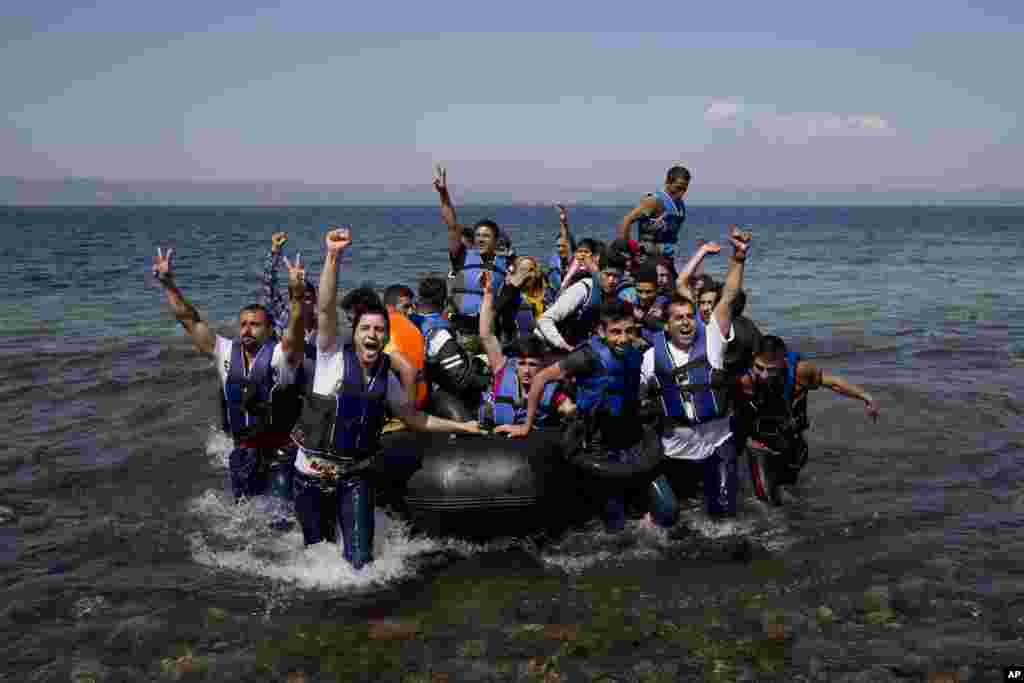
Refugees and migrants react as they arrive on a dinghy from Turkey to Lesbos island, Greece. The flow of migrants across the Mediterranean from Syria, Iraq, Aghanistan and Eritrea has hit record proportions this year.
2/10 Refugees and migrants react as they arrive on a dinghy from Turkey to Lesbos island, Greece. The flow of migrants across the Mediterranean from Syria, Iraq, Aghanistan and Eritrea has hit record proportions this year.
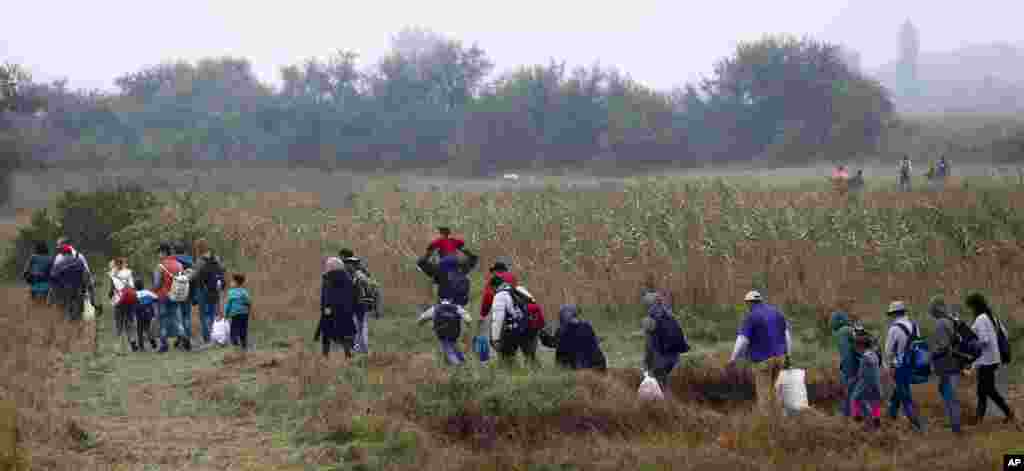
A group of migrants make their way through fields and meadows in the early morning after crossing the Serbian-Hungarian border near Roszke, southern Hungary.
3/10 A group of migrants make their way through fields and meadows in the early morning after crossing the Serbian-Hungarian border near Roszke, southern Hungary.
Iraqi refugee Umm Fadil, tends to her crying son, while resting by a railway track after they crossed the Serbian-Hungarian border near Roszke, southern Hungary. EU officials and human rights groups say they've been disappointed by the animosity toward asylum-seekers in countries from which hundreds of thousands of people fled communist dictatorships just decades ago.
4/10 Iraqi refugee Umm Fadil, tends to her crying son, while resting by a railway track after they crossed the Serbian-Hungarian border near Roszke, southern Hungary. EU officials and human rights groups say they've been disappointed by the animosity toward asylum-seekers in countries from which hundreds of thousands of people fled communist dictatorships just decades ago.
A Macedonian border policeman opens a gate for migrants to reach the southern Macedonian town of Gevgelija. Hundred of thousands migrants and refugees trying to reach the heart of Europe via Turkey, Greece, the Balkans and Hungary have faced dangers, difficulties and delays on every link of the journey.
5/10 A Macedonian border policeman opens a gate for migrants to reach the southern Macedonian town of Gevgelija. Hundred of thousands migrants and refugees trying to reach the heart of Europe via Turkey, Greece, the Balkans and Hungary have faced dangers, difficulties and delays on every link of the journey.
Czech Republic's FM Lubomir Zaoralek, left, talks to Hungarian FM Peter Szijjarto during a press conference as the Visegrad Group foreign ministers meet their counterparts from Germany and Luxembourg to talk about the current migration crisis in Prague, Czech Republic.
6/10 Czech Republic's FM Lubomir Zaoralek, left, talks to Hungarian FM Peter Szijjarto during a press conference as the Visegrad Group foreign ministers meet their counterparts from Germany and Luxembourg to talk about the current migration crisis in Prague, Czech Republic.
Hungarian workers build a partially constructed fence at their border with Serbia near Roszke. Hungary has been widely criticized for its treatment of refugees, compared to Germany and Austria.
7/10 Hungarian workers build a partially constructed fence at their border with Serbia near Roszke. Hungary has been widely criticized for its treatment of refugees, compared to Germany and Austria.
Migrants walk on the highway A4 toward Vienna after crossing the Hungarian-Austrian border near Nickelsdorf, Austria.
8/10 Migrants walk on the highway A4 toward Vienna after crossing the Hungarian-Austrian border near Nickelsdorf, Austria.
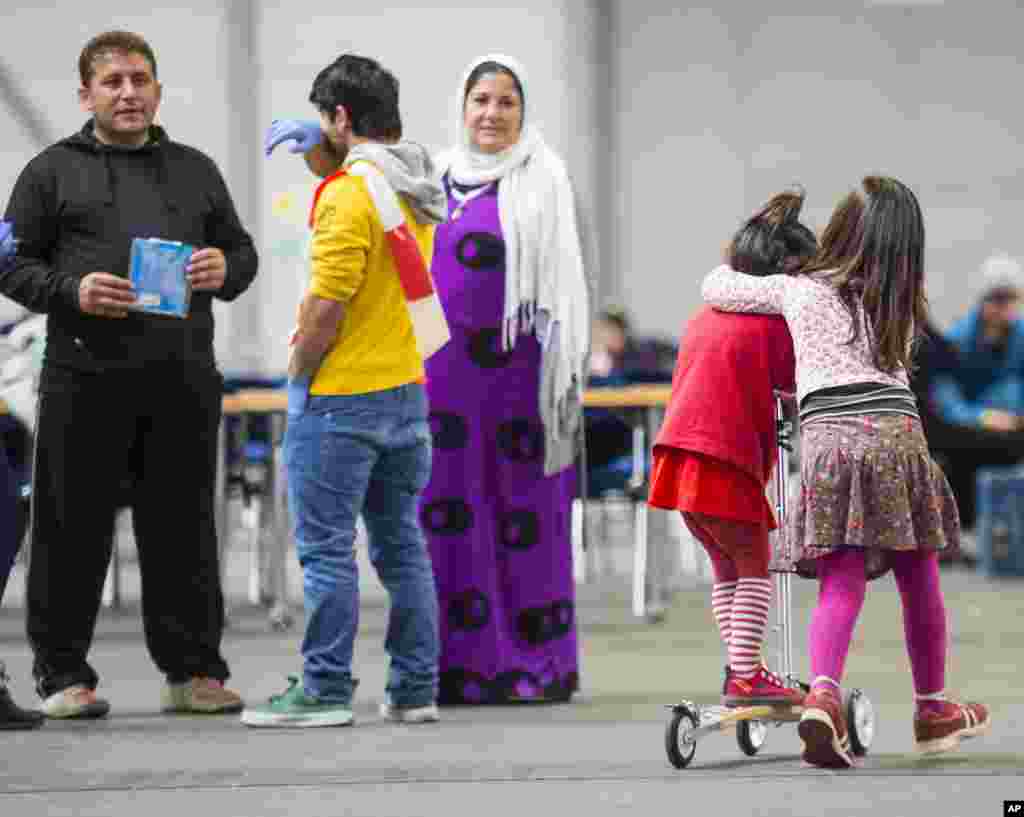
Childrens play in the accommodation, at the exhibition halls of the trade fair Messe Erfurt, in Erfurt, central Germany. More than 700 refugees are living there at the moment.
9/10 Childrens play in the accommodation, at the exhibition halls of the trade fair Messe Erfurt, in Erfurt, central Germany. More than 700 refugees are living there at the moment.
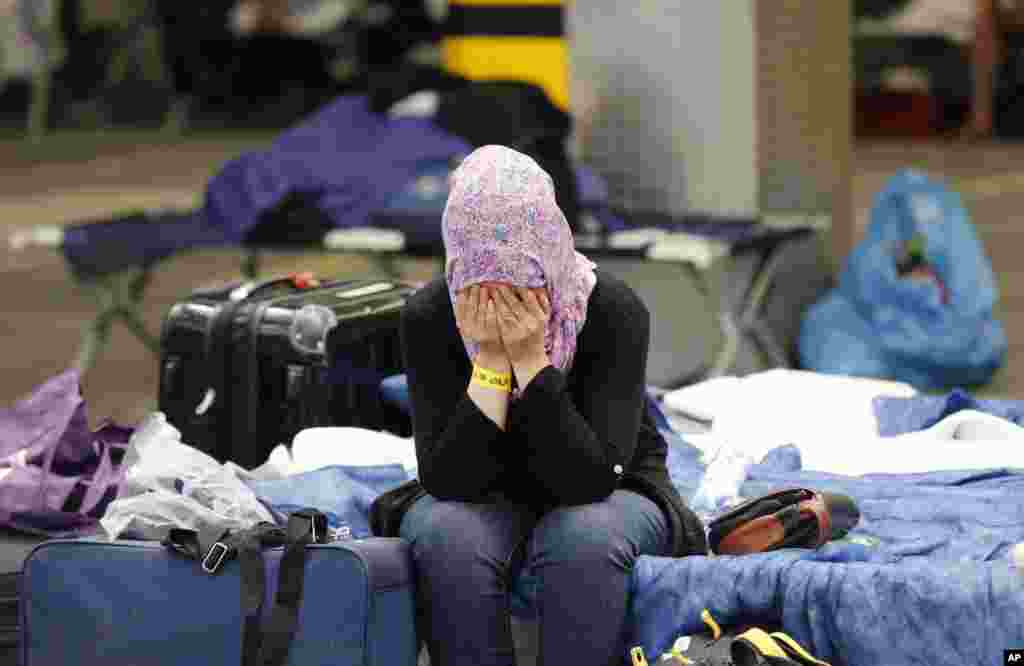
A migrant woman covers her face as she sits on her bed at a first registration point for refugees in Neu Isenburg, Germany.
10/10 A migrant woman covers her face as she sits on her bed at a first registration point for refugees in Neu Isenburg, Germany.
Previous slide
Next slide

XS
SM
MD
LG