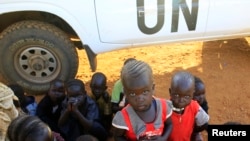
Children of displaced families are seen camped inside Tomping U.N. base near Juba international airport, Dec. 24, 2013.
JUBA —
As the United Nations moves to deploy more peacekeepers to South Sudan, witnesses say the country is slipping toward civil war. The political conflict between President Salva Kiir and his former vice president has laid bare ethnic tensions that could potentially tear apart the world's newest country.
The chaos in South Sudan is evident at the airport in the capital, Juba, where it is standing room only as people push and shove, trying to secure a seat on a plane that will take them out of the country.
Out on the streets, it is quiet, but a few hundred meters away at a United Nations peacekeeping base, 10,000 people are hiding from violence that only started 10 days ago but has spread across the nation like a cancer.
For Bang Teny, what started as a political struggle in the world's newest country has turned into another internal war, in a country that raised its own flag only two years ago after fighting Sudan for decades.
South Sudan's Peace Talks Open in Ethiopia
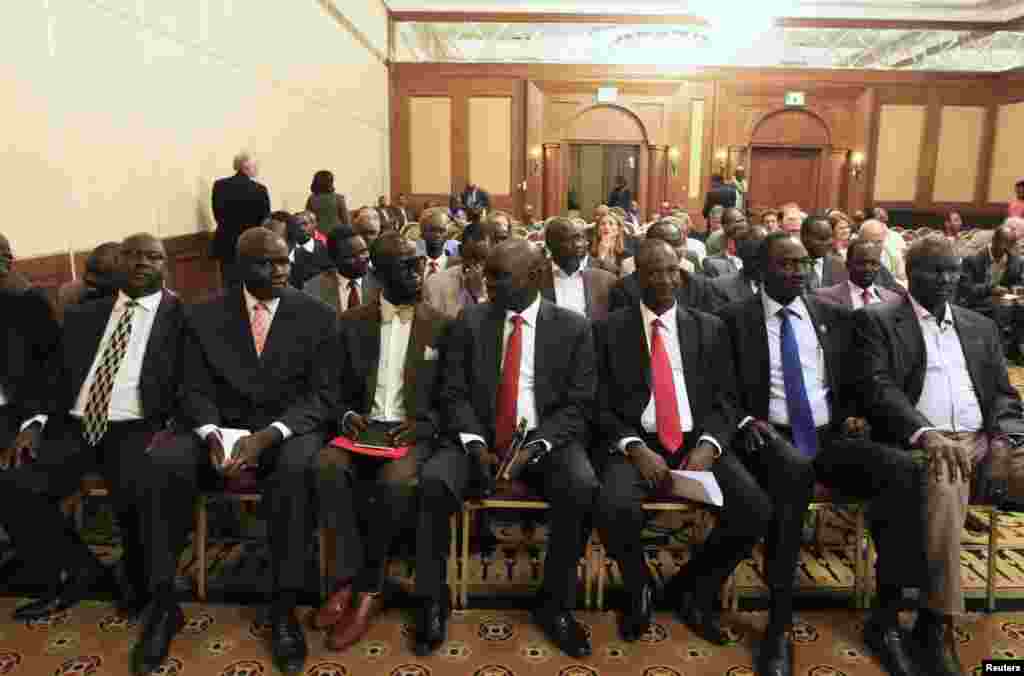
1/12Members of the South Sudan rebel delegation attend the opening ceremony of South Sudan's peace negotiations, Addis Ababa, Ethiopia, January 4, 2014.
South Sudan's warring factions have opened peace talks in Ethiopia, as violence continues in at least two regions of South Sudan.The two sides begin face-to-face negotiations Sunday, January 5, 2014 in Addis Ababa following days of delays.
Show moreShow less
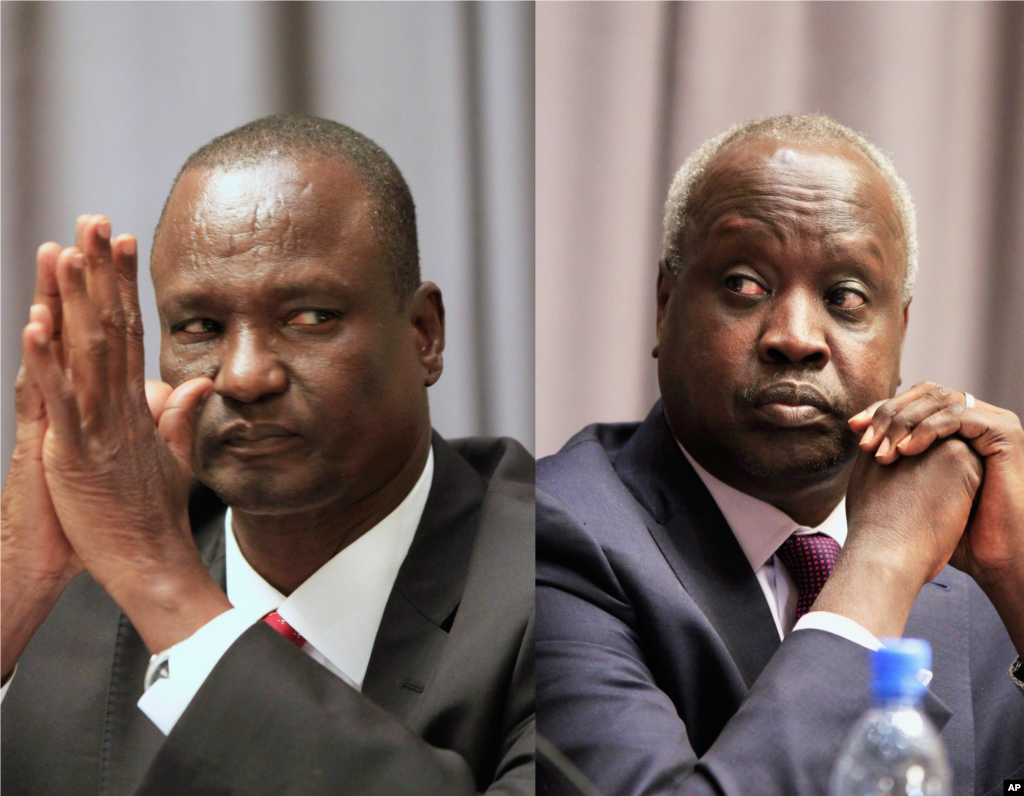
2/12Taban Deng Gai, left, head of the rebel delegation and South Sudan's leader of the government delegation, Nhial Deng Nhial, attend the opening ceremony of South Sudan's peace negotiations, Addis Ababa, Ethiopia, January 4, 2014.
South Sudan's warring factions have opened peace talks in Ethiopia, as violence continues in at least two regions of South Sudan.The two sides begin face-to-face negotiations Sunday, January 5, 2014 in Addis Ababa following days of delays.
Show moreShow less
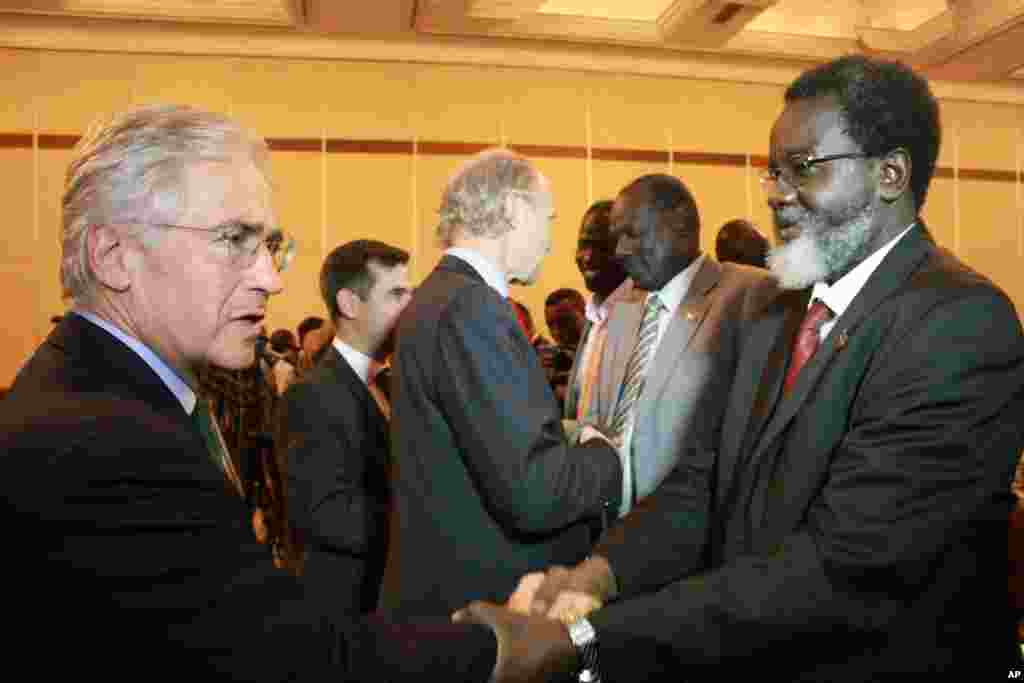
3/12Unidentified members of the delegation from the South Sudan government and western observers meet at the Sheraton Hotel, Addis Ababa, Ethiopia, January 4, 2014.
South Sudan's warring factions have opened peace talks in Ethiopia, as violence continues in at least two regions of South Sudan.The two sides begin face-to-face negotiations Sunday, January 5, 2014 in Addis Ababa following days of delays.
Show moreShow less
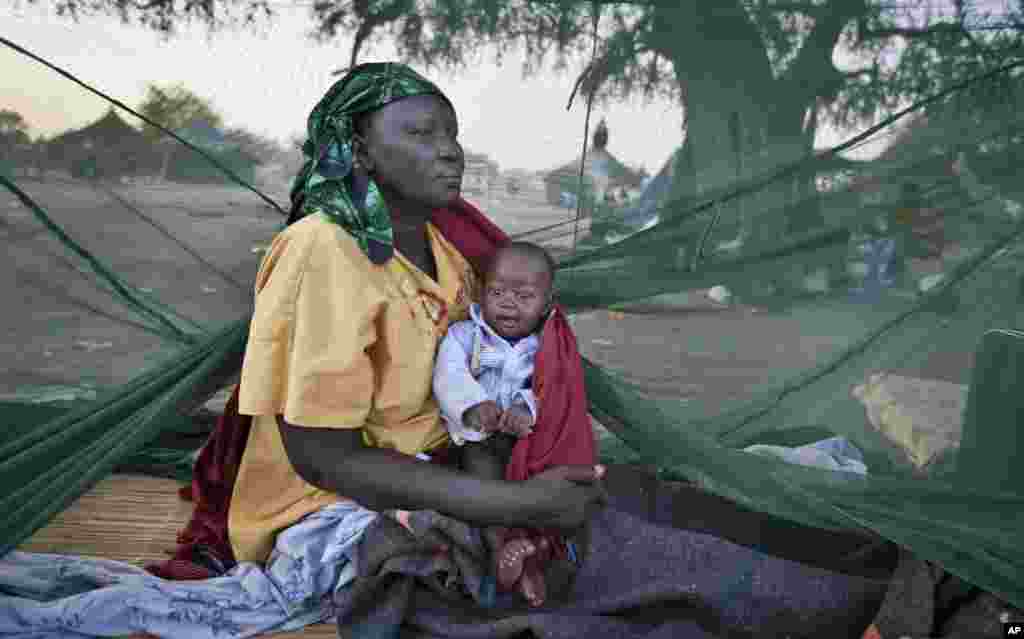
4/12A displaced mother and her baby, one of the few to have a mosquito net, wake up at a refugee camp, Awerial, South Sudan, Jan. 2, 2014.
South Sudan's warring factions have opened peace talks in Ethiopia, as violence continues in at least two regions of South Sudan.The two sides begin face-to-face negotiations Sunday, January 5, 2014 in Addis Ababa following days of delays.
Show moreShow less
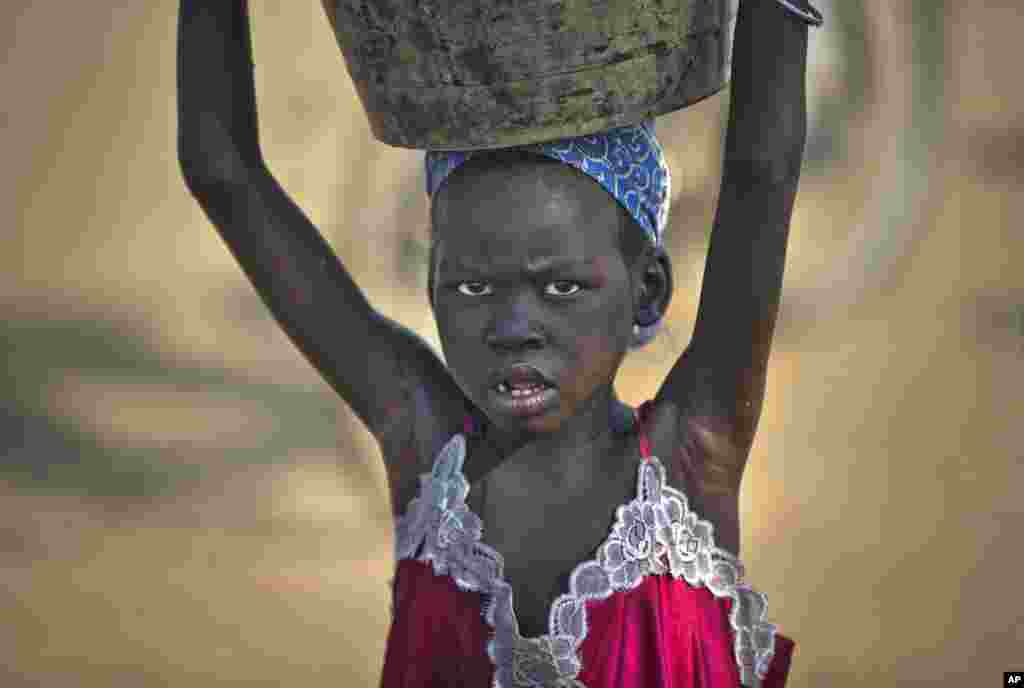
5/12A young displaced girl carries a bucket of water back to her makeshift shelter at a United Nations compound. The compound has become home to thousands of people displaced by the recent fighting, Juba, South Sudan, Dec. 31, 2013.
South Sudan's warring factions have opened peace talks in Ethiopia, as violence continues in at least two regions of South Sudan.The two sides begin face-to-face negotiations Sunday, January 5, 2014 in Addis Ababa following days of delays.
Show moreShow less
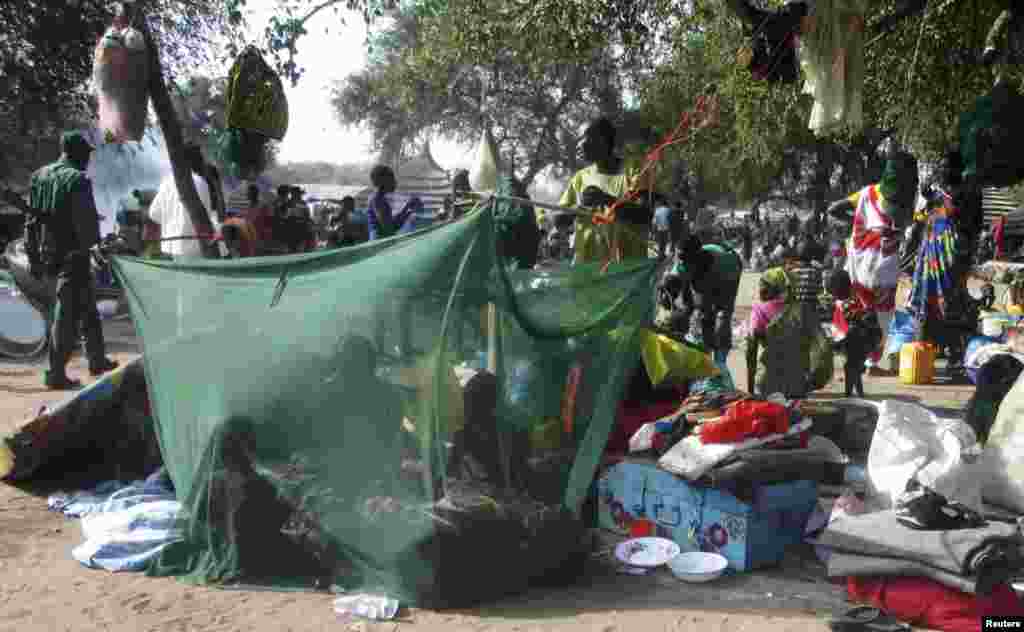
6/12Displaced people gather inside a mosquito net tent as they flee from the fighting between the South Sudanese army and rebels in Bor town, in Juba, South Sudan, Dec. 30, 2013.
South Sudan's warring factions have opened peace talks in Ethiopia, as violence continues in at least two regions of South Sudan.The two sides begin face-to-face negotiations Sunday, January 5, 2014 in Addis Ababa following days of delays.
Show moreShow less
7/12A displaced woman hangs up laundry on the plastic sheeting wall of a latrine at a United Nations compound, Juba, South Sudan, Dec. 31, 2013.
South Sudan's warring factions have opened peace talks in Ethiopia, as violence continues in at least two regions of South Sudan.The two sides begin face-to-face negotiations Sunday, January 5, 2014 in Addis Ababa following days of delays.
Show moreShow less
8/12Yared, 2, is held by his mother, Madhn, who fled from the town of Bor a few days ago. She receives medicine for her child at a Medecins Sans Frontieres (MSF) medical tent, at a United Nations compound, Juba, South Sudan, Dec. 31, 2013.
South Sudan's warring factions have opened peace talks in Ethiopia, as violence continues in at least two regions of South Sudan.The two sides begin face-to-face negotiations Sunday, January 5, 2014 in Addis Ababa following days of delays.
Show moreShow less
9/12A young displaced boy rests on the wheel arch of a water truck while others fill containers from it, at a United Nations compound, Juba, South Africa, Dec. 31, 2013.
South Sudan's warring factions have opened peace talks in Ethiopia, as violence continues in at least two regions of South Sudan.The two sides begin face-to-face negotiations Sunday, January 5, 2014 in Addis Ababa following days of delays.
Show moreShow less
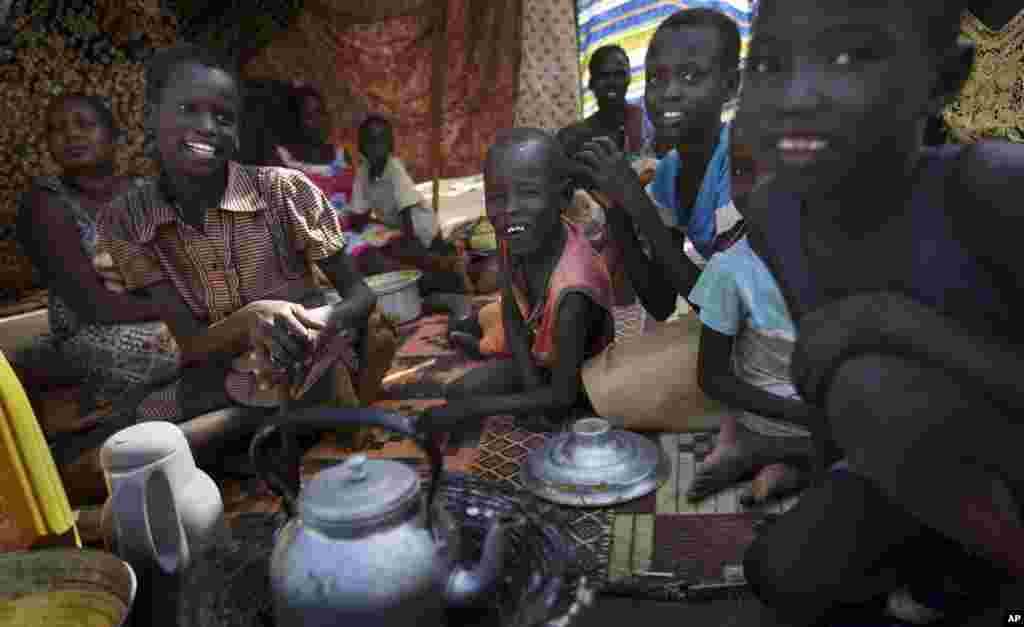
10/12A family makes tea outside their makeshift shelter at a United Nations compound, Juba, South Sudan, Dec. 31, 2013.
South Sudan's warring factions have opened peace talks in Ethiopia, as violence continues in at least two regions of South Sudan.The two sides begin face-to-face negotiations Sunday, January 5, 2014 in Addis Ababa following days of delays.
Show moreShow less
11/12A general view of a camp for displaced people set up in a United Nations compound in Bor, South Sudan, Dec. 25, 2013.
South Sudan's warring factions have opened peace talks in Ethiopia, as violence continues in at least two regions of South Sudan.The two sides begin face-to-face negotiations Sunday, January 5, 2014 in Addis Ababa following days of delays.
Show moreShow less
12/12South Sudan army soldiers hold their weapons as they ride on a truck in Bor, Dec. 25, 2013.
South Sudan's warring factions have opened peace talks in Ethiopia, as violence continues in at least two regions of South Sudan.The two sides begin face-to-face negotiations Sunday, January 5, 2014 in Addis Ababa following days of delays.
Show moreShow less
Previous slide
Next slide
The core of the struggle is the rivalry between the country's two main ethnic groups -- the Dinka and Nuer. The violence spread from the presidential guard to many divisions of the army. In short order, gunmen began to target civilians along tribal lines.
Bang was among those seeking refuge at the U.N. compound.
“There was an incident that we all know of, and for whatever reason, it did not extend from the political parties, it extends to who you are, based on your tribe. I came to this U.N. compound two hours ago, fearing for my life. I know a lot of friends who were picked up based on their tribe, and once you are picked up, you will never be seen again,” said Bang.
Bang is half Dinka and half Nuer, but says that the Nuer ceremonial scarring on his forehead - four deep lines carving out a boy's transition to manhood - mean that he and many others have been targeted by Dinka forces in the capital Juba.
“When you have a mark like myself, they will pick you up. It doesn't matter whether it's day or night, but usually most of the lynching is done at night, they will pick you up and your family will never see you again,” said Teny.
Only traces of life
In abandoned neighborhoods across the city, the only traces of life are half-eaten meals, broken chairs, and pairs of shoes lying outside mud houses and tin shops that have been burgled and vandalized.
The capital's residents say that men with guns come during the night, followed by trucks to pick up the dead bodies.
Sprawled on a mattress in the dirt, a man by the name of Simon said that he and some 250 others were picked up one evening at 8 p.m. local time. He said that they were taken to a police building in a busy suburb, and over the course of two days, shot at through the windows by policemen and soldiers.
Simon said he is one of 12 survivors rescued by national intelligence services. He kept silent despite suffering from four gunshot wounds and being surrounded by decaying corpses.
"I had a bad feeling,” he said. “To survive you had to cover yourself with the bodies. During the two days, the bodies of the killed people were smelling too bad. I can't talk too much about it,” said Simon.
In another part of the U.N. base, a man named Gatchuak is nursing three bullet wounds and has one arm in a sling. He said he was another survivor of the same incident.
“This is one bullet, this one a bullet and this one a bullet, and my left hand side is broken,” he said pointing to parts of his body. “I'm a civilian. We were captured in Gudele one, with the number of around 275 people, we remain 12 people. The rest were all killed.”
Nuer offensive
Last week, ethnic militias belonging to a Nuer sub-clan stormed a U.N. base in Jonglei state, killing two U.N. peacekeepers, wounding another and killing at least 11 Dinka civilians.
Nuer armies fighting under defected commanders or renegade political leaders are on the offensive, having seized two state capitals over the past week, and sending hundreds of thousands of people fleeing to the bush.
United Nations agencies are struggling to provide aid and protection, said the U.N.'s local humanitarian chief, Toby Lanzer.
“I think that some people might not have realized so far is that this really does go across all of the communities. All communities are being affected at the moment, and everyone has a part to play in making sure that people are safe,” said Lanzer.
The U.N. Security Council vote on Tuesday will boost the peacekeeping force in South Sudan to nearly 14,000. But unless a political deal is reached and leaders call for calm among communities, the country could soon find itself split along ethnic lines.