Moscow’s Muslim Community Defined by Street Prayers, Pogroms
MOSCOW —
Moscow is now home to 2 million Muslims - more than any other city in Europe.
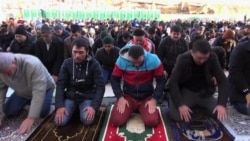
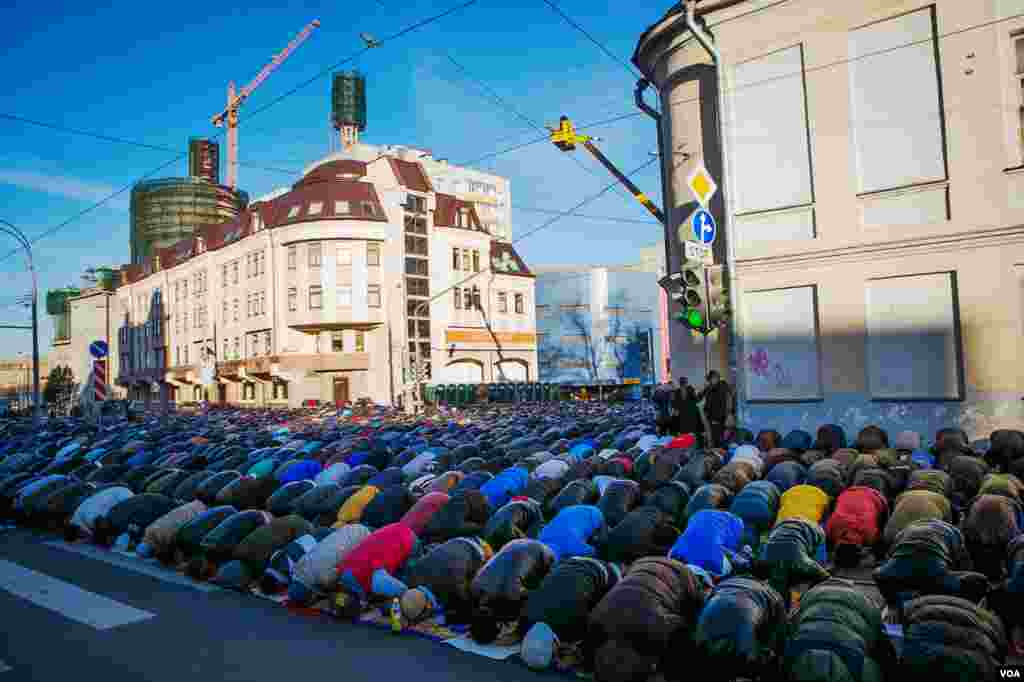
So when the faithful gathered Tuesday for the start of the Eid al-Adha holiday, tens of thousands of men unrolled their prayer mats on the asphalt of Moscow’s streets. Last year, they prayed outside in rain and snow.
Looming overhead were the new minarets of the Moscow Cathedral Mosque, a century-old mosque that is now being expanded. It is one of only four mosques in all of Moscow.
“Certainly mosques are needed. Mosques are needed in each micro-district,” said Abdul Bari Sultanov, a Russian Muslim from Tatarstan, a historically Muslim region, after prayers Tuesday. “As well as madrassas, schools, imams so that people would be morally prepared for meeting their God.”
The Russian Orthodox Church is building 200 new churches around Moscow. In contrast, new mosque projects never win building permits.
Russian Muslim activist Geydar Dzhemal claims that the Kremlin blocks new mosques in Russia’s capital.
“They understand the politics of suppression -- direct suppression,” said Dzhemal, who has criticized Moscow’s policy on Islam since the Soviet days. “And they don't understand that this will create problems for themselves much worse then those they are trying to understand now.”
Moscow Mayor Sergei Sobyanin has vowed that no new mosques will be built in Moscow. He claims that the Muslims praying in streets on holidays are largely Central Asians, guest workers who will eventually go home.
“It has turned out that the praying Muslims are not at all Russian citizens and they are not Moscow residents,” Sobyanin recently told Ekho Moskvi. “They are labor migrants. There are only 10 percent of Moscow residents among them and building mosques for everyone who wants it - I think this will be over the top,” continued the mayor.
“Muscovites now get irritated by people who speak a different language, have different manners, with aggressive behavior,” he added.
Sobyanin, a Kremlin ally, won last month’s mayoral elections. He seems to know what voters are thinking. On Sunday, Slavic residents in a working class Moscow neighborhood rioted against Central Asians and Caucasians. “Russia Forward! Russia Forward!” they chanted.
The spark that set off the incident was the stabbing death last week of a young Slavic Russian man. An immigrant from Azerbaijan was arrested in the case on Tuesday.
Moscow's Muslims Mark Eid al-Adha
1/11Moscow has one mosque for 500,000 Muslims. On religious holidays, like Eid Al-Adha, tens of thousands of faithful pray in streets specially blocked off near mosques, Moscow, Oct. 15, 2013. (Vera Undritz for VOA)
Show moreShow less
2/11Police line a pedestrian tunnel connecting Prospect Mira (Peace Avenue) Metro station and the Cathedral Mosque area, Moscow, Oct. 15, 2013. (Vera Undritz for VOA)
Show moreShow less
3/11Vendors sell colorful, durable mats for praying on the pavement in Moscow, Oct. 15, 2013. (Vera Undritz for VOA)
Show moreShow less
4/11Twin minarets of Moscow's new Cathedral Mosque rise over the green painted madrassa, a religious school which dates to the original construction in 1904. (Vera Undritz for VOA)
Show moreShow less
5/11Some men arrived as early as 2 am for prayers that started at sunrise -- 8 am in Moscow, Oct. 15, 2013. (Vera Undritz for VOA)
Show moreShow less
6/11Tens of thousands of faithful occupied almost every corner of Schepina Street, near the Cathedral Mosque in Moscow, Oct. 15, 2013. (Vera Undritz)
Show moreShow less
7/11Vendors sell prayer beads and skull caps, Moscow, Oct. 15, 2013. (Vera Undritz for VOA)
Show moreShow less
8/11Men pray in the streets of Moscow, Oct. 15, 2013. (Vera Undritz for VOA)
Show moreShow less
9/11Men complete their prayers on a closed street, Moscow, Oct. 15, 2013. (Vera Undritz for VOA)
Show moreShow less
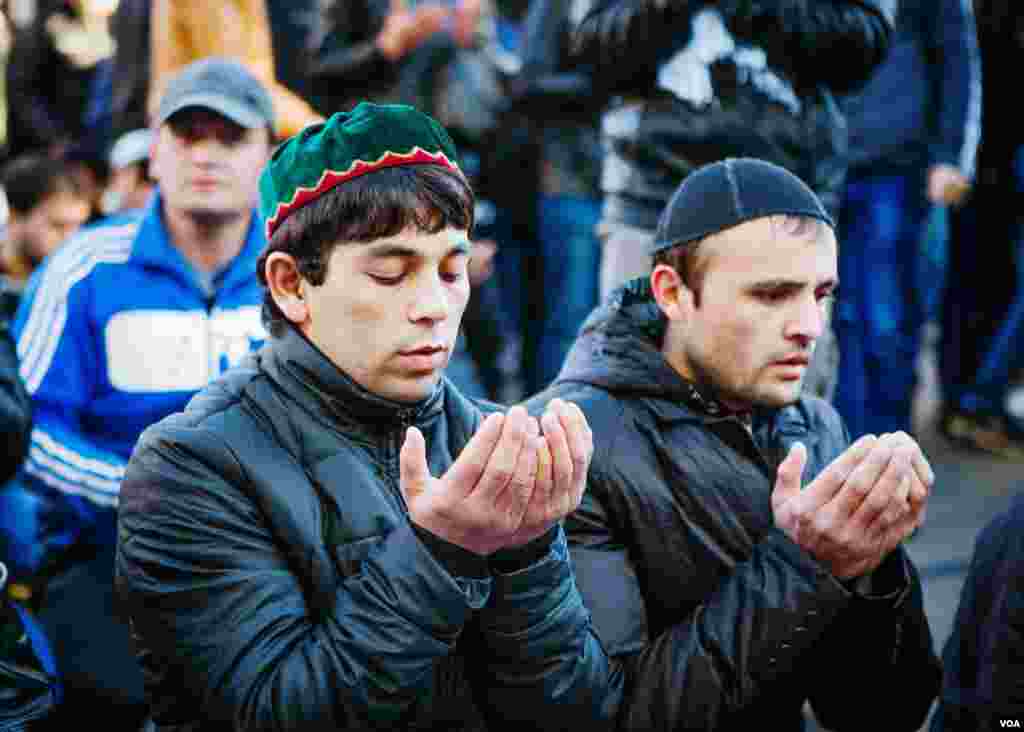
10/11A man completes his prayers on a closed street, Moscow, Oct. 15, 2013. (Vera Undritz for VOA)
Show moreShow less
11/11Blue construction workers barracks stand next to the concrete shell of the Cathedral Mosque which is to be completed by 2015, Moscow. (Vera Undritz for VOA)
Show moreShow less
Previous slide
Next slide
Analysts called the anti-immigrant riot a modern day pogrom. While police released most of the rioters, they detained 2,000 migrant workers for identity checks. Politicians called for banning apartment sales to foreigners and for imposing visa restrictions on migrants from the southern Muslim nations that only a generation ago were part of the Soviet Union.
After the collapse of the Soviet Union, Isolda Kukushkina moved to Moscow from Ukraine, a nation often seen as Russia’s cultural and religious cradle. On Tuesday, near the Moscow Cathedral, she looked at the rivers of Muslim men who flowed past her Orthodox Church, dedicated to St. Philip and worried about Moscow’s future.
“It will be Muslim, I am afraid,” she said. “Believe me I like them, but Moscow must be Slavic. It should be somehow balanced. But this influx of immigrants influences our life in a bad way,” said Kukushkina.
For now, Moscow’s future is playing out on the streets, defined by prayers - and pogroms.