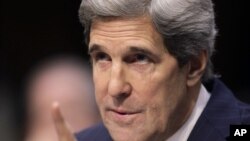
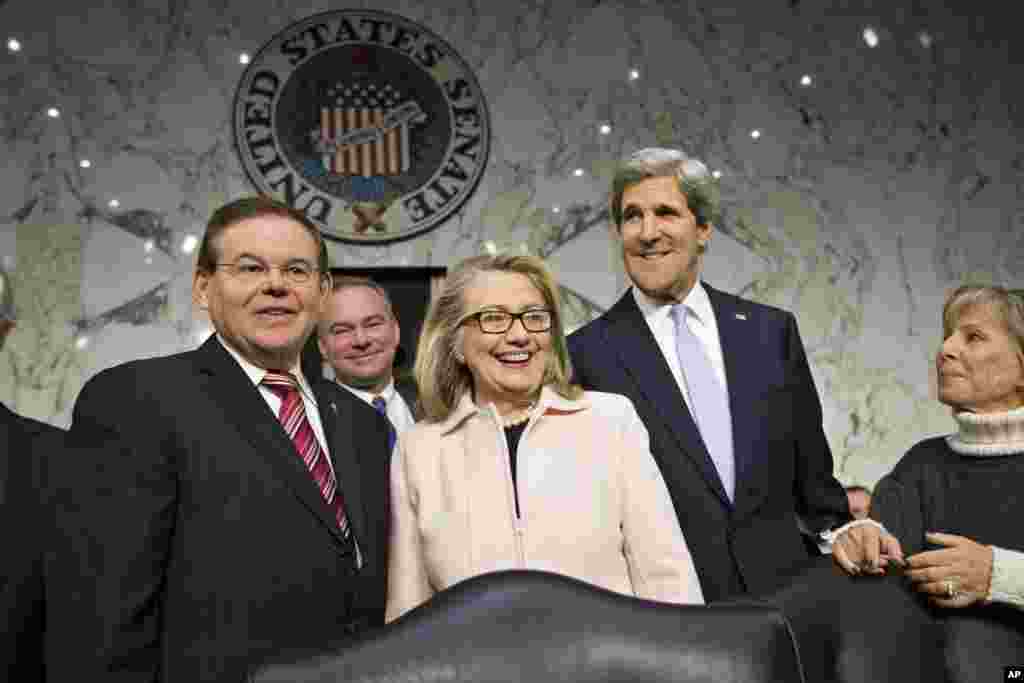
The nominee to be the United States' next top diplomat, John Kerry, turned some heads Thursday when he appeared to criticize parts of one of the Obama administration's key foreign policy objectives: the U.S. pivot toward Asia.
Kerry, who is almost certain to succeed Secretary of State Hillary Clinton when she steps down later this year, told a Senate confirmation hearing he is "not convinced that a military ramp-up is critical yet" in Asia, saying it may unnecessarily offend China. "We have a lot more forces out there than any other nation in the world, including China," he said. "And the Chinese take a look at that and say, 'What's the United States doing? Are they trying to circle us?' I think we need to be thoughtful in how we go forward."
Since President Barack Obama announced his so-called "pivot" toward the region in late 2011, Australia, the Philippines, Singapore and other countries in the Asia-Pacific have seen an increase in U.S. equipment, troops and military cooperation.
Administration officials, who now usually refer to the shift as a "rebalancing" rather than a "pivot," insist they are not trying to contain China's rising power. But many in Beijing remain unconvinced, contending they are being increasingly cornered by U.S. allies.
Some analysts say it is significant that Kerry is acknowledging those concerns. But it is not clear whether it could amount to a change in strategy for the administration, which views the pivot as a signature foreign policy of its first term.
Bonnie Glaser is a China expert at the Center for Strategic and International Studies in Washington. In an interview with VOA, she points out that it is the president, not the secretary of state, who decides military commitments.
"That does sound somewhat different from what the current secretary of defense [Leon Panetta] has been saying. But ultimately that is a decision that the president is going to have to make, about where our military commitments are going to be. The current position of the administration is to not draw down our military commitments in Asia," Glaser stated.
At his confirmation hearing, Kerry acknowledged as much, saying he does not suggest that the U.S. reduce its current force in Asia, and that there are legitimate reasons to be concerned about China's intentions.
But Stephen Lewis, a China scholar at Houston's Rice University, tells VOA it is important that U.S. officials recognize Chinese leaders perceive the pivot as a threat.
"It's an important point to be made, mainly because this is something that the Chinese government has always complained about," says Lewis, who adds that Chinese citizens are concerned about the pivot as well. "They see it as a legitimate point, that the United States seems to be opposing Chinese efforts to go overseas, whereas we actually do have a number of military bases overseas."
Lewis says Kerry's comments probably do not represent a fundamental change in U.S. policy. He points out that no other administration official has made similar comments.
Glaser, the analyst at CSIS, agrees. She says even though she does not think the U.S. policy is aimed at China, perceptions still matter. "I think that it is important for any secretary of state to be able to put him or herself in the shoes of another country in the world, and understand how that country views the United States," she said. "China has some concerns about the U.S. rebalancing strategy ... We need to understand that perception, that doesn't mean we need to agree with it."
Additional reporting by Victor Beattie
John Kerry
1/11Senator John Kerry emerges after a unanimous vote by the Senate Foreign Relations Committee approving him to become America's next top diplomat, January 29, 2013.
Show moreShow less
2/11Senate Foreign Relations Committee Chairman John Kerry arrives on Capitol Hill for the start of his confirmation hearing to replace Secretary of State Hillary Clinton, January 24, 2013.
Show moreShow less
3/11John Kerry sits before the Senate Foreign Relations Committee he has served on for 28 years and led for the past four as he seeks confirmation as U.S. secretary of state, January 24, 2013.
Show moreShow less
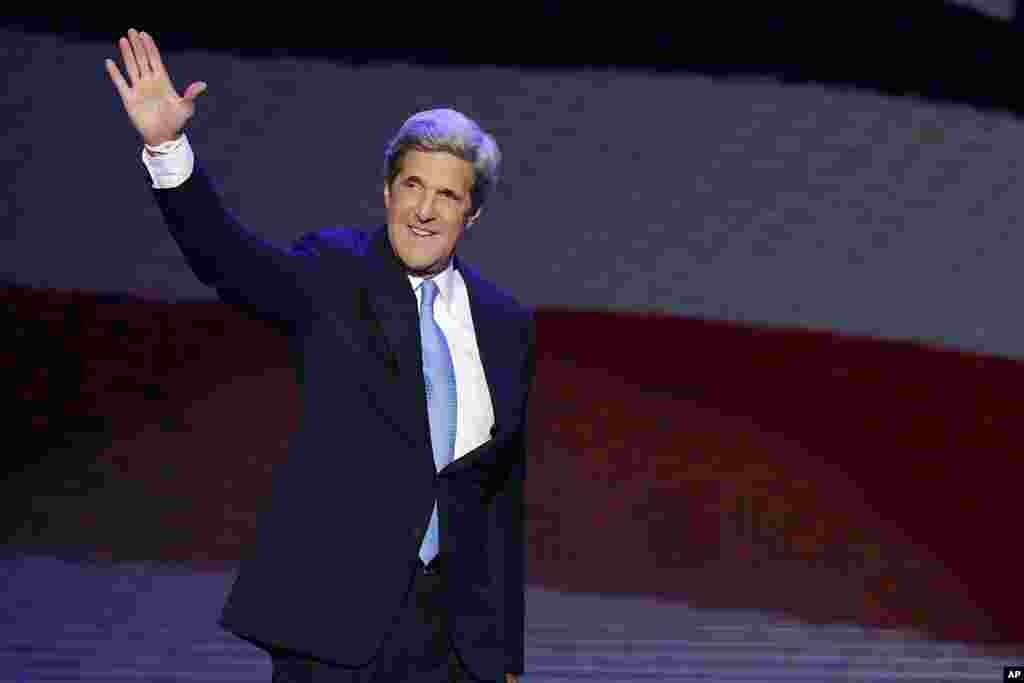
4/11John Kerry waves as he walks to the podium to address the Democratic National Convention in Charlotte, North Carolina, September 6, 2012.
Show moreShow less
5/11Barack Obama works the crowd during his first presidential campaign with John Kerry, during a rally at the College of Charleston campus in South Carolina, where Kerry endorsed Mr. Obama, January 10, 2008.
Show moreShow less
6/11Then-Democratic presidential candidate John Kerry points toward the audience beside his wife Teresa Heinz Kerry after the presidential debate in Tempe, Arizona, October 13, 2004.
Show moreShow less
7/11Then President George W. Bush and John Kerry greet each other at the end of their first presidential debate at the University of Miami in Coral Gables, Florida, September 30, 2004.
Show moreShow less
8/11John Kerry windsurfs off the coast of Nantucket, Massachusetts when he was the Democratic presidential candidate, August 30, 2004.
Show moreShow less
9/11Democratic presidential candidate John Kerry along with his wife Teresa Heinz Kerry greet supporters during a fundraiser when he was the Democratic presidential candidate in Boston, Massachusetts, 2003.
Show moreShow less
10/11Senator John Kerry is swarmed by supporters as he arrives for a re-election victory rally in Boston, Massachusetts, November 5, 1996.
Show moreShow less
11/11John Kerry raises his arms in victory in this November 6, 1984 photo in a Boston hotel where he celebrated his defeat over Ray Shamie, in the Senate race.