JERUSALEM —
Preliminary election results show Israel's right-wing and center-left blocs winning an even split of seats in parliament -- a surprise result that leaves Prime Minister Benjamin Netanyahu working to form a new ruling coalition.
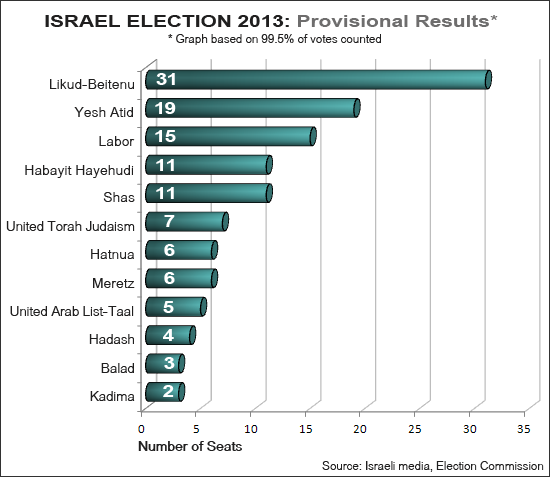
With more than 99 percent of the vote counted Wednesday, each side had 60 seats in the 120-member Knesset.
Netanyahu's hard-line Likud party alliance with the Yisrael Beitenu party led with 31 seats - 11 fewer than its 42 spots in the previous parliament.
The prime minister is expected to be asked to form a government, a task made more difficult by the unexpected success of centrist parties.
But the fallout is expected to be felt regionally as Israel will likely retain its hardline stance on Iran's controversial nuclear program and debate will continue over dormant talks with the Palestinians over the Mideast peace process.
Israel's major parties
Israel's Major Political Parties:
Likud: Israel's main conservative party; supports the Israeli settlement movement in the occupied West Bank
Yisrael Beitenu (Israel Our Home): Secular, nationalist party that wants to redraw borders so that parts of Israel with large Arab populations would be in a Palestinian state
Yesh Atid: Centrist party founded by former journalist Yair Lapid in 2012
Labor: Center-left party; supports renewing peace negotiations with the Palestinians and dismantling most Israeli settlements
Shas (Union of Sephardic Torah Observers): Represents Israel's ultra-orthodox Jews of Middle Eastern, Mediterranean and Spanish origin and advocates a nation based on Jewish religious law
Habayit Hayehudi (Jewish Home): Far-right party that advocates annexing more than half the West Bank and opposes the Oslo Peace Accords
The biggest surprise came from the secular Yesh Atid party, which won 19 seats, beating out the Labor Party's 17 seats and the 12 seats won by the far-right religious nationalist Jewish Home party.
Netanyahu claimed victory and vowed to form as broad a coalition as possible.
He told cheering supporters "the first challenge was and remains preventing Iran from obtaining nuclear weapons." He also said he hopes to "effect the kind of change the Israeli people are waiting for" with "the broadest government possible."
Nearly 67 percent of Israel's 5.5 million voters cast ballots Tuesday, a larger turnout than in previous elections. Some analysts say the turnout may have helped centrists gain traction and win legislative seats.
Regional fallout
Official tallies are expected next week but already the results are having a regional fallout.
Netanyahu is expected to retain the leading role in governing and analysts foresee little change in Israeli policies on security and major regional issues including his hardline stance on Iran.
“First, strong security in the face of the great challenges before us, and the first challenge was, and remains, preventing Iran from obtaining nuclear weapons,” he said.
That was echoed by Liliane Brunswich, who voted in Jerusalem's well-to-do German Colony. “I want our government to protect Israel,” she said.
Stalled peace process
Hebrew University political science professor Avraham Diskin said the lack of progress on ending the Israeli-Arab conflict polarized the electorate.
Talks have been stalled for months over several issues including the building of Israeli enclaves in largely-Palestinian environs.
"Something close to 70 percent of the voters believe in the two-state solution," Diskin said. "They support negotiations with the Palestinian Authority. But also 70 percent - not the same 70 percent - don't believe there is a chance to achieve a peaceful agreement."
Political commentator Danny Rubinstein said Israelis are worried too about the rise of Islamist leaders in neighboring countries amid the upheaval in the Arab world.
“What happened in the Arab world, especially in Egypt and in Syria, proved to the Israelis that you can't trust the Arabs," he said. "We can make an agreement with a regime in Egypt or a regime in Syria and all of a sudden this regime has fallen apart and there is another regime.”
Palestinian officials see little hope that a new government will change the Israeli stance.
“I don't see a peace coalition or a peace camp emerging now and revitalizing itself," Hanan Ashrawi, a senior official with the Palestine Liberation Organization said Wednesday.
Israel's General Election
1/7Supporters of Yair Lapid's Yesh Atid (There is a Future) party celebrate at the party's headquarters in Tel Aviv, Israel, January 23, 2013.
Israelis voted Tuesday in a parliamentary election that left Israel's right-wing and center-left blocs winning an even split of seats.
Show moreShow less
2/7Yair Lapid, leader of the Yesh Atid (There is a Future) party, gestures in front of supporters at his party's headquarters in Tel Aviv, Israel, January 23, 2013.
Israelis voted Tuesday in a parliamentary election that left Israel's right-wing and center-left blocs winning an even split of seats.
Show moreShow less
3/7Israel's Prime Minister Benjamin Netanyahu waves to supporters as he stands at Likud party headquarters in Tel Aviv, January 23, 2013.
Israelis voted Tuesday in a parliamentary election that left Israel's right-wing and center-left blocs winning an even split of seats.
Show moreShow less
4/7Head of the Jewish Home party Naftali Bennett arrives at his party's headquarters in Ramat Gan, near Tel Aviv, after exit polls were announced, January 22, 2013.
Israelis voted Tuesday in a parliamentary election that left Israel's right-wing and center-left blocs winning an even split of seats.
Show moreShow less
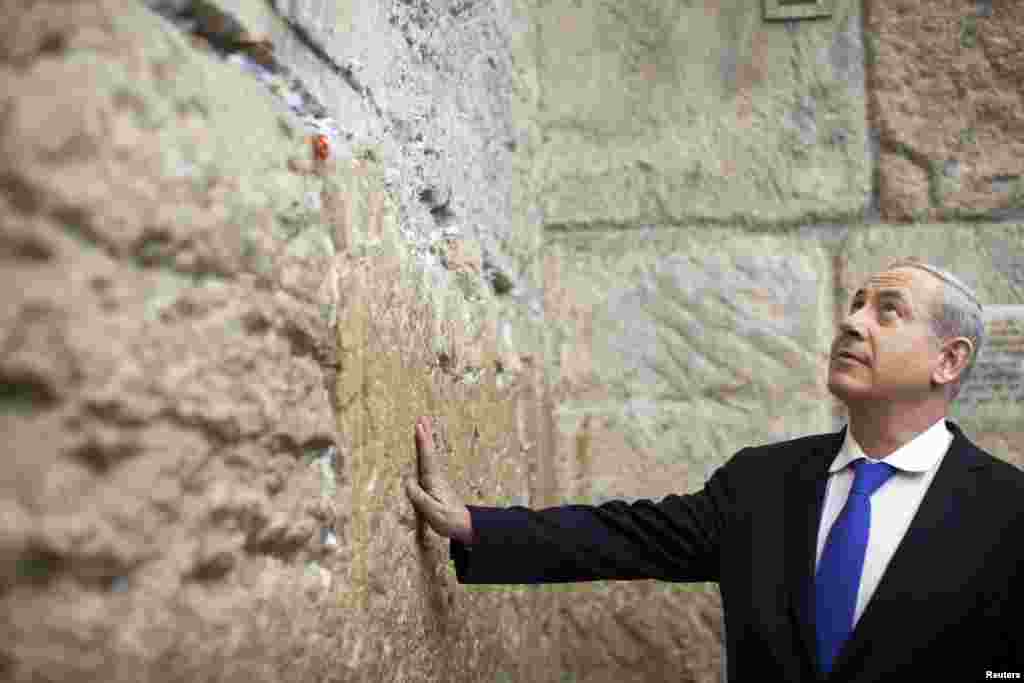
5/7Israel's Prime Minister Benjamin Netanyahu touches the Western Wall in Jerusalem's Old City after casting his ballot in Israel's parliamentary election January 22, 2013.
Israelis voted Tuesday in a parliamentary election that left Israel's right-wing and center-left blocs winning an even split of seats.
Show moreShow less
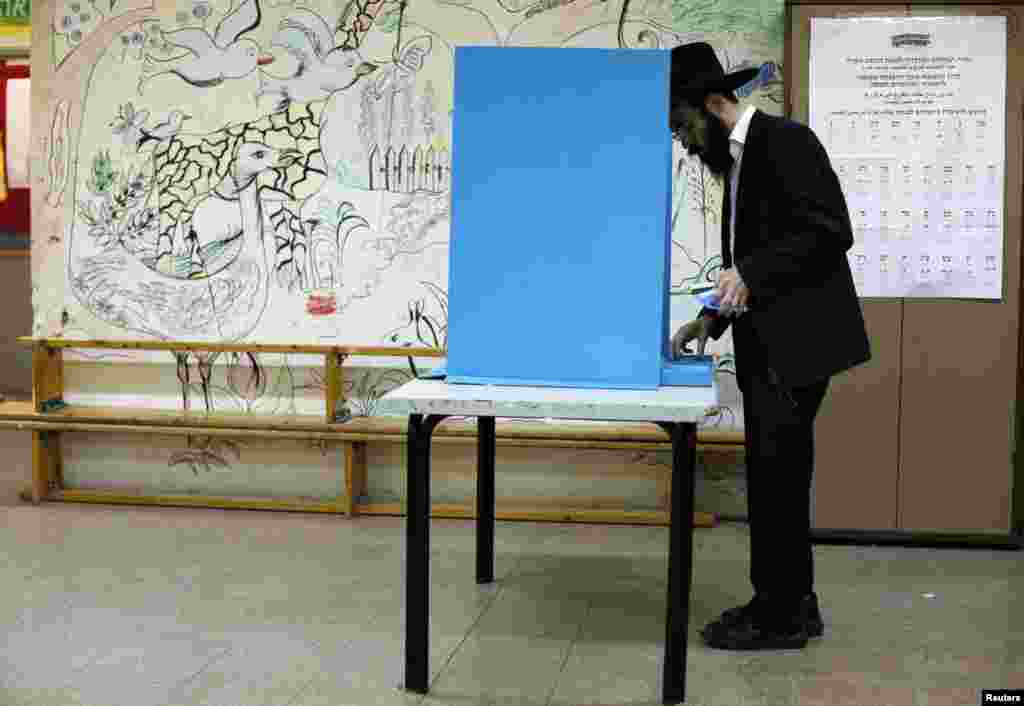
6/7An ultra-Orthodox Jewish man stands near a booth at a polling station in the West Bank Jewish settlement of Kochav Ya'acov, north of Jerusalem, January 22, 2013.
Israelis voted Tuesday in a parliamentary election that left Israel's right-wing and center-left blocs winning an even split of seats.
Show moreShow less
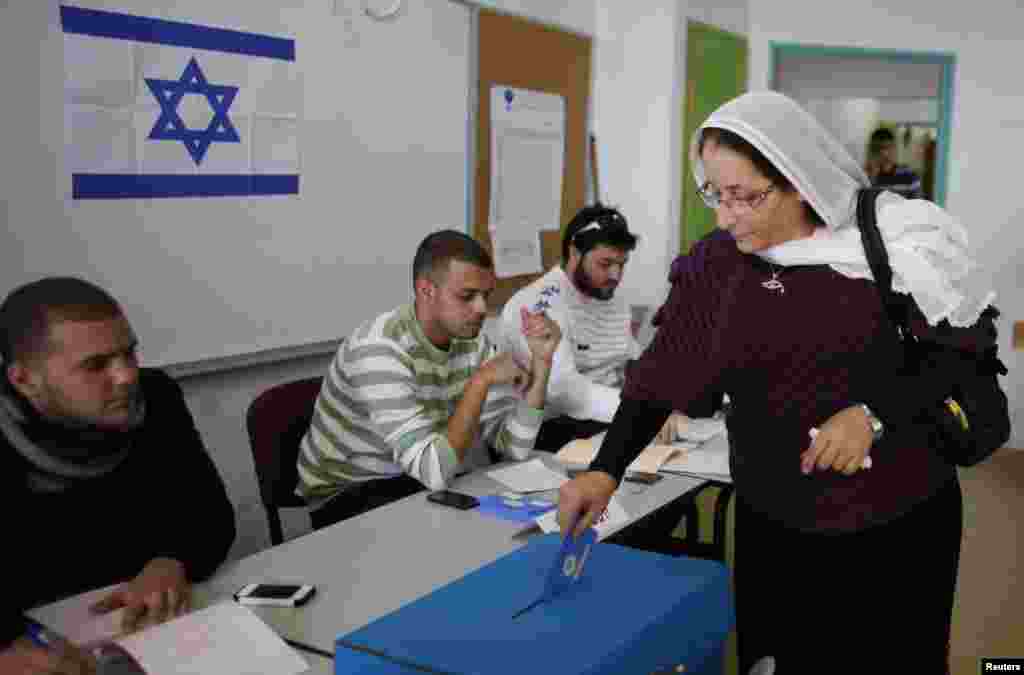
7/7A Druze woman casts her ballot for the parliamentary election at a polling station in the northern Druze-Arab village of Maghar, Israel, January 22, 2013.
Israelis voted Tuesday in a parliamentary election that left Israel's right-wing and center-left blocs winning an even split of seats.