



Editor's note: this story was translated from the original VOA Korean article.
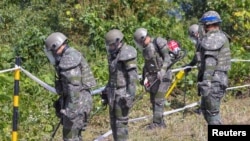
South Korea’s Joint Chiefs of Staff told members of the National Assembly’s intelligence and defense committee last month that North Korea has laid an estimated 960,000 land mines in the Demilitarized Zone since 2024.
South Korean media, citing lawmakers’ offices, reported that the military had presented the estimate to the National Assembly in late October.
VOA reached out to the International Campaign to Ban Landmines for a response to the news, but the ICBL said it could not independently verify the figure or explain how it was calculated.
The ICBL did tell VOA that if the 960-thousand mine figure is accurate, it would be one of the "largest uses of antipersonnel mines anywhere in the world..."
But it's not the largest. In Russia’s war in Ukraine, international experts estimate Russia has laid more than 2 million land mines since 2022, according to the U.S. State Department.
The ICBL did say that North Korean landmines can float into waterways beyond the Demilitarized Zone, threatening civilians and soldiers with injuries likely to cost them a limb.
The ICBL notably shared the 1997 Nobel Peace Prize with Jody Williams for efforts to ban and clear antipersonnel mines.
Separately, South Korea’s Joint Chiefs of Staff concluded on October 5 that North Korean antipersonnel mines deliberately planted on the South Korean-controlled side of the DMZ caused the September 21 explosions that injured three South Korean troops.
Citing a joint investigation with United Nations Command and forensic testing, the military said those mines had been planted rather than washed into the area.
North Korea rejected responsibility for planting the mines. In an October 25 letter to the U.N. Security Council president, Pyongyang called the incident a South Korean fabrication intended to obstruct its border fortifications and evade blame for worsening tensions.