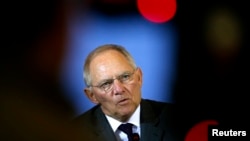
Germany's Finance Minister Wolfgang Schaeuble addresses a news conference in Berlin in this March 25, 2013 file photo.
BERLIN —
German Finance Minister Wolfgang Schaeuble has said savings accounts in the eurozone are safe, adding that Cyprus is a "special case" and not a template for future rescues.
In an interview with Bild newspaper published on Saturday, Schaeuble distanced himself from comments on Monday by Eurogroup chairman Jeroen Dijsselbloem, who said the rescue programme agreed for Cyprus - the first to impose a levy on bank deposits - would serve as a model for future crises.
"Cyprus is and will remain a special one-off case," Schaeuble said. "The savings accounts in Europe are safe."
Cyprus Vows to Stay in Eurozone
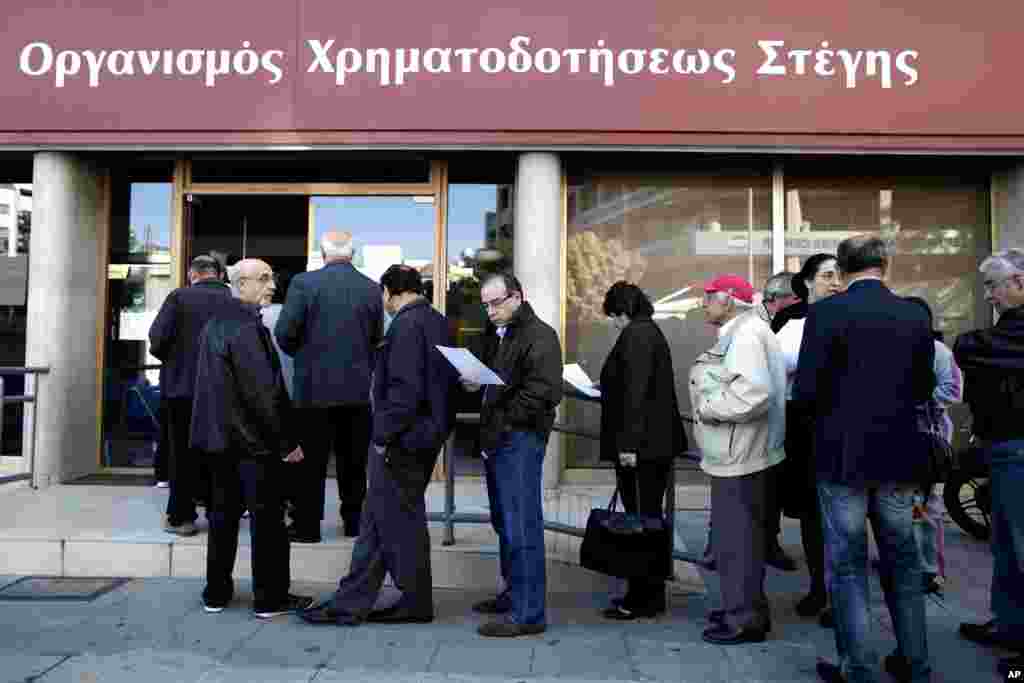
1/7People line up outside a branch of Cyprus' Housing Finance Corporation, a state-run bank that mainly helps low and middle income people, in capital Nicosia, March 29, 2013.
Banks opened Thursday, nearly two weeks after being shutdown amid the island's near-economic collapse.
Show moreShow less
2/7Supporters of the extreme right group National Popular Front (ELAM) take part in an anti-bailout protest outside parliament in Nicosia, Cyprus, March 28, 2013.
Banks opened Thursday, nearly two weeks after being shutdown amid the island's near-economic collapse.
Show moreShow less
3/7A Laiki Bank manager helps a police officer enter the bank after getting past depositors waiting outside the bank's branch in Nicosia, Cyprus, March 28, 2013.
Banks opened Thursday, nearly two weeks after being shutdown amid the island's near-economic collapse.
Show moreShow less
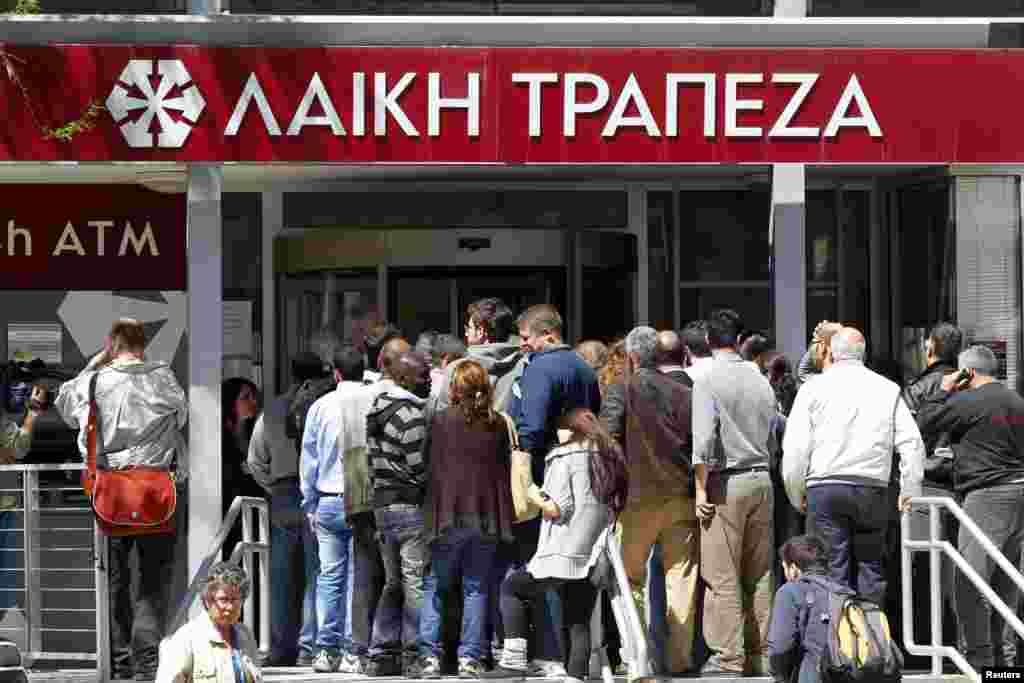
4/7People wait to enter at a branch of Laiki Bank shortly after it opened in Nicosia, Cyprus, March 28, 2013.
Banks opened Thursday, nearly two weeks after being shutdown amid the island's near-economic collapse.
Show moreShow less
5/7People wait for the opening of a branch of Laiki Bank in Nicosia, Cyprus, March 28, 2013.
Banks opened Thursday, nearly two weeks after being shutdown amid the island's near-economic collapse.
Show moreShow less
6/7A man walks with a parrot on his hat in front of a Bank of Cyprus branch before it opens in Nicosia, March 28, 2013.
Banks opened Thursday, nearly two weeks after being shutdown amid the island's near-economic collapse.
Show moreShow less
7/7A man reacts outside a branch of the Bank of Cyprus in Nicosia, March 28, 2013.
Banks opened Thursday, nearly two weeks after being shutdown amid the island's near-economic collapse.
Show moreShow less
Previous slide
Next slide
Schaeuble said the problem in Cyprus was that two large banks in Cyprus were in effect no longer solvent and the Cyprus government did not have enough money to guarantee savings.
"That's why the other eurozone countries had to help," he said. "Together in the Eurogroup we decided to have the owners and creditors take part in the costs of the rescue - in other words those who helped cause the crisis."
Schaeuble said he was confident Cyprus would be able to completely pay back the help. "Cyprus's economy will now go through a long and painful period of adjustment. But then it will pay back the loan when it is on a solid economic foundation," he said.
Schaeuble said the euro was stronger today than at any time since 2010.
"Yes, you could see that during the Cyprus crisis," he said. "The entire turbulence did not have any impact on the other countries in southern Europe."
He said it was different in early 2012, when elections in Greece caused interest rates across southern Europe to rise.
"The financial markets have seen: we are better prepared now. We've accomplished quite a bit," Schaeuble said.
He said he was against thinking about individual countries leaving the eurozone.
"What is more important is that we are strong enough to keep everyone in the boat," he said.
"I believe that we will one day read in the history books about this period that the crisis brought Europe even closer together," he said, adding the continent was currently enjoying "a very fortunate era."
Reuters is a news agency founded in 1851 and owned by the Thomson Reuters Corporation based in Toronto, Canada. One of the world's largest wire services, it provides financial news as well as international coverage in over 16 languages to more than 1000 newspapers and 750 broadcasters around the globe.