CAIRO —
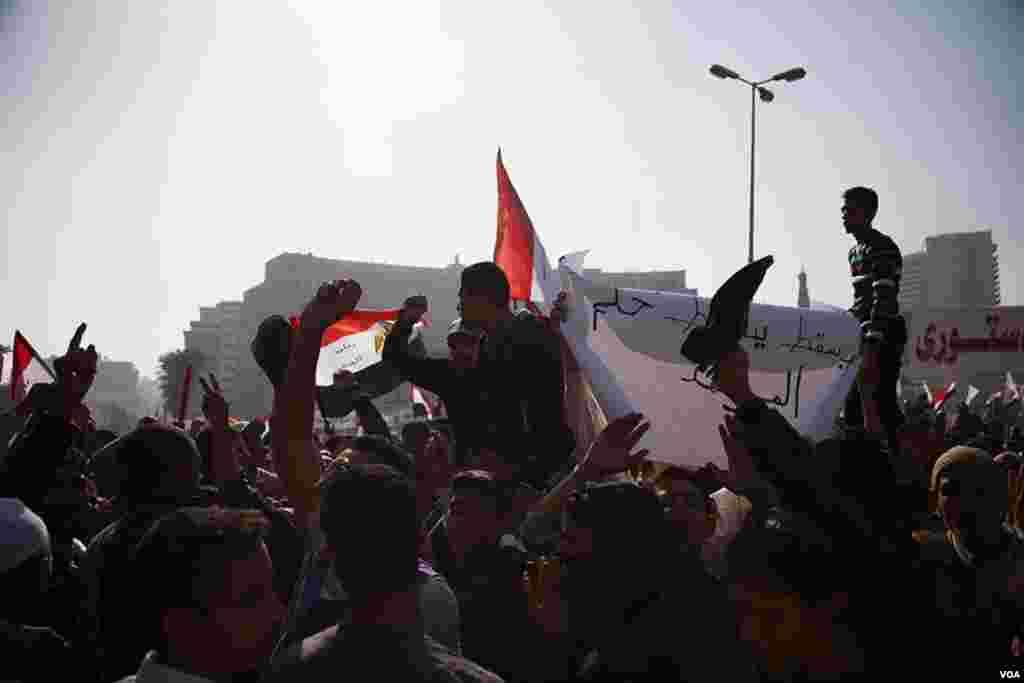
Egyptians protested in Cairo's Tahrir Square Friday for an eighth straight day of demonstrations against President Mohamed Morsi, as an Islamist-dominated panel approved Egypt's new draft constitution that must now be voted on in a nationwide referendum.
The panel, boycotted by several Christian and liberal members, retained the principles of Islamic law as the main source of legislation. The group rushed through the approval of the 234 articles in a meeting that lasted from Thursday afternoon until early Friday.
The assembly moved up the vote to pass the draft before Sunday, when Egypt's highest judicial power is expected to rule on whether to dissolve the panel.
Egypt's Draft Constitution
Egypt's Draft Constitution
Limits president to two four-year terms
Provides protections against arbitrary detention and torture
Islamic law, or Sharia, serves as the basis for legislation
Religious freedom is limited to Muslims, Christians and Jews
Citizens are deemed equal before the law and equal in rights
Over the past few days, about 30 liberal and Christian members pulled out of the panel to protest what they called the hijacking of the process by Islamists loyal to the president.
Morsi went on national television late Thursday to reassure Egyptians that the passage of a new constitution would resolve the current standoff. He said the decree granting himself extraordinary powers would end as soon as the constitution was adopted. And he defended the move, saying it necessary to protect the revolution from reactionary forces.
Protesters in Tahrir Square
1/7Thousands of people gather in Tahrir Square to protest Egyptian President Mohamed Morsi's recent consolidation of power, November 30, 2012. (Y. Weeks/VOA)
Protesters continue their anti-government rallies in Cairo's Tahrir Square.
Show moreShow less
2/7A protester on Tahrir Square holds up a poster comparing Egyptian President Mohamed Morsi to former fascist leaders Benito Mussolini and Adolf Hitler, November 30, 2012. (Y. Weeks/VOA)
Protesters continue their anti-government rallies in Cairo's Tahrir Square.
Show moreShow less
3/7 کراچی : بگھیوں کے مالکان ان گاڑیوں کے استعمال کیلئے لینےوالے گاہکوں کے انتظار میں کھڑے رہتے ہیں
Protesters continue their anti-government rallies in Cairo's Tahrir Square.
Show moreShow less
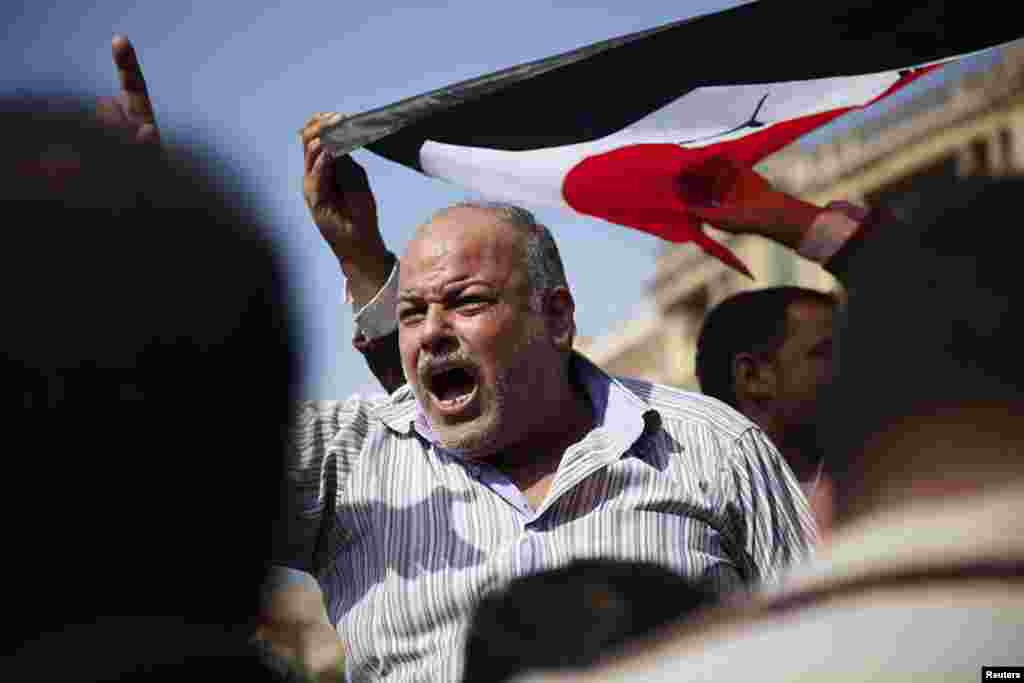
4/7Protesters chant slogans against the Muslim Brotherhood, whose political wing launched Mohamed Morsi to the presidency, November 30, 2012. (Y. Weeks/VOA)
Protesters continue their anti-government rallies in Cairo's Tahrir Square.
Show moreShow less
5/7A protester leads a group of Egyptians in anti-Muslim Brotherhood chants, November 30, 2012. (Y. Weeks/VOA)
Protesters continue their anti-government rallies in Cairo's Tahrir Square.
Show moreShow less
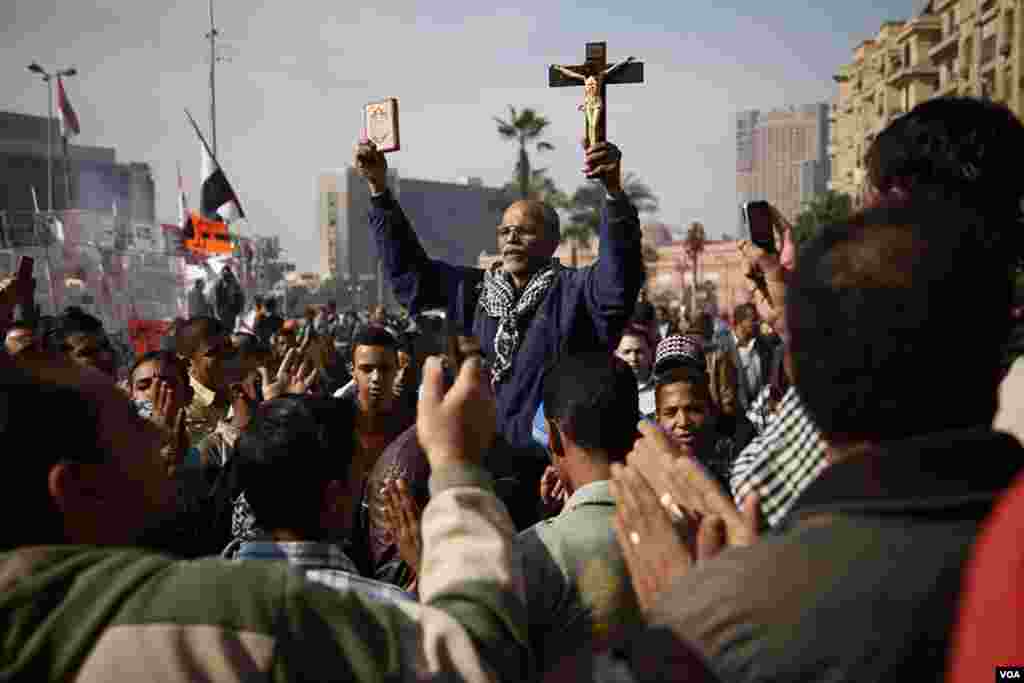
6/7A protester in Tahrir Square holds up a copy of the Koran and a Christian cross, November 30, 2012. (Y. Weeks/VOA)
Protesters continue their anti-government rallies in Cairo's Tahrir Square.
Show moreShow less
7/7Protesters in Tahrir Square calling for the Muslim Brotherhood to leave government, November 30, 2012. (Y. Weeks/VOA)
Protesters continue their anti-government rallies in Cairo's Tahrir Square.
Show moreShow less
Previous slide
Next slide
But the president's opponents argue the wording on personal rights and freedom of expression and religion opens the possibility for repression.
Realtor Hisham Mahmoud, who came to Tahrir with his teenage daughter and her friend, says the drafters did not represent Egypt. He said that after the revolution, Egypt should have “a more elevated constitution.” He wished a broad section of Egyptian intellectuals had been involved.
Protesters also argue the draft was pushed through to avoid a further showdown with Egypt's judiciary. The constitutional court was set to rule on the legitimacy of the body that wrote the draft Sunday, and appears ready to go ahead. What that could mean for the legitimacy of the constitution remains unclear.
Growing anger
While many protesters chanted peaceful slogans, the anger of others was palpable. Law student Eid, wearing a mask of the Egyptian flag, called for continued protests.
“We will stay here, not go anywhere," he said. "And tell Mohamed Morsi, you are not the Egyptian president. You are Ikhwan. You are a liar.”
The Ikhwan, or Muslim Brotherhood, is planning a counter-rally Saturday in support of President Morsi, who officially broke with the group and its political wing on becoming president.