Australia Checking Possible Debris From Missing Malaysia Jet
1/10Mike Barton, rescue coordination chief, right, shows Australia's Deputy Prime Minister, Warren Truss, the map of the Indian Ocean search areas during a tour of the Australian Maritime Safety Authority's rescue coordination center in Canberra, March 23, 2014.
Show moreShow less
2/10Royal Australian Air Force pilot Capt. Russell Adams, left, speaks to the media after returning from a search mission in an AP-3C Orion at Pearce Base, Perth, Australia, March 23, 2014.
Show moreShow less
3/10Ground crew members wave to a Japanese Maritime Defense Force P3C patrol plane as it leaves the Royal Malaysian Air Force base heading for Australia to join a search and rescue operation for the missing Malaysia Airlines plane, Subang, Malaysia, March 23, 2014.
Show moreShow less
4/10Royal Australian Air Force commander Craig Heap speaks to the media after Japan Maritime Self-Defense Force's P-3C Orion arrived to help with search operations for the missing Malaysia Airlines plane, at Pearce Base in Perth, Australia, March 23, 2014.
Show moreShow less
5/10Royal Australian Air Force Loadmasters prepare to launch a Self Locating Data Marker Buoy from a C-130J Hercules aircraft over the southern Indian Ocean, March 20, 2014. (AFP PHOTO / AUSTRALIAN DEFENSE/LEADING SEAMAN JUSTIN BROWN)
Show moreShow less
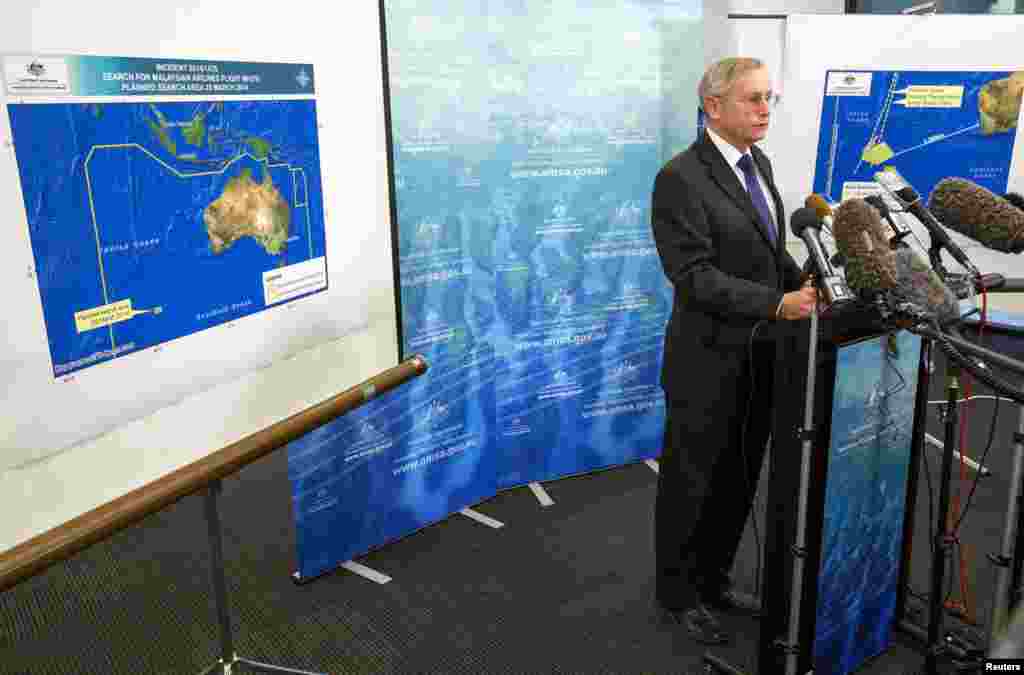
6/10John Young, general manager of the emergency response division of the Australian Maritime Safety Authority, answers a question as he stands in front of a diagram showing the search area for flight MH370 during a briefing in Canberra, March 20, 2014.
Show moreShow less
7/10A Royal Australian Air Force pilot steers his AP-3C Orion over the southern Indian Ocean during the search for missing Malaysia Airlines flight MH370 in this picture released by the Australian Defense Force, March 20, 2014.
Show moreShow less
8/10A Chinese family member of a passenger onboard missing Malaysia Airlines Flight MH370 screams as she is being brought into a room outside the media conference area at a hotel near Kuala Lumpur International Airport, March 19, 2014.
Show moreShow less
9/10An image in support of Malaysia Airlines Flight MH370 is seen on the United Malays National Organisation building in Kuala Lumpur, March 19, 2014.
Show moreShow less
10/10Students watch as a group of artists finish a piece based on the missing Malaysia Airlines flight MH370 that was painted on a school ground in Makati city, metro Manila, Philippines, March 17, 2014.
Show moreShow less
Previous slide
Next slide
BANGKOK —
An apparent breakthrough in the 12-day search for Malaysia Airlines flight MH370 came Thursday when Australian authorities said satellite imagery had located unidentified debris some 2,500 kilometers southwest of Perth, in the Indian Ocean. Australia sent search planes and ships to the region to try to confirm the finding.
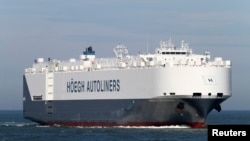
FILE - Undated file photo of Norwegian car carrier Hoegh St. Petersburg at sea.
Norwegian car carrier Hoegh St. Petersburg was the first to reach the area in the southern Indian Ocean at 0800 GMT the Norwegian shipping association told Reuters.
The car carrier was on its way from Madagascar to Melbourne when it got a request from Australian authorities to assist in investigating the objects spotted by satellite four days ago in one of the remotest parts of the globe, around 2,500 km (1,500 miles) southwest of Perth.
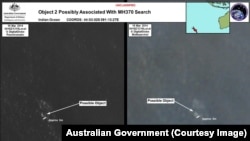
The second of the two objects spotted by the Australian satellite.
Earlier Thursday Australian Prime Minister Tony Abbott told the parliament "new and credible" information had come to light in the search for the Malaysian Boeing 777 that disappeared on March 9 bound for Beijing with 239 passengers and crew.
"The Australian maritime safety authority has received information based on satellite imagery of objects possibly related to the search. Following analysis of this satellite imagery two possible objects related to the search have been identified," said Abbott.
Abbott told Parliament a Royal Australian Air Force Orion aircraft had been diverted in an attempt to locate other objects.
Flight MH370 Timeline
Flight MH370 Timeline
Mar. 8: Departs Kuala Lumpur at 12:41am local time for Beijing
Air traffic controllers lose contact with the plane around 1:30am
Vietnam launches search operation, two oil slicks are spotted but are not related to plane
Mar. 9: Malaysia suggests plane may have strayed off course
Debris spotted off Vietnam, but it is not from the airplane
Mar. 10: Search radius expanded, as China urges Malaysia to speed up investigation
Mar. 11: Search extended to western side of Malaysian peninsula
Mar. 12: Chinese satellite images of possible debris are released and determined not to be related to the plane
Mar. 13: Malaysia rejects Wall Street Journal report that MH370 flew for four hours after its last known contact
Mar. 14: Search now includes South China Sea, Malacca Strait and Indian Ocean
Media reports say MH370 communications system continued to ping a satellite hours after plane disappeared
Mar. 15: Malaysian Prime Minister Najib Razak says someone on MH370 likely turned off its communications systems
Mar. 17: 26 countries now involved in the search
Mar. 19: FBI analyzes flight simulator data from the home of the MH370 pilot
Mar. 20: Australian aircraft investigate possible debris in a remote area of the southern Indian Ocean
In a news conference a short while later, John Young, the general manager of Australia's maritime authority, said the larger of the objects is roughly 24 meters long.
“The objects are relatively indistinct on the imagery. I don't profess to be an expert in assessing the imagery. But those who are expert indicate they are credible sightings. The indication to me is of objects that are a reasonable size and probably awash with water bobbing up and down under the surface,” said Young.
Young said the satellite imagery is not clear enough to determine if there are markings or features that would confirm if they are from the missing passenger jet. The objects were spotted in a part of the ocean that authorities estimate is several thousand meters deep.
Authorities are scrambling four search aircraft from Australia, New Zealand and the United States that have maritime radar appropriate for locating the objects spotted by the satellites.
Although the weather in the area is moderate, officials say visibility is not ideal, which could hamper search efforts. Authorities are also sending a C130 Hercules plane that will drop data marker buoys to track water currents and trace where the debris could be moving.
Young was cautious not to raise expectations until the findings can be confirmed.
“We have been in this business of doing search and rescue and using satellite images before and they do not always turn out to be related to the search even if they look good. So we will hold our views on that until they have been sighted close up,” said Young.
Authorities were noncommittal about when that confirmation could come, but said the first of the four search planes are already on the scene and others are expected to arrive in the coming hours. More than 25 countries have been involved in the search for the missing aircraft.
Investigators believe someone with advanced knowledge of aircraft deliberately diverted the plane either south toward the Indian Ocean or north toward Central Asia. They have refused to rule out any possibility, including terrorism, pilot suicide, or a mechanical malfunction.
U.S. President Barack Obama on Wednesday said the search is a "top priority" for the United States. He told an American television station that he has put every available resource into the effort.