Anti-Government Protesters Continue to Rock Bangkok
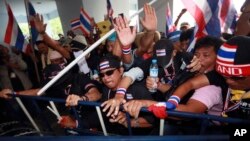
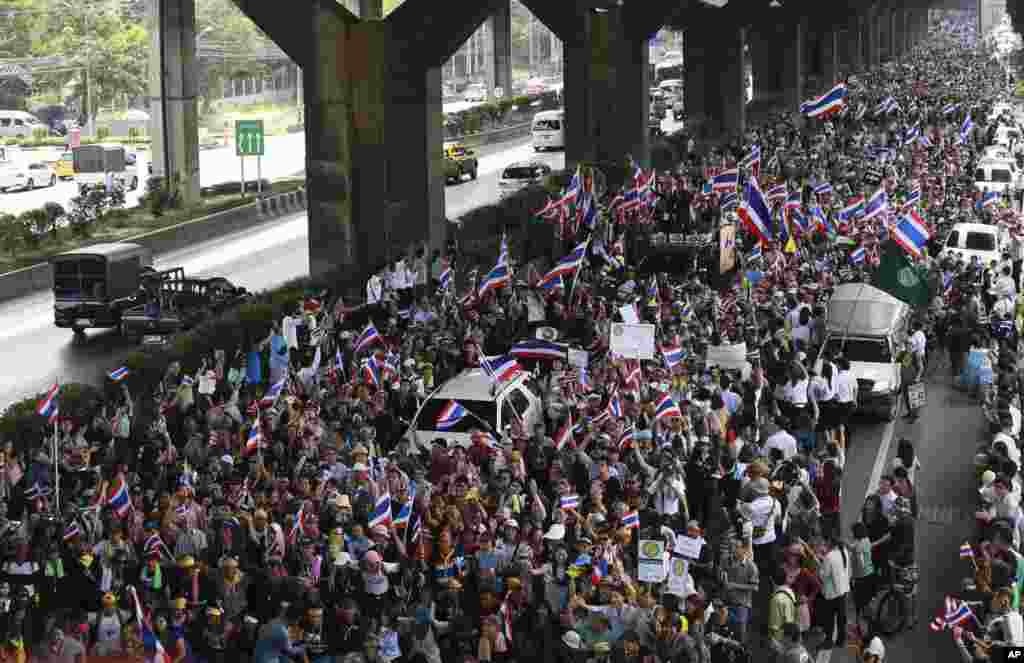
Anti-government protesters try to remove police barricade during a rally in front of the Department of Special Investigation in Bangkok, Thailand, Saturday, Nov. 30, 2013.
Thai police tightened security in Bangkok Saturday, as anti-government protesters moved on state-run telecommunications offices in their latest bid to topple the government.
Capital city police said the protesters also plan to surround the headquarters of the national and city police, Government House and even a zoo.
More than 1,000 protesters briefly stormed into army headquarters Friday in an attempt to convince the military to join their efforts to topple the government of Prime Minister Yingluck Shinawatra. They left the compound peacefully after about two hours.
Army Commander General Prayuth Chan-ocha later urged protesters not to force the army to take sides.
Opposition leaders say Sunday will be their "victory day" and have called for supporters to besiege the prime minister's office. They vow to take over every ministry until Prime Minister Yingluck resigns.
She survived a no-confidence vote in parliament Thursday. The prime minister refuses to step down and has called for dialogue to resolve the situation. She vows not to use violence to stop the protests.
Anti-Government Protests in Bangkok
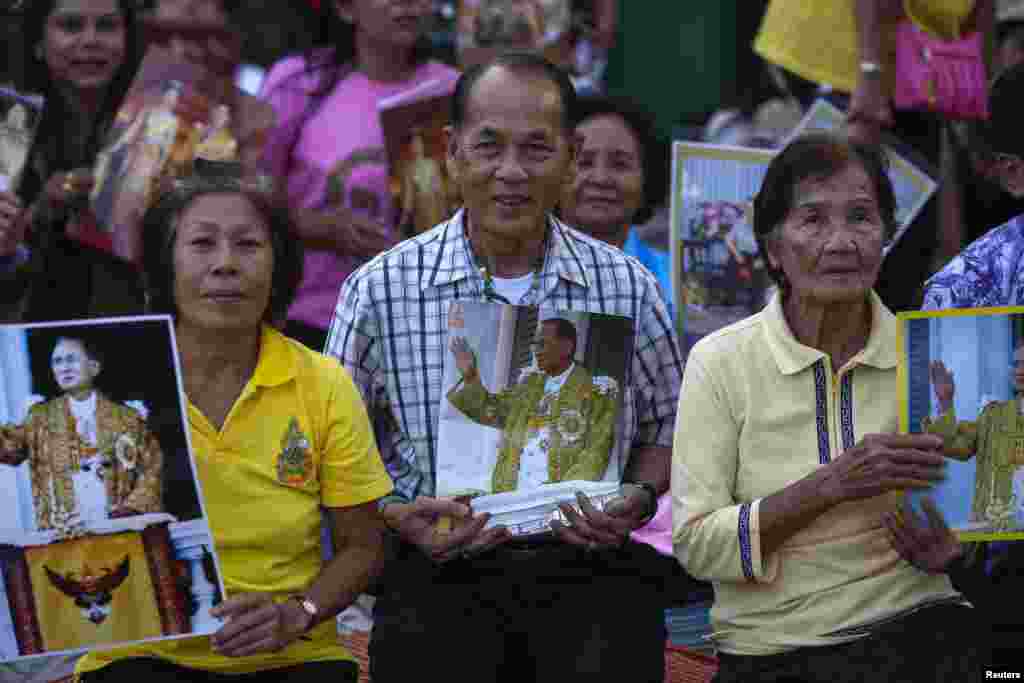
1/15Well-wishers hold pictures of Thailand's King Bhumibol Adulyadej, Dec. 4, 2013, as they camp outside the palace where he is staying in Hua Hin, Prachuap Khiri Khan province, Thailand, a day before his birthday.
Show moreShow less
2/15Anti-government protesters shout as they break down the barriers at the Thai Police Headquarters in Bangkok, Dec. 4, 2013.
Show moreShow less
3/15An anti-government protester sweeps the street around the Democracy Monument, Bangkok, Dec. 4, 2013.
Show moreShow less
4/15Anti-government protesters sweep the street around the Democracy Monument after weeks of protesting and days of clashes with police in Bangkok's city center, Dec. 4, 2013.
Show moreShow less
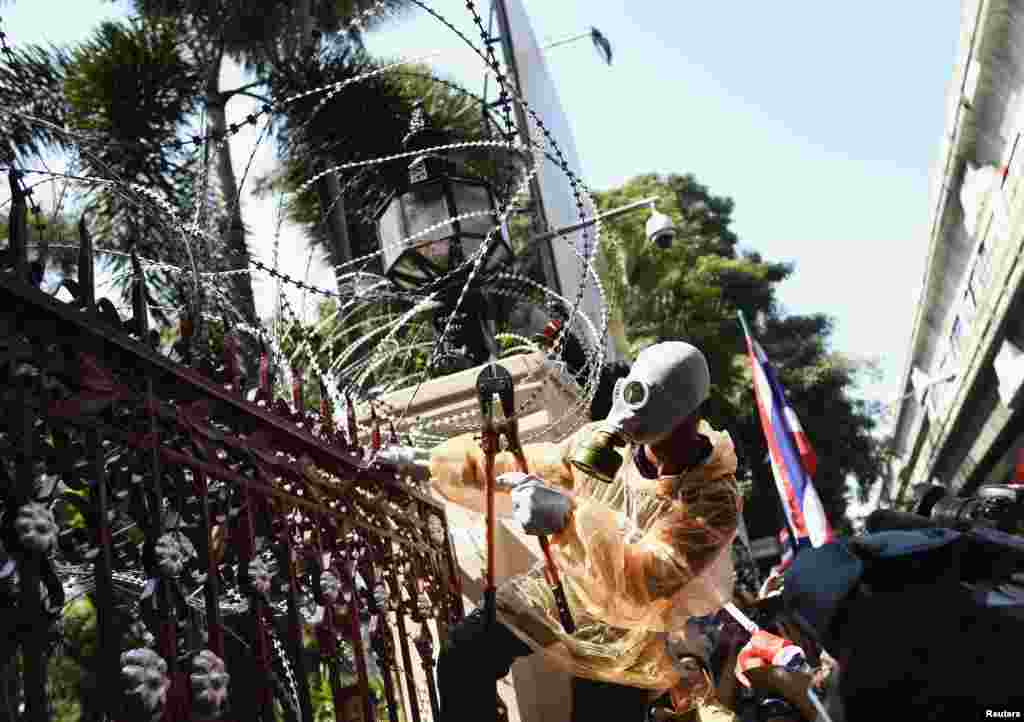
5/15An anti-government protester uses a wire cutter in an attempt to break down the barriers at the Thai Police Headquarters, Bangkok, Thailand, Dec. 4, 2013.
Show moreShow less
6/15Anti-government protesters gesture towards riot police outside the headquarters of the ruling Puea Thai Party of Prime Minister Yingluck Shinawatra in Bangkok, Nov. 29, 2013.
Show moreShow less
7/15An anti-government protester gestures towards riot police outside the headquarters of the ruling Puea Thai Party of Prime Minister Yingluck Shinawatra in Bangkok, Nov. 29, 2013.
Show moreShow less
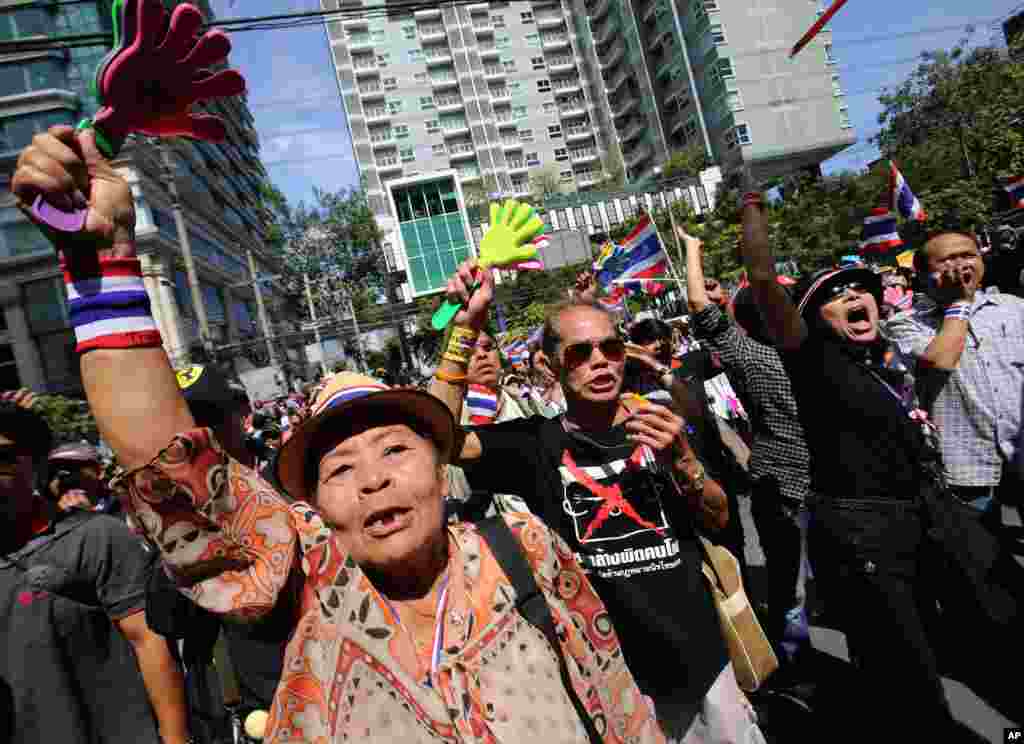
8/15Anti-government protesters shout slogans outside the headquarters of Prime Minister Yingluck Shinawatra's Puea Thai Party in Bangkok, Nov. 29, 2013.
Show moreShow less
9/15Anti-government protesters march to the government complex in Bangkok, Nov. 27, 2013.
Show moreShow less
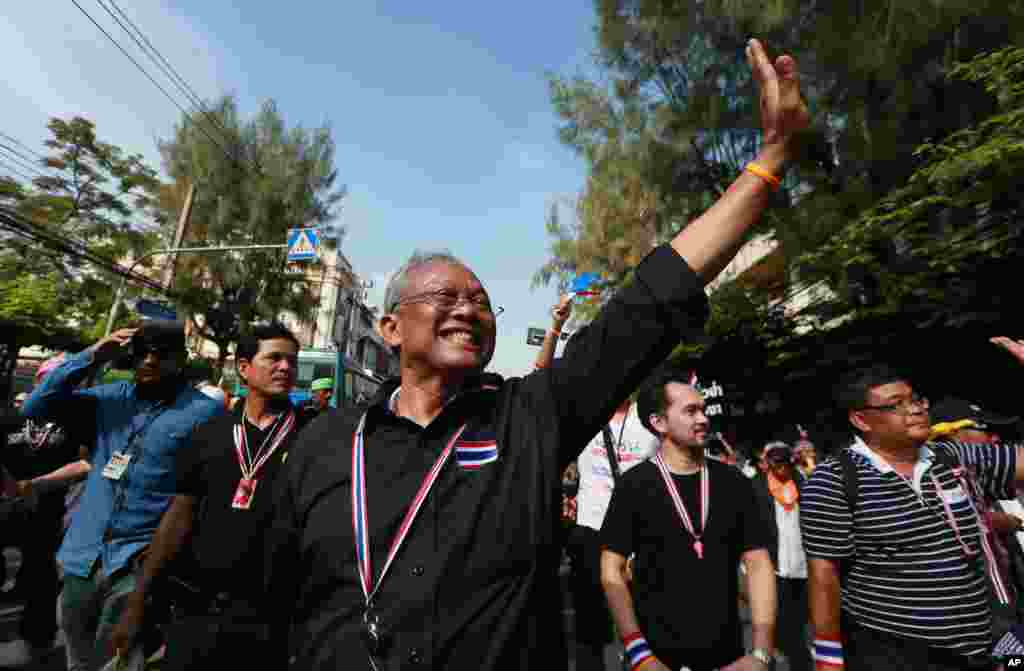
10/15Suthep Thaugsuban, a former deputy prime minister leading the protest, waves to his supporters during an anti-government march in Bangkok, Nov. 27, 2013.
Show moreShow less
11/15Supporters cheer anti-government protesters marching in Bangkok, Nov. 27, 2013.
Show moreShow less
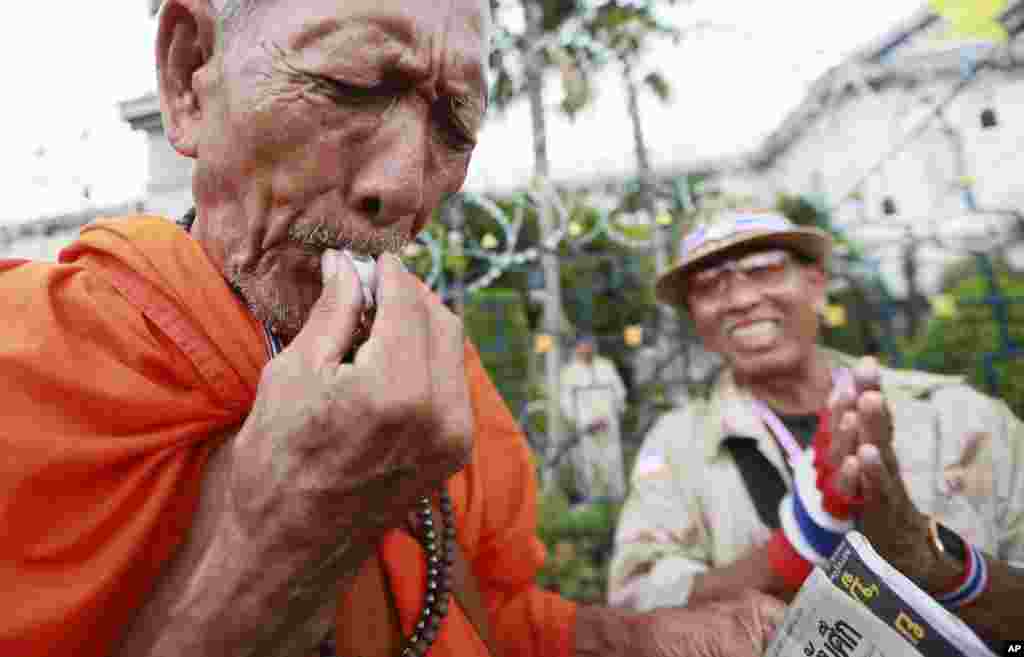
12/15A Buddhist monk blows a whistle during a rally outside Interior Ministry in Bangkok, Nov. 26, 2013.
Show moreShow less
13/15Riot police stand guard behind barricades during an anti-government rally in Bangkok, Nov. 26, 2013.
Show moreShow less
14/15Anti-government protesters march toward Thailand's Finance Ministry in Bangkok, Nov. 25, 2013.
Show moreShow less
15/15An anti-government protester fights with police at a barricade near Government House in Bangkok, Nov. 25, 2013.
Show moreShow less
Previous slide
Next slide
The protesters have taken over parts of the finance and foreign ministries and surrounded the interior ministry. On Thursday they pulled down electrical cables outside police headquarters and an adjacent hospital, forcing them to use backup power.
The street protests are the largest in Thailand since 2010, when more than 90 people were killed in a military crackdown on an opposition protest.
The latest demonstrations were triggered several weeks ago by an amnesty bill that would have allowed former Prime Minister Thaksin Shinawatra - Yingluck's brother - to return home and avoid a two-year jail term for corruption. The Senate rejected the bill, but protests have continued.
Prime Minister Yingluck was elected in 2011. Her brother was toppled by a military coup in 2006 and later convicted of corruption. He has lived in exile to escape the charges, which he says were politically motivated.
Some information for this report provided by AP, AFP and Reuters.
The Voice of America provides news and information in more than 40 languages to an estimated weekly audience of over 326 million people. Stories with the VOA News byline are the work of multiple VOA journalists and may contain information from wire service reports.